
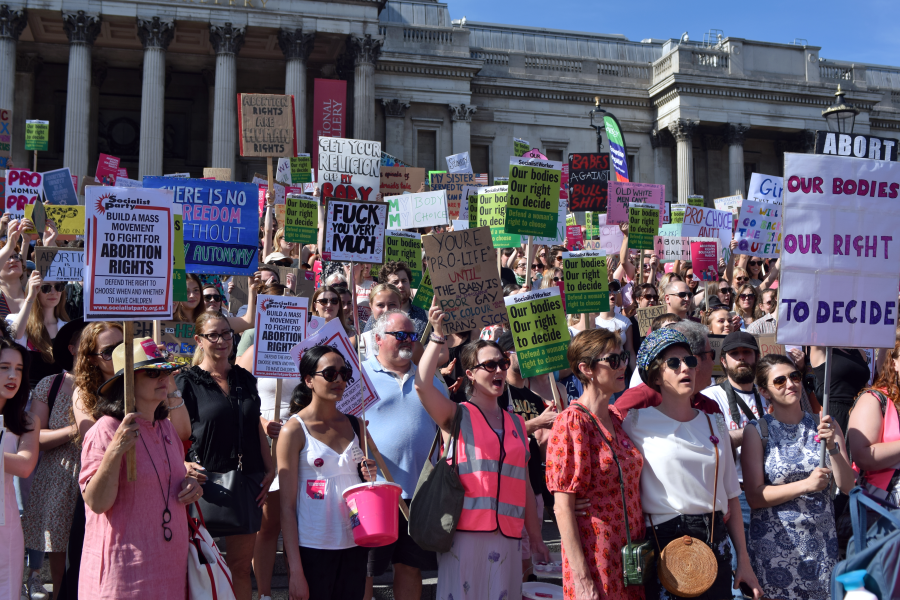
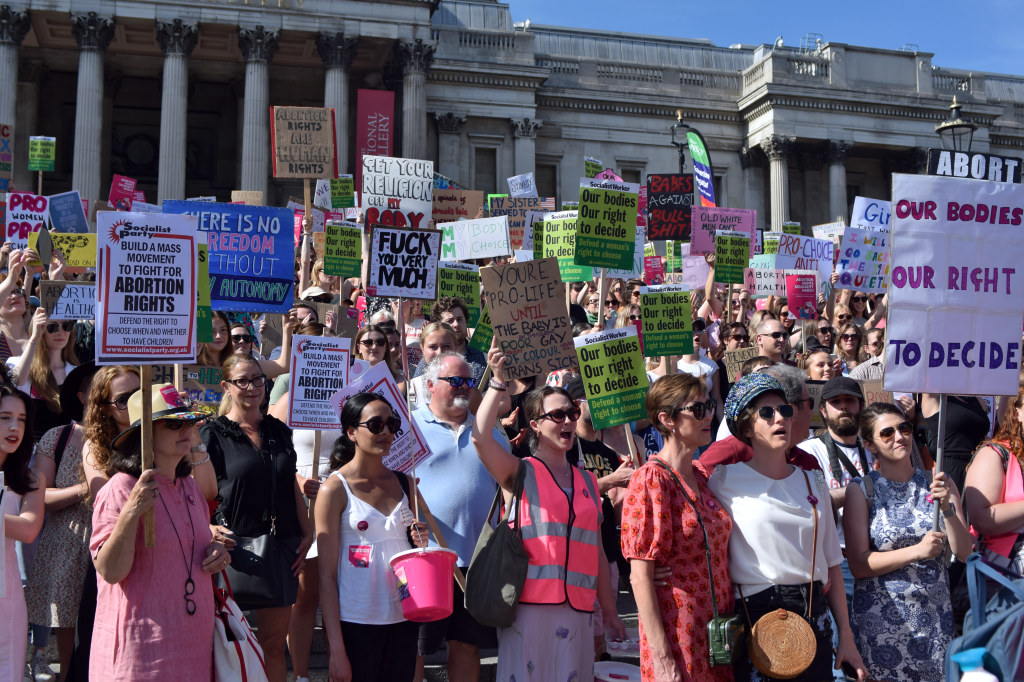
The US Supreme Court’s decision to overturn the ruling on Roe v Wade, which recognised a constitutional right to abortion, has been met with protests across America and across the world. Echo Malkin from Cardiff Socialist Students spoke to Christine Thomas, author of ‘It Doesn’t Have to Be Like This: Women and the Struggle for Socialism’, about the way forward in the struggle for reproductive rights in the US and globally.
What are the immediate effects of the overturning of Roe v Wade in the US?
This is the biggest attack on women’s rights in the US for 50 years. Already one-third of women are living in states where abortion is banned, and that is set to spread, with up to 40 million women eventually affected. Because they don’t have the money to travel to states where abortion is still legal, it will be the poorest, working-class and minority ethnic women who will suffer the most. There have already been horror stories, like that of the ten-year-old rape victim who was denied an abortion in her home state. Unfortunately, those horrors are likely to get worse unless a movement is built to re-establish the right to abortion for all those who want one throughout the US.
In your article for Socialism Today you highlighted the surrounding social unrest of the period that led to the original ruling of Roe v Wade. Our current social climate is full of unrest from the Black Lives Matter movement, as well as the Me Too and Times Up movement, to the increasingly urgent climate crisis as well as human rights crises like the overturning of Roe v Wade taking place in Poland and 23 other countries. Do you believe this social unrest will help the restoration of reproductive rights as it was able to in the 70s? How could such a movement be built?
There are obviously things that need to be done immediately to help women access abortions, and this is happening now. Women’s organisations are fundraising to help women travel to ‘sanctuary’ states, offering accommodation to those seeking an abortion, and providing access to abortion pills. This kind of mutual aid is vital, but it needs to go hand-in-hand with building a mass movement, with roots in the workplaces, universities, colleges, schools and local communities. That is how the right to abortion was won in the first place – through grassroots organising by women’s organisations at a time when US society was in ferment. As well as the women’s movement there was the movement for civil rights and black liberation, the mass protests against the war in Vietnam and strikes of workers. This was the backdrop which forced the Supreme Court, with a right-wing majority, and under the Republican anti-abortion president Richard Nixon, to grant a constitutional right to abortion.
The current attacks on abortion rights are taking place at a time when the living standards of ordinary Americans are also facing an onslaught from the cost-of-living crisis. What’s more, over two-thirds of Americans think that abortion should be legal. If the movement for abortion rights was to link up with workers in the workplaces and trade unions fighting for higher wages and better working conditions, with Black Lives Matter and those fighting to save the environment, a formidable movement could be built.
But for that to happen, the campaign for the ‘right to choose’ needs to be broadened from just fighting for the legal right to abortion to incorporating wider demands, including universal free health care, and easy access to abortion and health and reproduction clinics. Even before the US Supreme Court overturned Roe v Wade, thousands of poor women were denied an abortion because of the high costs or because there was no clinic in the area where they lived. Winning the legal right to abortion on its own is not sufficient if those who need an abortion don’t have the material means to exercise that right.
Also, ‘the right to choose’ is much more than the right to abortion. It means the right to access safe, reliable contraception, inclusive and non-judgemental sex education in schools, and the right to have children and bring them up free from poverty. By campaigning for jobs for all on a wage we can live on, free, quality, universal childcare, paid maternity, paternity and parental leave, decent social housing, etc. the link between the movement to defend and extend abortion rights could be forged with workplace struggles and other social movements, building a movement that could win.
Your article speaks of the importance of international solidarity in regard to reproductive rights. There have been a number of counter-protests of the overturning of Roe v Wade, not just in America but also in Australia, Mexico and Argentina, the last two being locations where many Americans have gone seeking abortions. Could you expand on the importance of international solidarity in a time such as this, when people’s reproductive rights are being threatened worldwide?
In the US the anti-abortionists started organising as soon as Roe v Wade was passed in 1973. They talk about the ‘right to life’ but for many right-wing conservatives it’s really about promoting traditional gender roles and the ‘sanctity of the family’. So they are opposed to contraception, LGBTQ+ rights and feminism. The anti-abortionists targeted the Republican party, and the Republicans have increasingly relied on the religious and anti-abortion right to mobilise the vote for them in elections. Trump’s nomination of anti-abortion justices to the Supreme Court was his reward for that electoral support. But they won’t be satisfied with overturning Roe. They want abortion to be illegal in every state. And they will also be pushing for further attacks on women’s rights and LGBTQ+ rights.
Unfortunately, the Democrats have consistently failed to legislate to defend and extend abortion rights. As a party of the big corporations they will resist any of the meaningful reforms that would be necessary for the real right to choose. The workers’ and social movements need their own party that will fight for their interests, not those of big business and the super-rich.
Internationally the situation is very contradictory. There have been big movements for the right to abortion in a number of countries, and victories have been won – in Ireland, in Argentina, Colombia, Uruguay etc. Since the 2008 financial crisis women have been taking to the streets in their tens of thousands to protest against gender violence, sexual harassment, sexism and denial of reproductive rights. Anger at gender and economic inequality has fused to create a combustible situation. But at the same time, the global economic crisis of capitalism has led to right-wing populists coming to power, in the US, Brazil, Poland etc, who have tried to win a social base by stoking anti-feminism, homophobia and transphobia. Even where those ideas are only supported by a minority in society they have been able to win elections, especially where there has been no viable alternative put forward by the left.
That’s why fighting to build a political alternative is so important, not just in the US but here in Britain and elsewhere. The US attack on the right to abortion has shown how, with capitalism in crisis, gains that have been won can be stripped away again. The movements for women’s rights, workers’ rights, LGBTQ+ rights, against racism and environmental destruction need their own political party, based on the economic power of the trade unions, which we have seen displayed in Britain over the past few months, and which fights for a socialist alternative to the inequality, oppression and destruction of the capitalist profit system.
 Socialist Students