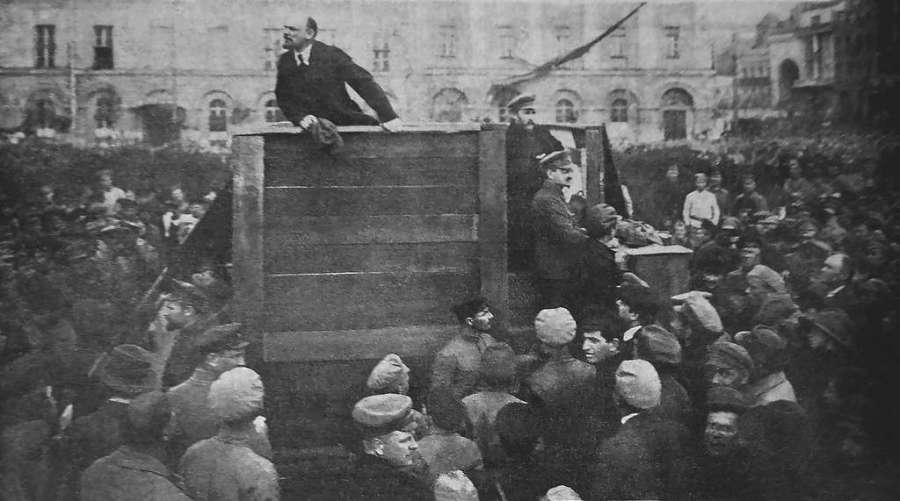
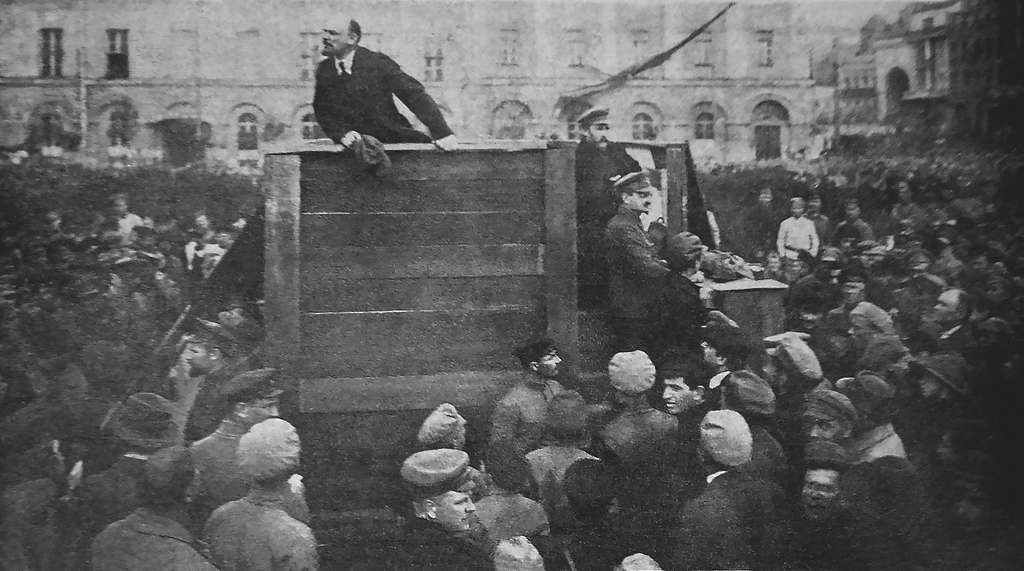
For socialists, the 1917 October Revolution in Russia remains one of the most important events in history. It was the first successful socialist revolution anywhere, overthrowing the pro-capitalist ‘Provisional Government’ to establish the first ever democratic workers’ state, in which Marxist revolutionary Vladimir Lenin played a central role until his death in 1924.
Lenin had led the October Revolution together with Leon Trotsky. It was Lenin’s revolutionary ideas – forged through years of debate, discussion and experience of struggle within socialist organisations – that gave him the authority and ability to co-lead the Russian working class to power in October 1917.
When Lenin wrote his famous April Theses just a few months earlier, he stood in a minority within the Bolshevik Party, which in turn was followed only by a minority of the Russian working class. But the revolutionary programme he put forward succeeded in winning over the worker Bolsheviks, who in turn had authority among tens of thousands of Russian workers, which moved the Bolshevik Party as a whole to quickly align itself to Lenin’s ideas. It was this combining of a revolutionary programme with a mass party of the working class that provided the decisive ‘subjective factor’ for socialist revolution in Russia.
Under the newly formed workers’ state, millions of workers were freed from capitalist exploitation, while peasants who had previously suffered at the hands of feudal landlords benefited from sweeping land redistribution. The death penalty was abolished, and national minorities were allowed the right to self-determination in place of the old Tsarist russification policy, which had aimed to create a homogeneous Russian culture. Furthermore, suffrage was extended to women, abortion was legalised, marital rape was outlawed, and homosexuality was decriminalised.
To this day, capitalist historians, academics, politicians and the press continue to portray Lenin as a dictator and repressor. And yet the reality is that, until his death, Lenin had played a key role in the most democratic form of government in history, formed from the soviets – councils of workers’, soldiers’ and peasants’ delegates – which had sprung up from the 1905 Russian Revolution.
Lenin believed in a higher form of democracy than capitalist ‘liberal parliamentarianism’, which Karl Marx famously characterised as a system that allowed “the oppressed […] once every few years to decide which particular representatives of the oppressing class are to represent and repress them”.
Instead, Lenin believed in worker’s democracy, which means workers discussing and democratically planning together how to run society so that the interests and needs of everyone can be met.
In practice, workers’ democracy meant putting all decision-making before a system of soviets at a local, regional and national level. Soviets had elections, with recallable delegates whose wages matched those of the workers they were representing, unlike many capitalist liberal democracies today.
Until his death, Lenin had played a key role in the most democratic form of government in history
Prior to the October Revolution, Lenin had built the Bolshevik Party, based on the principle of ‘democratic centralism’. This is the idea that, within an organisation, there is maximum debate and discussion until a decision is reached, at which point a united effort is made by the whole of the organisation to implement that decision.
There was a rich tradition of debate and disagreement within the Bolshevik party. But crucially, once a decision was made, the whole party got behind it and acted in unity. These methods of democratic centralism helped ensure that the Bolshevik Party could act in a decisive fashion when the time came to lead the Russian working class to victory.
So, given the democratic approach consistently prescribed by Lenin, why do capitalists and their representatives go to such lengths to portray Lenin as a dictator or tyrant?
In reality, such gross historical distortions are an attempt to discredit the ideas of genuine socialism, to dissuade workers and young people from socialist ideas by having them instinctively make a connection between Lenin and dictatorship.
It was only when Josef Stalin took power after Lenin’s death in 1924 that the Soviet Union took a turn towards dictatorship. Under Stalin the state apparatus was turned into what many typically think of when they hear about the Soviet Union: severe repression, purges, and the abolition of political rights.
Stalin’s counter-revolution did away with Lenin and Trotsky’s vision of mass democracy, along with expanded political rights and the institutions to protect them. Under Stalin, working people were once again barred from political participation, and the rights of national minorities that had been extended under Lenin were swiftly revoked. Contrast this to the stance taken by Lenin, who understood that the 1917 revolution could not take place with any element of suppression and extended the right of self-determination to all national groups who had been oppressed under Tsarism.
There was nothing inevitable about the development of Stalinism, which was a complete and conscious deviation from the workers’ revolution led by Lenin and Trotsky.
Trotsky explained that a socialist society cannot survive on a permanent basis surrounded by a world capitalist market, and fought for the revolution in Russia to spread to the working classes of the world, particularly in the more advanced capitalist countries like Germany.
Unfortunately, the revolution in Russia became isolated, producing the conditions for a bureaucratic clique around Stalin to take power – but only through a protracted period of bloody counter-revolution against those who opposed the bureaucracy and its disastrous policy of ‘socialism in one country’. These opponents most notably included Trotsky, who Stalin eventually had assassinated in Mexico in 1940.
Before his death, Lenin had warned against the growing influence of Stalin, even recommending in 1922 that the Bolshevik Party Congress “think about a way of removing Stalin [from his post as Secretary-General]”. This did not stop Stalin from falsely proclaiming that he was continuing the legacy of Lenin as leader of the Soviet Union, however. Illustrating the dishonesty in these claims, Lenin’s widow and fellow revolutionary, Nadezhda Krupskaya, famously stated in 1926 that if Lenin had lived, he would have been imprisoned by Stalin!
Stalin’s attempts to identify his brutal, undemocratic regime with the ideas of Lenin have been eagerly taken up by capitalist commentators looking to convince workers and youth of the infeasibility of a socialist world. Socialists today have to answer these distortions by “patiently explaining” what Lenin really stood for: a world where, on the basis of thorough debate, discussion and collaboration, things are democratically planned and the needs and interests of everyone are considered.
Lenin didn’t get everything right – for example, in 1901 Lenin was one-sided in asserting that the working class could only understand the need for socialism if it was explained to them by the revolutionary intelligentsia. Later, Lenin corrected this view. And it was Trotsky who realised earlier than Lenin the ideas of the ‘theory of permanent revolution’, in which Trotsky explained how the Russian working class would lead the peasantry to complete both the unfinished ‘bourgeois-democratic’ tasks of the capitalist revolution and the socialist revolution in one go.
Lenin admitted his mistakes and developed his ideas through collaboration and discussion. As we enter a new period of capitalist crisis today, it remains vitally important for socialists to be discussing and debating, as we work out our ideas and the next steps towards a socialist world. That’s why socialists need democratic, fighting organisations that allow us to prepare for the struggles ahead. If you are a student and a socialist, get involved in Socialist Students today.
Socialist Students says:
For living grants tied to the rate of inflation, not loans and debt. Cancel student debt – no to the lowering of the student debt repayment threshold!
No to rent increases or bill increases being passed onto students. For third party accommodation to be taken over by the university as a step towards the introduction of democratically set rent controls.
No to price rises on campuses and to course closures. Build a national student movement to fight for the full funding our campuses need and free education.
Solidarity with the strikes – students and workers unite!
Make the rich pay for the cost of living crisis. Bring the energy companies, the banks and monopolies into democratic public ownership to provide us with a future.

 Socialist Students