

Lucas Smith Grant, Socialist Students Scotland
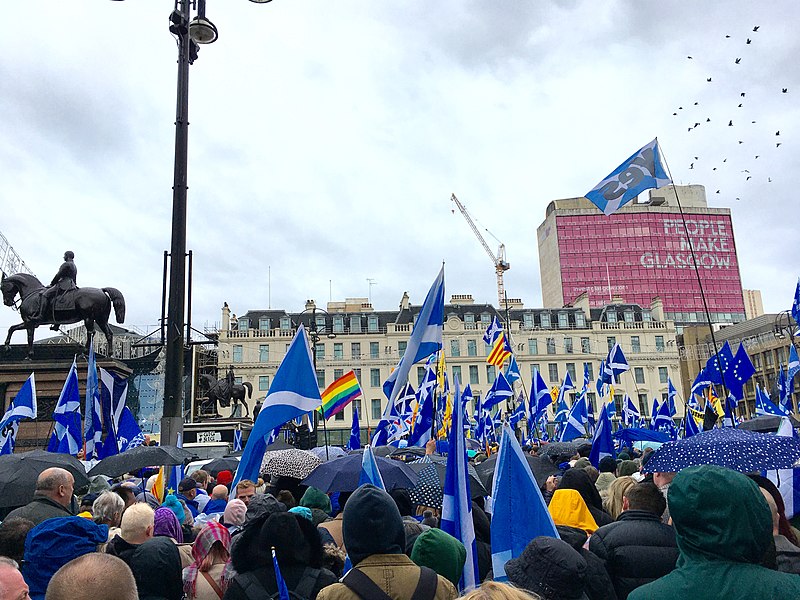
In Scotland, the fight for independence has been a critical issue for many young people since the events of the 2014 independence referendum, which saw a 45-55 percentage split in favour of a ‘no’ vote. There was a massive youth turnout in the referendum, as many of us saw this as a tangible opportunity to change our lives. In the last few days before the referendum, young people filled and occupied city centres in large pro-independence rallies. Today, more than 60% of young people in Scotland support independence.
Those who voted YES in 2014 predominantly tended to be working class and young people, whereas those who voted NO tended to be older generations and the middle class. Crucially, a layer of working class people were understandably not convinced by the pro-capitalist vision of independence promoted by the Scottish National Party (SNP).
Now Scotland faces the prospect of a second independence referendum, dubbed ‘indyref2’. Recent polls on the potential result of this referendum have shown huge polarisation, with a small margin between YES and NO.
However, the Tories are refusing to allow this referendum. Against this backdrop, we call for a mass working-class movement for the democratic right to indyref2. We fight for an independent socialist Scotland as part of a voluntary socialist confederation with England, Wales and Ireland as a step towards a socialist Europe. As socialists, we stand for the right of all nations and peoples to self-determination, including the right to independence.
In fighting for self-determination and democratic rights, socialists stand for the maximum unity of workers and young people. In Scotland, the mood among both workers and young people for independence has been fed by a desire to escape Tory austerity and successive pro-business governments in Westminster.
Students must fight alongside workers to secure the right to a second independence referendum, while driving to fight out the Tories. The ongoing strike wave has demonstrated the potential power of the organised working class to fight for this. And as students, we could mobilise mass action in the form of strikes, walkouts, demonstrations and occupations to support such a movement. The mass student movement in 2010-11 has shown the potential for students to fight back, but we need democratic, fighting student organisations to lead this struggle across the UK.
With the ever-deepening cost of living crisis ripping through working-class communities, capitalism has shown its nature as a system for the rich that is in terminal decline. In 2014 the main campaign for a NO vote, ‘Better Together’, warned that Scottish independence would bring economic calamities like wildly increasing energy bills and spiralling inflation. But is this not the reality in Scotland – and the rest of the capitalist world – today?
The ‘Better Together’ campaign, also known as Project Fear, was widely supported by the Tories, Labour, and the majority of the ruling class internationally. Within Scotland these organisations – including Scottish Labour – have since collapsed in the eyes of many workers and young people, while the SNP have made enormous gains.
Fundamentally, the pro-capitalist SNP are fearful of working class mass organisation to secure the right to a second referendum. The threat of a workers’ movement that could challenge capitalism on the issue undoubtedly threatens their rule and their programme for an independent capitalist Scotland. The SNP’s 2013 White Paper and their recent Growth Commission are modelled on so-called “successful small capitalist countries” like New Zealand, Ireland, and Belgium. These are all countries that have implemented attacks on workers and youth.
The Sturgeon-led SNP leadership looked fearfully at the mass insurrectionary movement that developed in Catalonia in 2017, when an illegal independence referendum was called, and a republic briefly declared. There were general strikes of workers, mass demonstrations, and occupations by students. The movement was only defeated by violent repression by the capitalist Spanish state – backed up by the EU – and the lack of a mass workers’ party with a socialist programme.
In the face of the Tory government’s refusal to grant a section 30 order to allow indyref2, Sturgeon’s current strategy is to appeal to the UK Supreme Court. But the court judges will likely refuse the right to a referendum. Then the only plan for the SNP would be to urge people to vote for them in the next general election and secure another “democratic mandate” if they get over 50% of the vote.
What would a vote for the SNP mean for workers and young people? Currently the SNP is in a coalition-type government with the pro-independence Scottish Greens. Both parties have been more than eager to pass on Tory cuts and pay freezes for workers. And although the SNP have not brought back fees for Scottish students, they have never lived up to their promises to scrap debt and introduce a real living grant for students.
Workers and young people in Scotland hoping for an end to poverty, oppression and exploitation will find no solace in an independent capitalist Scotland, and this is clear from the pro-austerity, anti-worker policies being implemented by the SNP and Scottish Greens today. The grim reality of the paltry offerings provided by the parties of capitalism in Scotland can only be challenged along principled socialist lines.
The experience of 2014 and the large pro-independence marches since then have shown the potential of the Scottish working class and young people to be a force for social change. We have also seen recent mass strikes of rail workers, postal workers and Scottish local government workers, who have shut down major parts of the economy and society. This power can be utilised in a mass struggle for socialist change, including the right to a second independence referendum for the people of Scotland.
It is vital that we work towards the building of a new mass workers’ party in Scotland, which can act as a democratic vehicle of the working class and challenge the pro-capitalist parties in Holyrood and Westminster. Importantly, such a party could coordinate and provide a lead to a mass working-class movement for the democratic right to indyref2.
Scottish indepenedence would be a major blow to British capitalism, weakening the prestige of the UK ruling class internationally and inflaming national movements elsewhere. But only a socialist transformation of society where the major parts of the economy were brought into public ownership under the democratic control of the working class – including major industries, banks, oil, and gas – could meet the radical aspirations of workers and youth who are radicalised by the crisis of capitalism currently. It would be a society based on collaborative planning to meet everyone’s needs, not on what makes a profit. This is the kind of world that Socialist Students fights for. If you agree, join us today.
 Socialist Students