
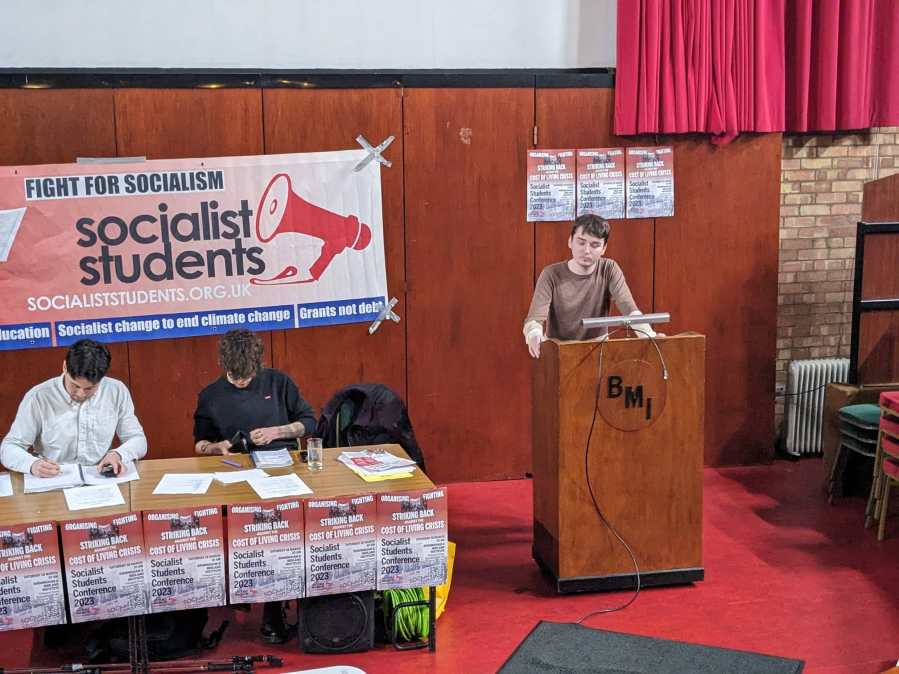
Here we publish the main motion from the Socialist Students 2023 conference, Organising, fighting and striking back against the student cost of living crisis. Conference delegates passed the motion unanimously, resolving to launch cost of living campaigns on all university and college campuses where Socialist Students groups are present.
The crisis facing students – of soaring living costs, inadequate funding, dilapidated housing, and deteriorating mental health, all part and parcel of a rotten capitalist system – totally eclipses the current low level of student organisation. The motion below outlines what Socialist Students argues is needed to begin rebuilding fighting, democratic student organisations, which could at some stage link up to organise students in a movement for free education and for socialism.
Organising, fighting and striking back against the cost of living crisis
Socialist Students steering committee
The student cost of living crisis
- At the same time that workers are taking strike action against the biggest single drop in living standards since the 1950s, students face a severe cost of living crisis of our own.
- With inflation at the end of last year reaching the 41 year high of 14%, maintenance loans for the 2022/23 year only increased by 2.3%. The average monthly shortfall between students’ loans and living costs has risen to £439 this year, up from £340 in 2021/2022, and nearly double the position in 2020/2021, at £223.
- The financial squeeze has already had a devastating effect on the day to day lives of students. The Office for National Statistics found last year that 40% of students are studying at home more to save money. A fifth are attending lectures remotely. An additional survey by the Sutton Trust found that 18% of students have avoided buying educational resources needed for their courses.
- But it isn’t only in the realm of study that students are feeling the cost of living squeeze. 11% of students now use foodbanks. 28% reported skipping meals to save on food costs, 47% are going out less with friends, and 14% are travelling to campus for free energy use.
- With inflation projected by the Bank of England to continue running high throughout 2023, the Tories’ decision to increase maintenance loans by only 2.8% will be another vicious cut in the living standards of hundreds of thousands of students. This will in particular affect students from working class backgrounds who are less able to rely on financial support from their families.
The roots of the cost of living crisis
- The student cost of living crisis is fundamentally the result of the marketisation of higher education.
- The introduction of tuition fees by Tony Blair’s New Labour government in 1998 marked the beginning of the gradual ‘weening’ of universities off public funding, and taking its place a self-funding model, leaving universities’ income increasingly reliant on student tuition fees.
- What followed was a decades-long expansion of student numbers as universities attempted to make up for funding lost from government. This massive increase in student numbers however has not been met with increased investment in the educational resources both students and staff need. For students this has meant overcrowded lecture theatres, a lack of student support services available on campuses, overcrowded and unaffordable student accommodation, and the overall decline of the quality of education.
- This expansion has been financed through a massive piling up of government debt. Government owned student debt – which reached £201 billion across the UK in 2022 – was at one stage tolerable for British capitalism.
- But with a new stage of crisis in the long term historic decline of British capitalism – underscored by the Truss/Kwarteng budget crisis – this mountain of state-owned student debt is an increasingly intolerable economic burden for British capitalism.
- Despite splits within the Tory leadership over the question of how to handle the crisis in Higher Education, the currently prevailing approach being forwarded by the Tory leadership is to now attempt to limit student numbers, particularly numbers of students enrolled in arts and humanities courses, which the Tories deem as ‘low value for money’.
- The resulting Tory policy – to in effect freeze maintenance loans, as well as the tuition fee cap at £9,250 – is to pass the costs of the inflationary crisis further onto the shoulders of universities, students and staff to pay for the current crisis.
- The scale of the current inflationary crisis means not only a cost of living crisis facing students, but also a massive real terms decrease to the value of tuition fee payments to universities, and therefore university funding.
- As the student cost of living crisis drags on, the possibility exists for a spike of student dropouts from university, as well as decreased enrolment on future university courses, threatening to exacerbate this funding crisis even further.
- Indicative of the scale of the funding crisis is the growing level of disquiet and in some cases open protest from university Vice Chancellors at the government’s policies.
- This includes in September 2022 when the head of the UUK – a body bringing together university management from across the country – publicly called on the government to provide a new funding model for HE. This is significant from university management who have and continue to oversee on the campuses the implementation of Tory attacks to our education, including course closures, jobs cuts, and attacks on staff wages and conditions.
- The funding crisis has now reached such heights that some universities, including Brunel and Worcester, have moved to introducing medical courses which are only open to international students in order to secure higher tuition fee payments, in effect circumventing the current domestic tuition fee cap.
- The question however is what funding model ought to be implemented, and who in society should be made to pay for it. Socialist Students says that the tuition fee system and marketisation as a whole should be scrapped and replaced with free, fully funded education – financed by taking the wealth off the super-rich in society.
Fighting student organisations needed
- Despite the level of crisis facing students, no generalised fight back has yet emerged on the campuses against the attacks students face. The general response of students so far has been to ‘grin and bear it’ – with figures showing that 62% of students are now cutting back on essentials, while 52% are using their savings, and a staggering 25% have reported taking on new debt to finance their living costs.
- This is largely down to the massive weakening of student organisation over the last decade, which includes the abdication of the NUS and local Students’ Unions from helping to organise and lead students in struggle. This was underscored by the last national demo called by the NUS – now a whole year ago – which only around 500 students attended.
- This was not a reflection whatsoever of a lack of appetite on the part of students to struggle. It reflected the complete lack of programme and strategy put forward by the NUS at that stage, as well as the complete failure organisationally to mobilise students.
- Central then to the building of a fighting student movement in this period is the rebuilding of democratic and fighting student organisations on the campuses, capable of linking up nationally in the fight for free education. The key task facing the student movement as a whole – and Socialist Students – is not only to build our own forces, but to aid in the rebuilding of broader student organisation too.
- That isn’t to say that student struggles will be delayed until such organisations are built. On the contrary, with continued attacks on students, spontaneous outbursts of struggle on the campuses, like those which broke out on campuses during the Covid pandemic, are likely.
- Out of these spontaneous struggles can emerge new forms of student organisation. The rent strike movement, which involved 55 universities at its peak at the start of 2021, is an example of what can be thrown up by students in the course of struggle.
- Despite the political and organisational limitations of the rent strike’s national leadership, Socialist Students intervened into meetings on campuses and at a national level as well to put forward a programme and strategy to help further organise students and broaden the struggle against marketisation. Socialist Students should continue to take the same approach of attempting to act positively as a lever on new student campaigning organisations which may be thrown up in the course of future struggles.
- Also lacking in this period is any kind of political alternative to the policies of the Tories. Starmer’s Labour has completely ruled out the possibility of introducing free education, as well as continuing to demonstrate to big business that Labour is now a safe party to represent the interests of big business and capitalism. That’s why Socialist Students fights for a new workers’ party.
- Notwithstanding the weakening of student organisation and leadership in this period, the strike wave is demonstrating in practice the power of the working class and the potential of mass collective action. This gives Socialist Students a massive opportunity to argue the need for students to also get organised, not only to more effectively link up with workers in struggle and to support the strikes on campuses, but also to formulate our own programme of demands in the cost of living fightback.
The programme
- Any steps taken to help resolve the crisis of student organisation on the campuses and nationally would be positive.
- Being organised in and of itself however is not enough. Also central is the question of around what programme and set of demands can students be mobilised in the struggle against the cost of living crisis and for free education.
- Socialist Students has almost alone raised the need to build a movement to fight for free education. The new student cost of living crisis however means it’s necessary for Socialist Students to adapt to the concrete situation with a set of demands which offer a way forward for students looking to fight back on the cost of living.
- Developments in recent months of universities giving small emergency energy grants to students, like at York University, and small rent relief, like at Manchester University, can lift the confidence of students to struggle for the same elsewhere and more.
- This raises the opportunity for Socialist Students to build on these developments a programme of demands which students could mobilise around in the battle against the cost of living crisis on campuses.
- These demands include but are not limited to:
- For emergency cost of living grants available for all students who need them. Replace student loans with living grants, rising with the rate of inflation.
- For subsidised university canteen meals for students struggling to feed themselves; against early closures of campus spaces due to the energy cost crisis.
- For heated and safely staffed campus spaces available 24/7 to students and staff who need them.
- To take third-party student halls under the control of our universities, as a step towards introducing democratic rent controls.
- For an end to and a reversal of cuts to our education, including courses, jobs, and student support services.
- Any and all of these demands can be campaigned for locally on the campuses, directed at university management and Vice Chancellors to take action to alleviate the crisis facing students.
- But campaigning for any of them would also pose to students the need for a struggle to win the funding our universities need from central government in order to secure them on a permanent basis – and therefore the need to build a national student movement to fight for a new funding model in our interests, of free education.
- The crisis of capitalism is pushing students and young people towards socialist ideas and conclusions. The Institute for Economic Affairs (IEA) found in 2021 found that 67% of under 35 year olds in Britain today consider themselves socialist. That’s why vital in this period is to boldly raise socialist ideas as well as explaining what a socialist transformation of society would mean – i.e. the democratic public ownership of the banks, monopolies and major industries to provide young people with a future.
- But the current cost of living crisis has the potential to affect and radicalise a whole layer of students not yet familiar with socialist ideas or having yet reached socialist conclusions. The potential exists for all Socialist Students groups then to build and lead campaigns on the cost of living crisis, not only involving current Socialist Students members but students not yet politically active on the campuses.
- Part of this process will sometimes mean reaching out to other campaigning organisations on campuses in order to discuss and when necessary to debate democratically around what programme of demands students should organise around as part of building broad cost of living campaigns.
This conference resolves:
- To launch cost of living campaigns on university campuses and colleges where Socialist Students is present.
- To campaign as widely as possible to build such campaigns – including stalls on campuses, building for public meetings, campus protests, open letters and petitions to management, to Students’ Unions and course reps, and inviting trade union branches and other campaigning organisations to participate within them.
 Socialist Students
Pingback: Brighton students protest against mass redundancies – Socialist Students