
The following article has been adapted from a discussion document submitted to this year’s Socialist Students national conference by the Socialist Students national steering committee.
Capitalism today is a system in turmoil, marked by mounting instability and increased upheaval everywhere. Life for billions of people is increasingly fraught with war, environmental breakdown, falling living standards and failing social infrastructure.
The dystopian character of this era of capitalism is epitomised by the catastrophic situation currently unfolding in the Middle East. The ongoing slaughter of the Palestinian population in Gaza – and increasingly in the West Bank – by the Israeli state is a step up even from its past brutal attacks on the Palestinians. Over 1% of the population of Gaza has been wiped out since October 2023. The Israeli military onslaught aims not only to displace the people of Gaza through mass, indiscriminate acts of terror, but to destroy the infrastructure necessary for maintaining a functioning society in this area.
At the same time, the Israeli state’s onslaught on Gaza has provoked huge anger among vast swathes of the world’s population. There have been massive anti-war protests in cities around the world, most significantly in the Arab and Muslim world. There is not only outrage towards the barbaric actions of the Israeli state, but also towards the role of capitalist governments in backing up or failing to oppose Israel.
Added to the equation, there is fear among the capitalist ruling classes that Israel’s onslaught could ignite a major regional war, which would have devastating consequences for profit-making in the Middle East and internationally. It would spell a further collapse in living conditions for millions of people in the region, bringing mass death and suffering. A widespread mood against war could quickly develop into a generalised mass movement. The staunchly pro-capitalist Arab governments are terrified of being overthrown by a movement like the one that developed in North Africa and the Middle East in 2011 – the ‘Arab Spring’, which deposed dictatorial regimes in Tunisia and Egypt.
Nonetheless, attempts by different capitalist powers to prevent the spread of the conflict have failed to this point. Not only has the Israeli onslaught not stopped, but the US government – backed up by the Tory government and Labour opposition here – has launched air strikes against the Iran-backed Houthis in Yemen. US imperialism has desperately hoped to stem the development of a regional war yet has taken measures which could have the exact opposite effect! This situation illustrates the weakening control that the capitalist class now wields over developments within its system.

New multipolar world
In particular, the recent increase in national conflicts and war globally – most strikingly illustrated first in Ukraine, then in Gaza – marks the end of an era in which the US was the completely dominant ‘superpower’ following the collapse of the Soviet Union and Stalinist states in Eastern Europe.
The Stalinist regimes were brutal dictatorships which bore no resemblance to genuine socialism, but they were based on planned economies which for a time took the productive forces forward, even despite their gross bureaucratic mismanagement. It thus represented an alternative system to capitalism and acted as a counterweight to US imperialism. After the collapse of Stalinism from the late 1980s, western capitalism – led by the US – went on the offensive, restoring profits by stepping up its exploitation of the working class globally. It did so through a ‘two-pronged’ attack: materially benefiting from the integration of 1.2 billion extra workers into the world capitalist economy; and ideologically gaining from the seeming triumph of capitalism as the ‘only possible system’. Both ‘prongs’ in turn reinforced one another, leading to a collapse in workers’ consciousness and organisation.
That brief ‘unipolar’ period of US dominance has now given way to a multipolar world of growing tensions between different national capitalist classes. The growing prospect of war globally has led to a dramatic increase in arms spending across the capitalist world.
Added to the growing threat of military destruction, there is the deepening environmental crisis, which threatens to destroy life and resources, and make vast parts of the world uninhabitable. The recent spike in inflation globally, accompanied by soaring interest rates, has significantly increased the cost of simply existing from day to day. This is especially the case in the neo-colonial world, but also in supposedly ‘advanced’ capitalist countries like Britain, where living standards have fallen at their sharpest rate since the 1950s. Beneath all these trends, economic growth across the whole capitalist system is slowing – and there is no prospect of a new, sustained period of economic growth.
Search for an alternative system
The capitalist system is being hit by a series of multiple crises – economic, political, environmental, geopolitical – which all impact on and exacerbate one another. All of this has meant further misery and suffering for the vast majority of the world’s population.
It is therefore increasingly difficult to not draw the conclusion that something is fundamentally wrong with the way that the world is currently organised. There is a widespread sense that the world is being dragged backwards. Large numbers of young people especially look upon the future with, at best, little to no enthusiasm. At worst, the outlook is one of despair. Capitalism itself is laying the basis for the ideas of socialism to gain mass appeal among workers and young people in the coming period.
Ultimately, capitalism will not collapse under the weight of its own crises; it will need to be overthrown. The capitalist class and ruling elites have a stake in maintaining this system, which grants them power and material comfort via profit. They will fight tooth-and-nail against any perceived threat to capitalism, even if that means inflicting further attacks on the living conditions of the world’s majority.
However, the tools at the disposal of the capitalists for doing so are severely rusted. They find themselves with an increasingly unreliable and unstable pool of political representatives, as many of the ‘traditional’ parties they used in previous periods have declined or collapsed. This process of decline will continue to threaten all parties who seek to work within capitalism, as they will be unable to deliver any substantial reforms.
The exceptional period of capitalist boom after the second world war, in which social-democratic and ‘communist’ (now former) mass workers’ parties were able to win reforms in the name of the working class, is not coming back. Now, the capitalist class is forced to rely on increasingly authoritarian measures; they are far less willing to offer concessions to the working class as they did in the past, because profits are much less reliable.
However, the capitalists are not guaranteed to get their way. A heavier use of repressive laws can only invite more social explosions. This was shown recently by the massive year-long movement that developed in Israel against the Netanyahu government’s judicial reforms. International youth-led movements like the school climate strikes and BLM movement are also increasingly likely to break out, and students will also find ourselves pushed into struggle. The mass movement in Sri Lanka in 2022, which swept aside the corrupt presidency of Gotabaya Rajapaksa, gives a glimpse of the important role that young people and students can play within political uprisings.

Students and workers unite
Moreover, the working class in a number of countries has re-entered the scene of history at a level not seen in a generation. In Britain, hundreds of thousands of workers have taken strike action and “refused to be poor”, in the words of RMT general secretary Mick Lynch. In the US, there were 4.5 million days lost due to work stoppages in October – the highest of any month for four decades. The significance of these developments is hard to overstate. While these strikes represent only the beginning of a process of the working class internationally finding its collective strength, they are the music of the future, as a capitalist system in crisis continues to provoke the working class into fighting back to defend its interests.
The working class is the only social force capable of leading the socialist transformation of society. In order to play this role, it will need its own mass parties, equipped with a socialist programme to take over the commanding heights of the economy – the banks, major industries and monopolies – and collectively run society through a democratic plan of the economy aimed at fulfilling all people’s needs. An island of socialism cannot survive surrounded by a sea of capitalism, so this socialist transformation would have to take place internationally.
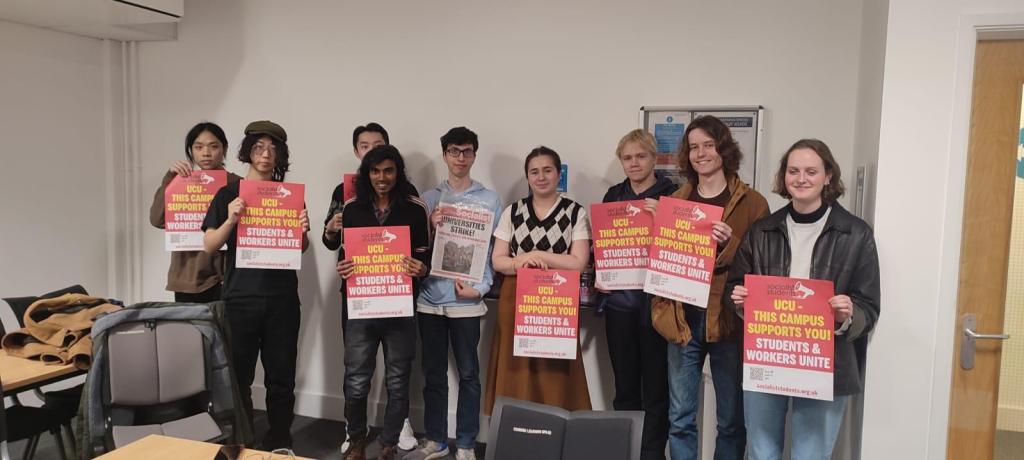
Young people and students have a vital role to play in these processes. As people who have the rest of our lives ahead of us, we can be some of the most determined fighters for socialism. We also have to fight now to defend against every attack by the capitalists on our living standards and win what we need for a decent life. That includes helping to build movements against all the horrors of capitalism – war, climate change, sexism, racism, and all other forms of oppression – and linking all these issues to the wider need to transform society along socialist lines.


 Socialist Students
Pingback: Preparing to kick out the Tories and take on a Starmer government – Socialist Students
Pingback: Meet the socialist college student standing in the General Election – Socialist Students