The Aragalaya (Sinhalese for “struggle”) protests in Sri Lanka, fuelled by a cost-of-living crisis, inspired students and young people across the world. People saw images of masses of protesters taking over the presidential palace and swimming in the presidential pool! These protests led to the resignation and flight of the president Gotabaya Rajapaksa and his family.
But his replacement, President Ranil Wickremesinghe has announced more cuts and austerity measures. It is obvious that this new government holds no solution for the people of Sri Lanka. Rather than changing the economic situation after he was brought into power, he has intensified the crisis through further mass repression and financial instability. He is representing the interests of the bosses not the mass of workers and poor.
Ultimately, this reflects the rottenness of capitalism: a crisis of a profit-driven system where the vast majority of wealth is accumulated by a few, and the inflating prices of goods means that people can’t afford food, fuel, or energy. It’s a system in which former colonial countries are shouldered with massive debt from the advanced capitalist countries, and the masses pay the price.
Just like in Sri Lanka, workers and young people here in Britain and around the world are experiencing a cost-of-living crisis. In Britain, one in ten students has to rely on the use of food banks as they enter higher education.
In Sri Lanka, after the protests ebbed, the government turned to repression. Many have been detained under the draconian Prevention of Terrorism Act (PTA). Among them, Wasantha Mudalige, convenor of the Inter University Students Federation (IUSF), the largest student’s union in Sri Lanka, has been detained for over 140 days.
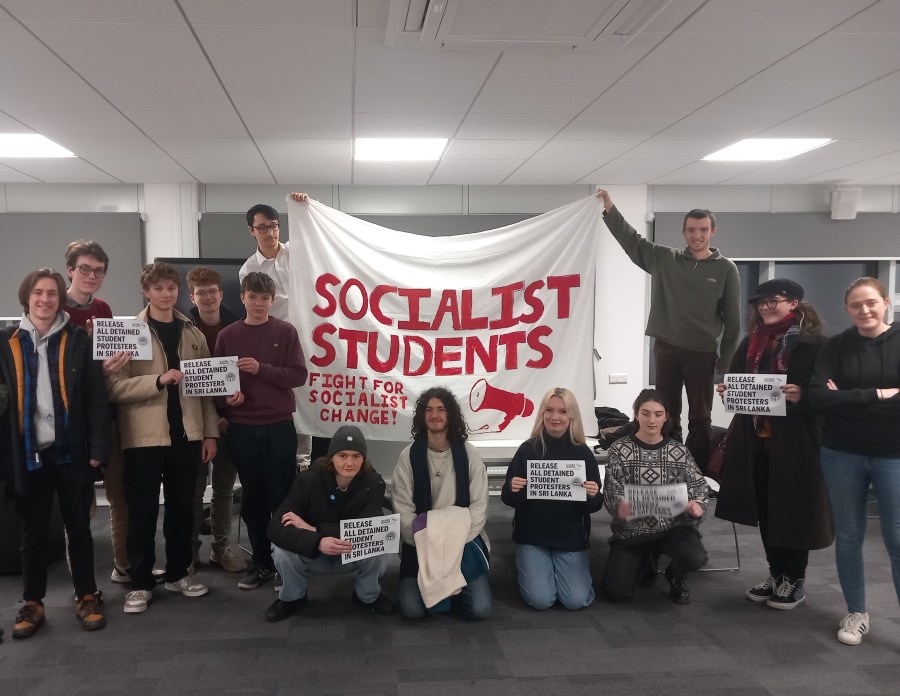
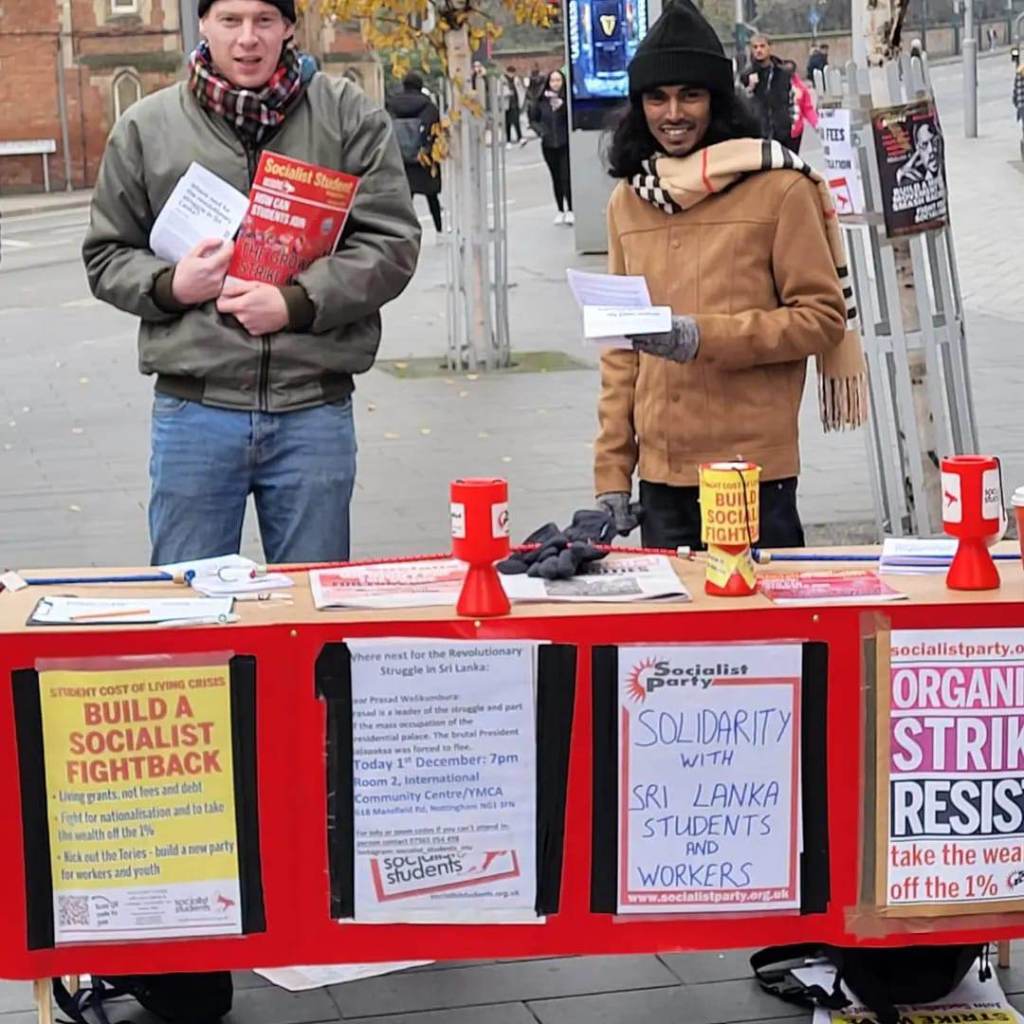
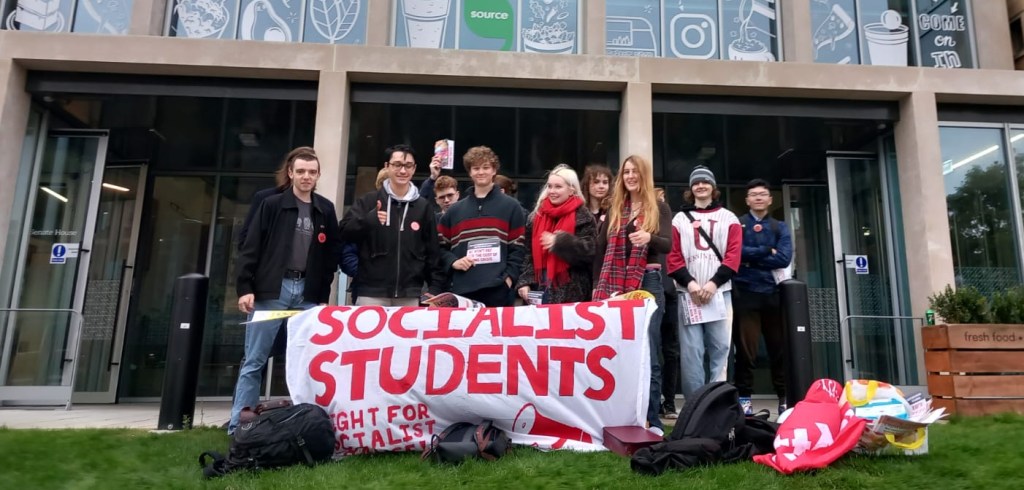
Socialist Students has been campaigning in solidarity with the movement in Sri Lanka and those facing repression. We want to learn the lessons from the struggle to forward socialist ideas for workers and students fighting against brutal repression and the economic crisis.
We have organised stalls and public meetings where we put forward student and trade union motions which called for the release of protesters detained under the PTA, the repeal of all oppressive laws, and to fight for the freedom of assembly, free speech and protest.
Campaigning at Coventry University
Building for the meeting at Leicester University with Prasad (right), one of the leaders of the Aragalaya
At Nottingham Trent University, we organised stalls, and mobilised on campus when the IUSF called for an international day of action on 9 November.
Prasad Welikumbura, one of the leading organisers of the movement and a member of the United Socialist Party, came to Nottingham and Leicester as part of a national speaking tour and described how the movement was developing and how the government attempted to suppress the protests. Parallels can be drawn between the Tories’ plans for new anti-strike laws to try and head off the movement here.
We say that the only way for workers and young people to have any future, whether in Sri Lanka, Britain or internationally, is to fight for socialist change, where society can be free of continuous economic hardship and oppression.
Text from a leaflet produced by Socialist Students for International Day for the Elimination of Violence against Women on 25 November.
You can order or print this leaflet to help with your campaigning on campus here.
A recent National Union of Students (NUS) study showed at least 75% of female students have had an unwanted sexual experience while at university. One in four women in their lifetimes will be raped or sexually assaulted.
Huge gains have been won for women’s rights in recent decades, and all have had to be hard fought for. But these gains are not reflected in our experiences on campus at university, on nights out, or at work.
There is still a gender pay gap, including among university staff, which is one of the reasons for the recent strikes by the University and College Union (UCU). Women are more likely to be lower paid and in insecure employment.
During the pandemic, domestic violence was on the rise. Two women a week are still killed by a current or ex-partner.
Despite all the gains and struggles for better living conditions, against gender discrimination and for equality, sexist and misogynist attitudes still persist.
Discrimination, sexism and abuse are rooted in inequality and associated ideas about gender roles. The capitalist system we live in is based on inequalities of wealth and power that reinforces these ideas. Therefore we can’t trust capitalism, its political representatives or its institutions to end sexism.
On campus, it’s university management, intent on cutting costs, who make the decisions around procedures dealing with sexual harassment. We say its students and staff who make the university – not management. We demand a democratic say over how our universities are run, to make sure that all procedures are fit for purpose and under democratic oversight.
On nights out, Tory MPs suggest we should moderate our behaviour. Police suggest there should be more of them undercover in nightclubs. As if that would make anyone feel safe, given the recent WhatsApps between police officers which have been uncovered.
Whereas, a safer night out is possible if there is minimum staffing levels and proper training for staff to deal with different situations. But we can’t trust night club owners, looking to profit out of young people to protect us. We need a democratic say in safety and stewarding though trade unions, local communities and young people.
Also hospitality staff should feel safe and secure at work. They too shouldn’t experience sexism and should feel able to stand up to sexism at work, backed up by a trade union. We need a fully funded, free public transport network, so that people can get home safely.
We are campaigning to win these demands. Huge gains can still be made to make our lives easier and safer.
But to end sexism, gender violence and abuse means challenging the unequal and violent capitalist system. That means fighting all the forms of exploitation which exist today. From low-paid work, to the beauty industry, to care in the family and sexism.
Such a struggle will need to unite the mass of working-class people for a socialist alternative to capitalism. Huge wealth exists in society, in the hands of a tiny few. That wealth could be used to save the planet, liberate people from the daily struggles and offer a decent future for all.
That’s what Socialist Students is fighting for. Join us in that fight.
Lluis Bertolin, UCU member and PhD student, Birmingham
University staff are at breaking point.
What once used to be a prestigious profession, which offered good and secure working conditions, in the last decades has transformed into exploitative arrangements, spurred by the commercialisation of higher education.
Long, unpaid hours over contract. Fixed-term casualised contracts. Oppressive working conditions for working-class and young academics, who depend on their precarious university job to survive. A widening of the gender gap. All of these are the reality of working in higher education today.
The unwarranted threat on USS pensions is just the culmination of the contempt higher education bosses feel for their employees.
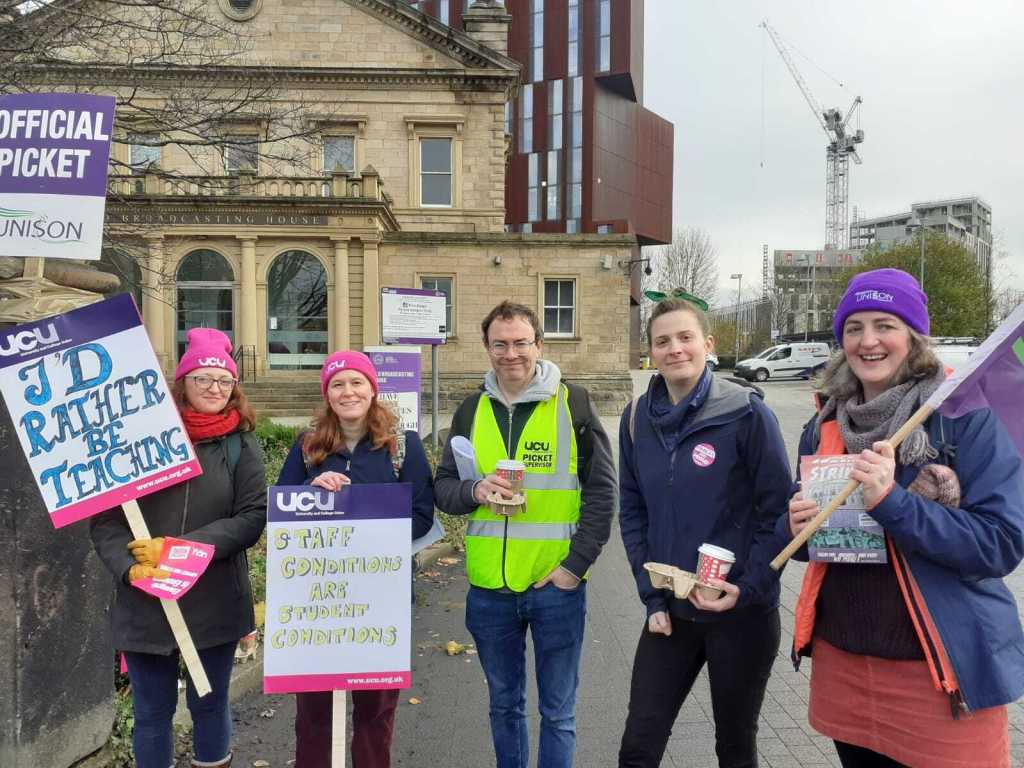
Bosses have escalated their attacks on our ability to live lives worth living, so the University and College Union (UCU) has also escalated, calling its most ambitious round of strikes yet.
I am striking because I want students to receive a proper education, delivered by lecturers who are secure in their working arrangements, and not on the brink of collapse. I am striking because I want the sector to be able to survive the greed and short-sightedness of the fat cat vice-chancellors.
Why students support the strike
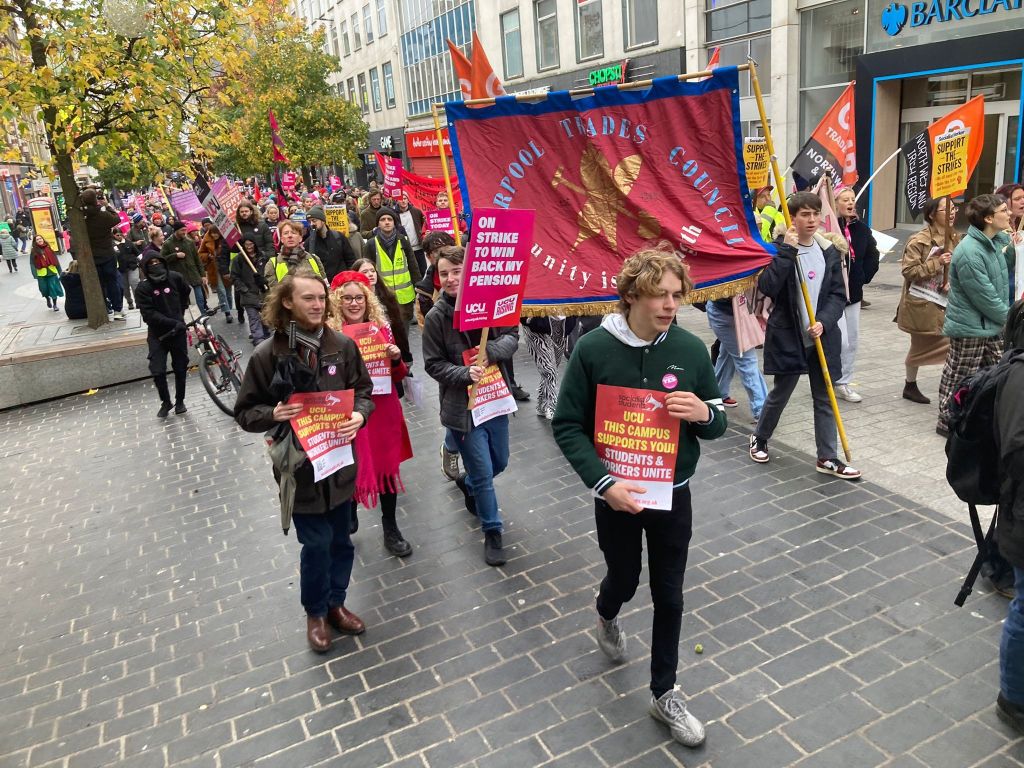
Liverpool Socialist Students marching under the Trades Council banner in support of the UCU
Staff are struggling
George Phillips, Cardiff Socialist Students
This is the second time in my university life that the UCU has taken strike action, and the third time it has balloted. This shows nothing has changed – university management continues to ignore workers’ demands for fair pay, conditions and pensions.
Lecturers and postgraduate teachers are overworked, underpaid and treated as cogs in the university business machine. Postgrad teachers are on zero-hour contracts, and lecturers work 60+ hours a week, leaving them just 20 minutes on average to prepare for a lecture.
Cardiff University vice-chancellor Colin Riordan earns £289,275 a year, has use of a company car, accommodation, and up to £1,000 for private healthcare, alongside other benefits. All this while staff struggle to pay their bills and put food on the table.
Cardiff University has the money to pump millions of pounds into vanity projects, but not to pay its staff a reasonable wage. Students must stand in solidarity with striking workers, as their working conditions are our learning conditions. We must rise up together to demand better pay, conditions and free university education.
You have our full support
Noah Eden, Sheffield Socialist Students
For too long now, university staff have been subject to unfair working conditions and a below-inflation pay rise, which means a real-terms cut since 2009. This is just one of many injustices that they are fighting against.
They are also striking to end all unfair pay gaps based on race, gender and disability, to get rid of precarious employment, action to address excessive workload and unpaid work, which are further adding to the ongoing mental health crisis, and for standard weekly full-time employment contracts of 35 hours, with no loss of pay.
All these harmful policies towards staff, while vice-chancellors make obscene amounts of money, highlight how capitalism and the marketisation of universities is not fit to meet the needs of the workers. And this is why the UCU has full solidarity from Socialist Students.
This is our fight too
Matthew Bates, Northampton Socialist Students
We want to explain why students should get behind striking academic staff.
Firstly, this is our fight as students. With lecturing staff being unfairly paid and overworked, this means we aren’t getting the high-quality education we deserve and pay for in astronomical fees.
Secondly, Socialist Students backs all striking workers. This is a corrupt world of work we will be entering. We must demand a better deal for our future selves, as well as for those being taken advantage of right now.
Thirdly, university vice-chancellors are laughing with their own obscene pay deals. Under capitalism, the ruling class inflicts poorer conditions on workers, while enjoying an affluent lifestyle themselves.
Join the picket lines at your university, and show solidarity with striking staff. As Karl Marx said: “Workers of the world unite, you have nothing to lose but your chains”.
Join Socialist Students at the national UCU demo in London on November 30th!
Rally starts 1pm, King’s Cross Station, London N1 9AL
Support the UCU strikes – for joint student-worker struggle to end campus crisis!
Solidarity with 70,000 UCU members joining the strike wave and taking industrial action to defend their pay and conditions.
Give university staff an inflation-busting pay rise. Pay all staff a minimum wage of at least £15/hr. End and reverse casualisation.
Make the November 30th UCU demo in London a joint day of protest between all the unions taking or balloting for strike action. Student Unions should organise transport to London on the day.
Fight for free education. For universities to be 100% publicly funded. Make the super-rich pay.
Fight for socialist change to provide a future for workers and young people.
Socialist Students stands in solidarity with the University and Colleges Union (UCU) taking national strike action on 24, 25 and 30 November.
The UCU has been fighting for years against attacks to our universities by management and the Tories – cuts to courses, staff wages, working conditions and pensions.
But now the cost-of-living crisis threatens even further attacks. Workers and students are feeling prices go up everywhere, with our wages and maintenance loans not even coming close to covering the increase in the cost of living.
Inflation is further squeezing the income of universities, as every day running costs skyrocket. Socialist Students calls for a united struggle to scrap the tuition fee funding model, which is bringing universities to ruin.
Fully fund free education
Replace loans with grants, tied to inflation
Cancel student debt
All paid for by taking the wealth from the super-rich
We say building a common and united struggle between students and workers against cuts, and for the reintroduction of free education is central to ending the crisis we face on campus. That’s why Socialist Students is building the maximum possible student support for the UCU, including collecting the signatures of students supporting the strikes.
The 30 November march called by the UCU in London could be a key event to bring together workers taking strike action on and off campus – CWU and RMT strikers, plus civil service workers in PCS and nurses in RCN, which recently balloted successfully for strike action – with students as well.
That’s why Socialist Students is mobilising our members to that demo, and campaigning for student unions to arrange travel to London. The National Education Union (NEU) in sixth forms is taking strike action starting on 30 November, so the march that day is also a chance for sixth-form teachers and students to link up with university students in the struggle against education cuts.
Socialist Students will be visiting UCU picket lines and getting in touch with UCU branches to discuss how best to build student support for the strikes. But key now is that the different trade unions – either with live industrial ballots or currently balloting for strike action – meet to discuss coordinating action to get rid of the imploding Tory government.
Socialist Students also says that students ourselves need to get organised. This is key to building student support for the strikes, allowing us to more effectively link up with striking campus workers. It would also mean we can discuss the cost-of-living crisis that we as students face, what demands we need to fight for, and to appeal to striking university staff to support rent control, cost-of-living grants, and free education.
National UCU demo – November 30th, 1pm, King’s Cross Station, London N1 9AL
Two thirds of young people in Britain are socialists…
But what is socialism?
George Phillips, Cardiff Socialist Students
Capitalism is failing. Every section of society, with the exception of the elite capitalist class, is being squeezed and cut. Households face yet another increase in energy prices, driving millions more into poverty this winter. All this while Shell recorded profits of nearly £9.5 billion in the last three months. BP’s profits tripled to £6.9 billion, and the world’s five biggest oil companies shared profits of $100 billion in the first six months of 2022.
Billionaires’ wealth increased by $5 trillion to $13.8 trillion between March 2021 and the start of this year. The rich keep getting richer at our expense.
Unsurprisingly, in this world where prices continue to rise and pay doesn’t keep up, record heatwaves expose the climate emergency, workers’ strikes spread, war rumbles on in Ukraine and the Tory government is in chaos, interest in socialist ideas has exploded. 67% of young people aged 16-34 want to live in a socialist economic system, according to a poll by the Institute of Economic Affairs last year. But what is socialism, and how do we fight for it?
Under capitalism, the way society is currently organised, the overwhelming majority of wealth and resources – including the means of producing all the goods and services society needs – is privately owned by a small layer of individual capitalists. Decisions about what to produce and how to produce it are made with the objective of maximising profit for the bosses. The workers, who build and operate the machines and deliver services, receive just a fraction of the wealth they produce. An increasingly small fraction of this is invested in progressive technology and training, and the rest is hoarded by the capitalist bosses.
Socialism is about turning this arrangement on its head, by transferring ownership and control of the world’s wealth and resources into the hands of the many, not the few – so that production can be planned democratically to meet the needs of ordinary people.
But of course the capitalist class with all its wealth and power – including the backing of the capitalist state, the armed forces and police, and so on – is not about to hand over control without a fight! To change society in our interests means getting organised and building a mass movement.
And people are demonstrating that they are not prepared to allow private companies to continue to exploit us. Motivated by the struggle for secure, safe, and warm housing, food on the table and access to a decent standard of living, people are fighting back.
The “Enough Is Enough’ campaign, backed by the Communication Workers Union and RMT leader Mick Lynch, has set out its demands for: A real pay rise, the slashing of energy bills, the ending of food poverty, decent homes for all and taxing the rich.
But the biggest show of strength by working-class people has been the development of nationwide strike action by rail workers, postal workers, BT telecoms engineers, as well as countless local strikes. Workers in the public sector, like health workers, teachers and council staff, are voting on whether to strike this autumn.
By refusing to work, the source of the bosses’ profits is cut off. Already, the strikes have given a glimpse of workers’ potential power – the effects of no trains, bins not being collected and post undelivered is clear for all to see. Coordinating the strikes, with workers in different industries taking action together, would demonstrate that power further.
Fearful of strikes spreading, like they have to Amazon warehouses, the mainstream capitalist media has tried to turn the public against the strikes, but they are not getting their way! A recent poll found that nearly 75% of people supported the RMT rail strikers’ demands. RMT leader Mick Lynch has galvanised a layer of workers and youth with his media appearances taking down journalists and political commentators. The Trades Union Congress, which brings together the trade unions, reported a 700% increase in traffic on its ‘Join a Union’ webpage in June.
All of these strikes bring workers into conflict with their bosses. But politically, there is no mass party fighting on the side of working-class people. On top of the decade of cuts and privatisation, the Tories continue to push for more restrictive anti-trade union laws, adding to the existing ones kept in place by previous Labour governments. Labour leader Keir Starmer continues to stick two fingers up to workers, disciplining MPs for backing workers’ demands for pay rises and backtracking on every promise made in his leadership campaign. And Labour’s proposals to deal with the cost-of-living crisis fall short.
The root of Labour’s inadequacy is that it is unprepared to seriously dent the bosses’ profits, let alone call for re-nationalisation of the railways, Royal Mail and BT – among others.
The Labour Party no longer represents working-class and young people; like the Tories it serves the well-off in society and big business. A new mass workers’ party, with the backing and democratic involvement of the trade unions with their millions of members, could put up a challenge at the ballot box and popularise demands that would truly start to deal with the cost-of-living crisis. Fighting to build such a party is a crucial task in the fight for socialism.
The huge rallies in support of Jeremy Corbyn in his campaign to be leader of the Labour Party showed the potential for young and working-class people to be mobilised by demands such as a £15-an-hour minimum wage, rent control and free education. A new party could quickly grow. But to succeed in the long term it would need to be armed with a socialist programme.
Capitalism is in deep crisis and cannot afford substantial reforms. The bosses seek to claw back any limited concessions as soon as possible in their quest for profit; this is even more the case in periods of economic crisis. Look how quickly access to free Covid testing was withdrawn, or the extra £20 a-week Universal Credit during Covid!
The UK economy is falling into a recession that is predicted to last until at least the end of 2023 – the biggest economic downturn since the 2008 financial crisis – and for many young people, it’s not the first in our lifetime. Inflation, a measure of the increasing cost-of-living, is set to exceed 13%, heaping more misery on ordinary people.
Periodic crisis is inherent to capitalism. Only rational planning of the economy, made possible by nationalisation of the biggest companies and banks under democratic working-class control and management, can lay the basis for a decent future for us all.
Students are being hit by the cost-of-living crisis as much as workers. Maintenance loans are not enough to cover rent, bills, travel and food. One in ten students rely on food-banks, according to the NUS. In recent years there has been a 300% increase in the number of students owing over £100,000 in student debt. The Tory-imposed crisis in Higher Education funding fuels course closures, attacks on teaching staff and deteriorating learning conditions. In 2021, one student took their own life every four days. Students have no choice but to fight back.
Socialist Students is a campaigning organisation. We fight for demands that would transform students’ lives: free education, living maintenance grants, and rent caps. But we also make it clear that to win those demands on a permanent basis and secure a decent future, we need to bring about socialist change. Mass movements of students and young people together with the economically powerful working class, organised around a socialist political programme to take the wealth and power off the capitalist class, can achieve that change in Britain and internationally.
Students and workers unite to kick out the Tories and fight for socialist change. For democratic public ownership of the banks, monopolies and major industry to provide us with a future
Link up with striking workers – build a movement to demand that the bosses are made to pay for the cost of living crisis
Replace student loans with living grants tied to the rate of inflation – cancel student debt, scrap fees, and make the super-rich pay
No to price rises on campuses, early closure of libraries or other campus spaces and any more cuts to our education, courses or jobs. No delays in access to student hardship funds for students in need
For third party halls to be immediately taken into the ownership and control of the university, as a step towards introducing democratic rent controls for students. Councils should use their powers to compulsorily register landlords to force action on dilapidated and overpriced student housing
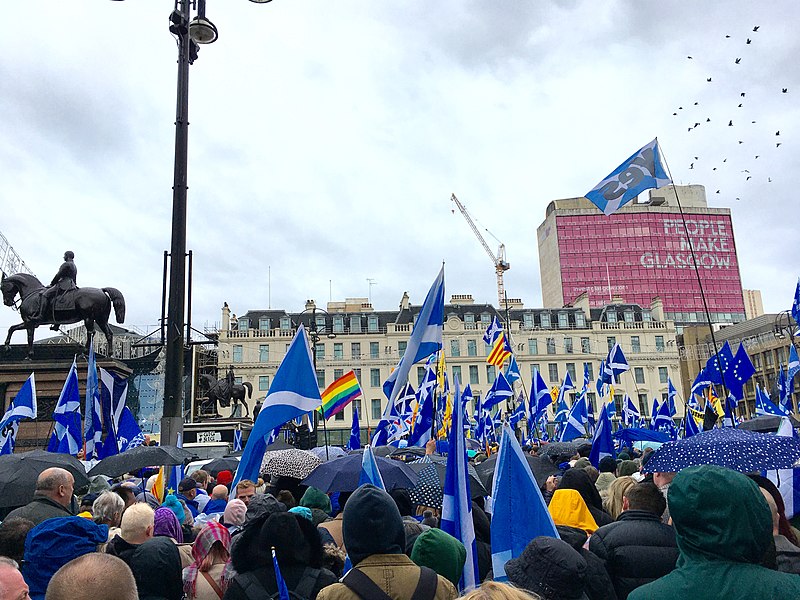
In Scotland, the fight for independence has been a critical issue for many young people since the events of the 2014 independence referendum, which saw a 45-55 percentage split in favour of a ‘no’ vote. There was a massive youth turnout in the referendum, as many of us saw this as a tangible opportunity to change our lives. In the last few days before the referendum, young people filled and occupied city centres in large pro-independence rallies. Today, more than 60% of young people in Scotland support independence.
Those who voted YES in 2014 predominantly tended to be working class and young people, whereas those who voted NO tended to be older generations and the middle class. Crucially, a layer of working class people were understandably not convinced by the pro-capitalist vision of independence promoted by the Scottish National Party (SNP).
Now Scotland faces the prospect of a second independence referendum, dubbed ‘indyref2’. Recent polls on the potential result of this referendum have shown huge polarisation, with a small margin between YES and NO.
However, the Tories are refusing to allow this referendum. Against this backdrop, we call for a mass working-class movement for the democratic right to indyref2. We fight for an independent socialist Scotland as part of a voluntary socialist confederation with England, Wales and Ireland as a step towards a socialist Europe. As socialists, we stand for the right of all nations and peoples to self-determination, including the right to independence.
In fighting for self-determination and democratic rights, socialists stand for the maximum unity of workers and young people. In Scotland, the mood among both workers and young people for independence has been fed by a desire to escape Tory austerity and successive pro-business governments in Westminster.
Students must fight alongside workers to secure the right to a second independence referendum, while driving to fight out the Tories. The ongoing strike wave has demonstrated the potential power of the organised working class to fight for this. And as students, we could mobilise mass action in the form of strikes, walkouts, demonstrations and occupations to support such a movement. The mass student movement in 2010-11 has shown the potential for students to fight back, but we need democratic, fighting student organisations to lead this struggle across the UK.
With the ever-deepening cost of living crisis ripping through working-class communities, capitalism has shown its nature as a system for the rich that is in terminal decline. In 2014 the main campaign for a NO vote, ‘Better Together’, warned that Scottish independence would bring economic calamities like wildly increasing energy bills and spiralling inflation. But is this not the reality in Scotland – and the rest of the capitalist world – today?
The ‘Better Together’ campaign, also known as Project Fear, was widely supported by the Tories, Labour, and the majority of the ruling class internationally. Within Scotland these organisations – including Scottish Labour – have since collapsed in the eyes of many workers and young people, while the SNP have made enormous gains.
Fundamentally, the pro-capitalist SNP are fearful of working class mass organisation to secure the right to a second referendum. The threat of a workers’ movement that could challenge capitalism on the issue undoubtedly threatens their rule and their programme for an independent capitalist Scotland. The SNP’s 2013 White Paper and their recent Growth Commission are modelled on so-called “successful small capitalist countries” like New Zealand, Ireland, and Belgium. These are all countries that have implemented attacks on workers and youth.
The Sturgeon-led SNP leadership looked fearfully at the mass insurrectionary movement that developed in Catalonia in 2017, when an illegal independence referendum was called, and a republic briefly declared. There were general strikes of workers, mass demonstrations, and occupations by students. The movement was only defeated by violent repression by the capitalist Spanish state – backed up by the EU – and the lack of a mass workers’ party with a socialist programme.
In the face of the Tory government’s refusal to grant a section 30 order to allow indyref2, Sturgeon’s current strategy is to appeal to the UK Supreme Court. But the court judges will likely refuse the right to a referendum. Then the only plan for the SNP would be to urge people to vote for them in the next general election and secure another “democratic mandate” if they get over 50% of the vote.
What would a vote for the SNP mean for workers and young people? Currently the SNP is in a coalition-type government with the pro-independence Scottish Greens. Both parties have been more than eager to pass on Tory cuts and pay freezes for workers. And although the SNP have not brought back fees for Scottish students, they have never lived up to their promises to scrap debt and introduce a real living grant for students.
Workers and young people in Scotland hoping for an end to poverty, oppression and exploitation will find no solace in an independent capitalist Scotland, and this is clear from the pro-austerity, anti-worker policies being implemented by the SNP and Scottish Greens today. The grim reality of the paltry offerings provided by the parties of capitalism in Scotland can only be challenged along principled socialist lines.
The experience of 2014 and the large pro-independence marches since then have shown the potential of the Scottish working class and young people to be a force for social change. We have also seen recent mass strikes of rail workers, postal workers and Scottish local government workers, who have shut down major parts of the economy and society. This power can be utilised in a mass struggle for socialist change, including the right to a second independence referendum for the people of Scotland.
It is vital that we work towards the building of a new mass workers’ party in Scotland, which can act as a democratic vehicle of the working class and challenge the pro-capitalist parties in Holyrood and Westminster. Importantly, such a party could coordinate and provide a lead to a mass working-class movement for the democratic right to indyref2.
Scottish indepenedence would be a major blow to British capitalism, weakening the prestige of the UK ruling class internationally and inflaming national movements elsewhere. But only a socialist transformation of society where the major parts of the economy were brought into public ownership under the democratic control of the working class – including major industries, banks, oil, and gas – could meet the radical aspirations of workers and youth who are radicalised by the crisis of capitalism currently. It would be a society based on collaborative planning to meet everyone’s needs, not on what makes a profit. This is the kind of world that Socialist Students fights for. If you agree, join us today.
Build a mass student movement against the cost-of-living crisis!
Socialist Students extends our solidarity to the tens of thousands of students across Ireland who have protested today against the student cost-of-living and housing crisis there.
Today’s large walkouts and rallies are a display of the huge anger that exists among students in Ireland, as sky-high fees and rents – compounded by an acute student accommodation shortage – have left many struggling to live.
Socialist Students supports the demands of the Union of Students in Ireland (USI), who have called for rent caps, the abolition of fees and a publicly funded higher education system, among other demands aimed at tackling the dire situation facing students.
The same crisis looms over students in the UK. During the summer, one in three students were left with £50 a month to live on after paying rent and bills. 11% of students now use food banks, up from 5% at the start of the year. Like in Ireland, some UK students have been forced to defer their studies due to a lack of accommodation, while others have had no option but to live miles from campus.
The President of the USI has said that today’s protests are “just the start”. Socialist Students calls on the National Union of Students (NUS), as the confederation joining together millions of students in the UK, to follow the example of the USI and take the lead in organising walkouts in all universities and colleges across the country, as the first step in a mass fightback against the student cost-of-living crisis.
But if the NUS does not act, then Socialist Students will be calling for walkouts and demonstrations on every campus, as a step towards building democratic and open student organisations that can link up nationally to build a mass student movement – for living maintenance grants, rent controls, and fully publicly funded, free higher education.
By uniting with workers fighting back in the trade unions, students can force this weak and divided Tory party to concede to our demands. That’s why Socialist Students will be marching alongside the trade union movement at the TUC lobby of parliament in London on November 2. We call on all students looking to link up with the growing strike wave to join us.
Young people’s experience of capitalism – poverty, crisis and austerity – has led many to search for a socialist alternative to what is happening. Join Socialist Students to help build a movement against the student cost-of-living crisis, for free education, to campaign on campuses, and fight for socialism.
Socialist Students says:
No to price rises on campuses, early closure of libraries or other campus spaces and any more cuts to our education, courses or jobs. No delays in access to student hardship funds for students in need
For third party halls to be immediately taken into the ownership and control of the university, as a step towards introducing democratic rent controls for students. Councils should use their powers to compulsorily register landlords to force action on dilapidated and overpriced student housing
Replace student loans with living grants tied to the rate of inflation – cancel student debt, scrap fees, and make the super-rich pay
Link up with striking workers – build a movement to demand that the bosses are made to pay for the cost of living crisis
Students and workers unite to kick out the Tories and fight for socialist change. For democratic public ownership of the banks, monopolies and major industry to provide us with a future
The working class is the most powerful force for change in society. How can students organise themselves to link up with workers in struggle and fight for socialism?
Jonathan Bennington, Swansea Socialist Students
Students this year are returning to the university campuses as a huge strike wave is spreading across Britain. Strikes throughout July and August by the National Union of Rail, Maritime, and Transport Workers (RMT) and the train drivers’ union ASLEF are now the largest rail strike in the UK in thirty years involving over 40,000 workers in 14 different train operating companies. Around only one in five trains ran during the strike days, and many lines had to close completely close, causing disruption to millions of people around the country and to the bosses’ profits.
Since then, the floodgates have opened with more and more workers turning to strike action to hit back at on these historic attacks on our living standards. Postal and communications workers in the Communication Workers’ Union (CWU) have recently taken action involving over 150,000 workers. And ballots in trade unions organising workers in the civil service, schools, buses, universites and local government are underway. Even barristers have been on strike!
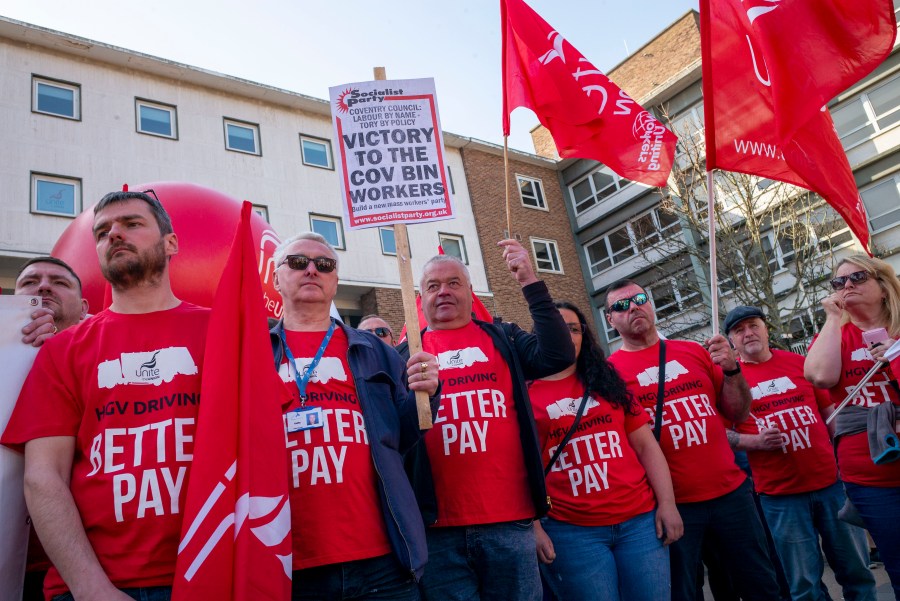
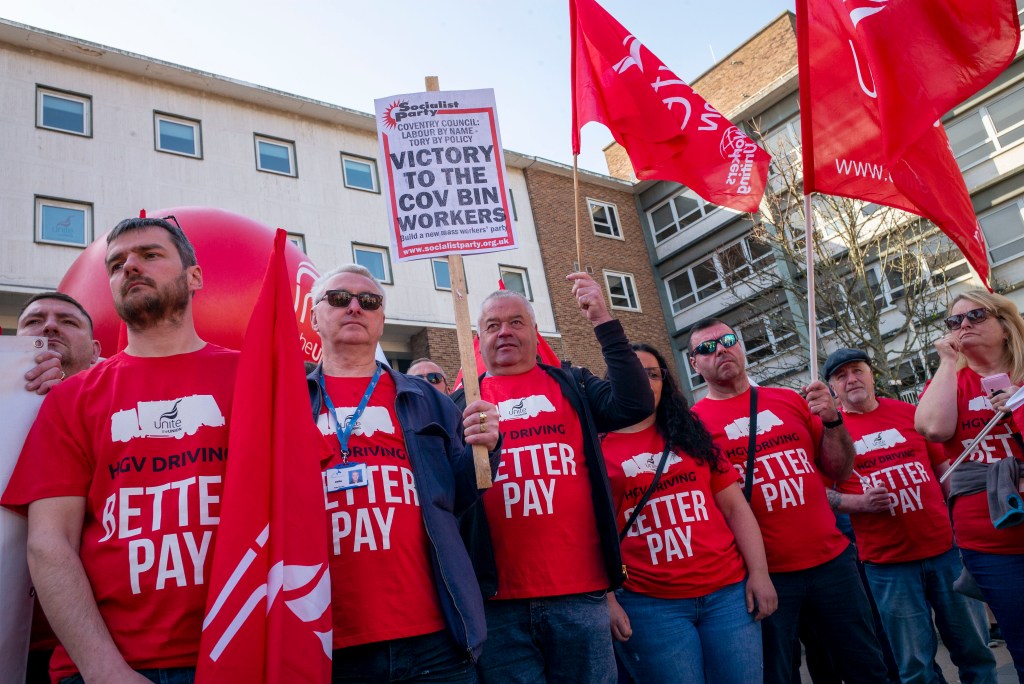
As well as nationally, there has been the spreading like wildfire of local industrial disputes – including bin workers in Coventry who won a 12.9% pay rise in a six-months-long dispute against the Labour-led council who sub contracted agency workers and spent over £3 million in an attempt to break the strike.
It hasn’t only been within traditionally unionised sectors that industrial action has taken place. Strikes and action in the hospitality industry – an industry overwhelmingly made up of younger workers and students – by the Bakers Food and Allied Workers Union and Unite have taken on unfair tipping policies in Pizza Express and TGI Fridays, and strikes at just two Wetherspoon’s pubs in Brighton led to a nation-wide pay increase for Wetherspoon’s night workers.
This includes workers in the very heart of big business greed, when Amazon warehouse workers took spontaneous wildcat strike action when news reached them that they were being offered a 35 pence an hour pay increase the same day inflation hit 13%!
Overnight the strike wave lifted the mood and confidence of millions that a fightback against the Tories and their agenda of inflation austerity is possible. The general secretary of the RMT Mick Lynch has become a new popular symbol of resistance to the Tories on the bosses, not only speaking out in the media against low pay but the effects of years of capitalist driven austerity and the spiralling of massive levels of inequality in society.Google searches meanwhile for ‘join a union’ increased by 200% in the days after the railway strikes.
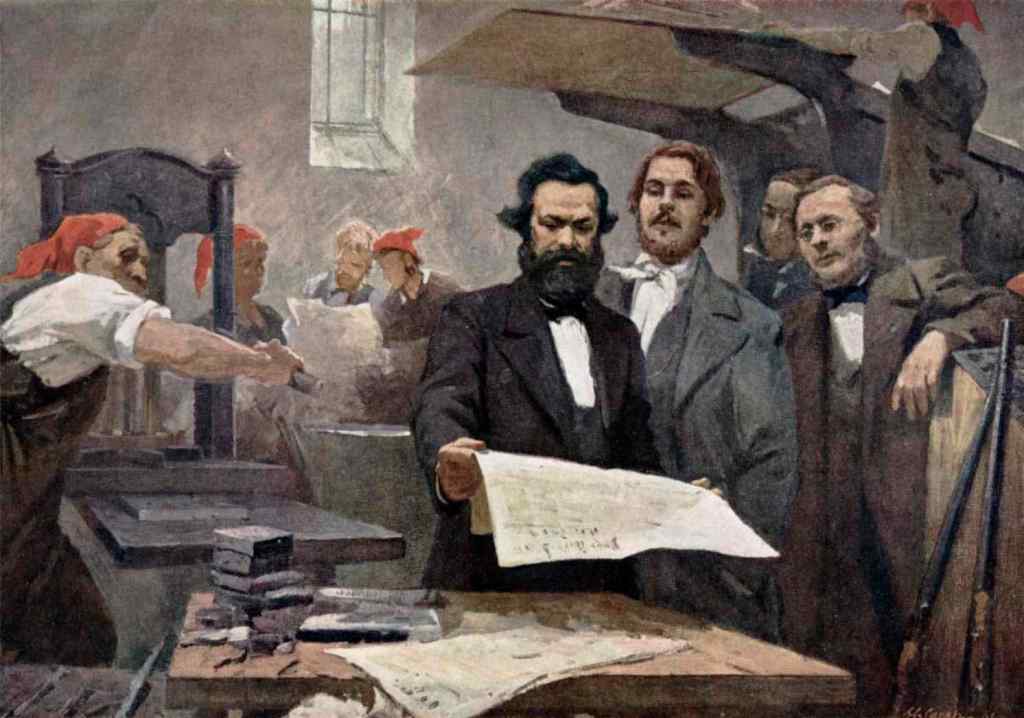
But there isn’t anything magical about strike action or why the effects of strike action are so powerful. It’s to do, as Karl Marx and Friedrich Engels explained, with the unique position the working class occupies within capitalist society.
It’s working class people who are integral to the day to day functioning of society. From the production of goods – from essentials such as food and medicine, to other goods – to the distribution of those goods and services, it’s the working class that runs society day to day. If all the bosses of the railways, Royal Mail, BT etc decided amongst themselves not to turn up to work one day, very few people would notice – but when workers within these industries collectively withdraw their labour, people take notice!
This is what provides the working class with the collective strength to not only bring single workplaces to a halt, but when organised and coordinated, entire society to a halt as well. By collectively withdrawing their labour, workers hit the big business bosses where it hurts the most – in their profits. Strike action is the most powerful tool working class people have at their disposal in the fight against the bosses and their political representatives, and for what we as the majority need.
No wonder then that the Tories are seeking to introduce even more legislation in attempt to curb the power of the trade unions. Against the backdrop of a massive crisis for world and British capitalism, the question posed is who in society is going to pay for this crisis? Will it be us, the working class majority – or them, the super-rich? Further attacks on the right to strike are the ruling class preparing for the massive class battles which are to come.
But if the working class is the most powerful force for change in society, what role then can students play in the growing strike wave and the struggle against the Tories, as well as the struggle to transform society itself?
On the basis of capitalism, a system totally incapable of offering any kind of decent future for young people, students and young people can be amongst some of the most energetic fighters against capitalism and austerity.
This has been the experience internationally in recent years, in countries such as Nigeria, Chile and Hong Kong. Most recently in Sri Lanka, where the combined forces of the workers and students have swept aside the corrupt Rajapaksa government (see pages 10 and 11), students protesting against government attacks on free education were some of the most prepared to confront the armed forces of the Sri Lankan state outside the presidential palace. A key task facing the leadership of the Sri Lankan student movement is to offer a programme capable of building further links with the broader Sri Lankan masses in the struggle to take the revolution forward.
Back in Britain, with the long term decline in the real terms value of student loans, growing numbers of university students are forced to enter part time work in order to make ends meet while studying? Socialist Students says that any students in work should join and get active in their workplace trade union.
Notwithstanding that, students do not carry the same social weight as the working class under capitalism – students are not central like the working class is to the day to day functioning of capitalist society. Separately from within the workplaces themselves, students cannot withdraw their labour in a strike like workers can.
But by getting organised, and crucially linking up with workers in struggle, students can be a powerful force in the struggle to transform society.
This begs the question however – how can students organise themselves to link up with workers in struggle, not only in the fight for above inflation pay rises, against austerity, but for what students need as well – including the fight for living grants for students and free education?
Socialist Students stands for the building of mass student organisations on the university campuses, capable of offering a forum within which students can democratically discuss the attacks we collectively face, and to debate out the ideas, programme and strategy necessary to fight for students’ rights. Such organisations could discuss with workers in struggle and trade union bodies about the steps necessary to build joint workers and students’ actions to fight against the Tories.
And by linking up nationally, a mighty national student movement could be built in the fight for free education, the cancellation of student debt, affordable housing for students and young people, living grants and decent jobs for all – and to take the wealth out of the hands of the 1%.
Socialist Students says:
No to price rises on campuses, early closure of libraries or other campus spaces and any more cuts to our education, courses or jobs. No delays in access to student hardship funds for students in need
For third party halls to be immediately taken into the ownership and control of the university, as a step towards introducing democratic rent controls for students. Councils should use their powers to compulsorily register landlords to force action on dilapidated and overpriced student housing
Replace student loans with living grants tied to the rate of inflation – cancel student debt, scrap fees, and make the super-rich pay
Link up with striking workers – build a movement to demand that the bosses are made to pay for the cost of living crisis
Students and workers unite to kick out the Tories and fight for socialist change. For democratic public ownership of the banks, monopolies and major industry to provide us with a future
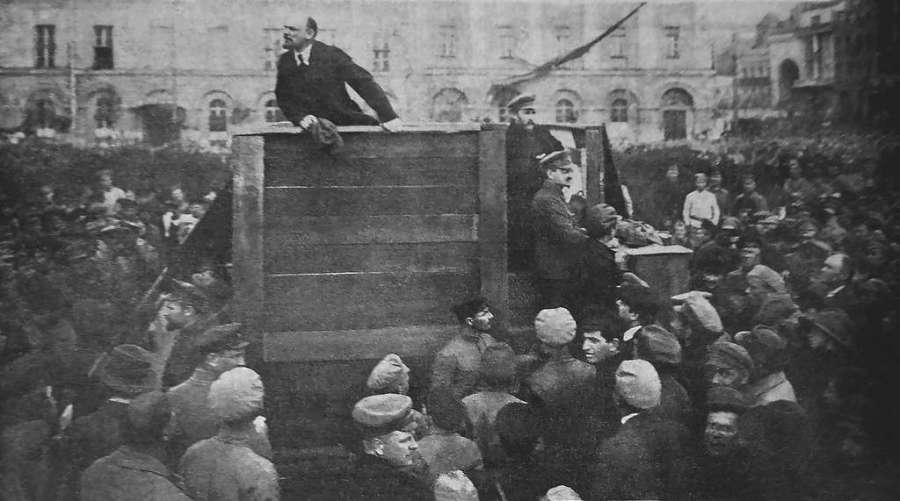
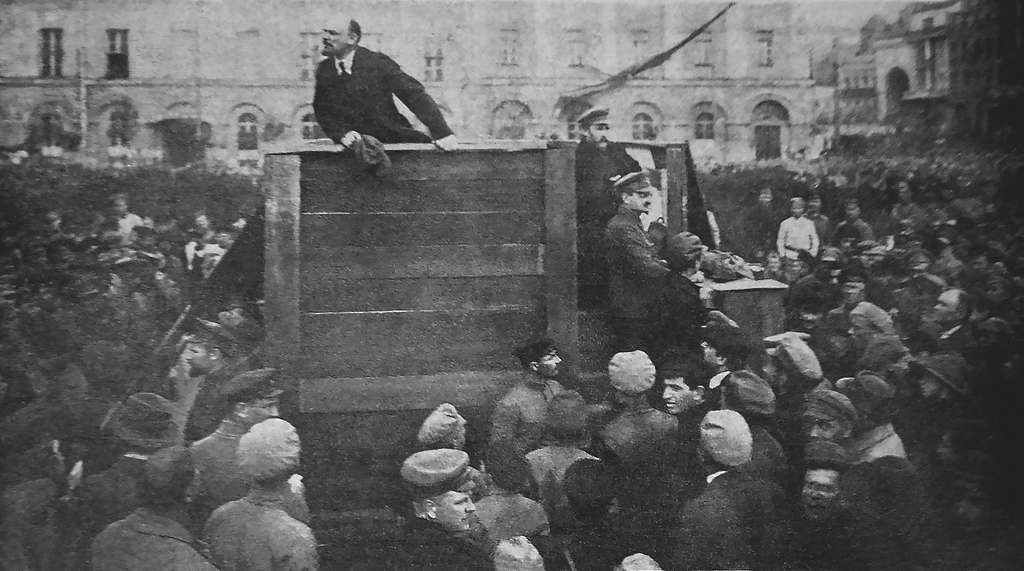
For socialists, the 1917 October Revolution in Russia remains one of the most important events in history. It was the first successful socialist revolution anywhere, overthrowing the pro-capitalist ‘Provisional Government’ to establish the first ever democratic workers’ state, in which Marxist revolutionary Vladimir Lenin played a central role until his death in 1924.
Lenin had led the October Revolution together with Leon Trotsky. It was Lenin’s revolutionary ideas – forged through years of debate, discussion and experience of struggle within socialist organisations – that gave him the authority and ability to co-lead the Russian working class to power in October 1917.
When Lenin wrote his famous April Theses just a few months earlier, he stood in a minority within the Bolshevik Party, which in turn was followed only by a minority of the Russian working class. But the revolutionary programme he put forward succeeded in winning over the worker Bolsheviks, who in turn had authority among tens of thousands of Russian workers, which moved the Bolshevik Party as a whole to quickly align itself to Lenin’s ideas. It was this combining of a revolutionary programme with a mass party of the working class that provided the decisive ‘subjective factor’ for socialist revolution in Russia.
Under the newly formed workers’ state, millions of workers were freed from capitalist exploitation, while peasants who had previously suffered at the hands of feudal landlords benefited from sweeping land redistribution. The death penalty was abolished, and national minorities were allowed the right to self-determination in place of the old Tsarist russification policy, which had aimed to create a homogeneous Russian culture. Furthermore, suffrage was extended to women, abortion was legalised, marital rape was outlawed, and homosexuality was decriminalised.
To this day, capitalist historians, academics, politicians and the press continue to portray Lenin as a dictator and repressor. And yet the reality is that, until his death, Lenin had played a key role in the most democratic form of government in history, formed from the soviets – councils of workers’, soldiers’ and peasants’ delegates – which had sprung up from the 1905 Russian Revolution.
Lenin believed in a higher form of democracy than capitalist ‘liberal parliamentarianism’, which Karl Marx famously characterised as a system that allowed “the oppressed […] once every few years to decide which particular representatives of the oppressing class are to represent and repress them”.
Instead, Lenin believed in worker’s democracy, which means workers discussing and democratically planning together how to run society so that the interests and needs of everyone can be met.
In practice, workers’ democracy meant putting all decision-making before a system of soviets at a local, regional and national level. Soviets had elections, with recallable delegates whose wages matched those of the workers they were representing, unlike many capitalist liberal democracies today.
Until his death, Lenin had played a key role in the most democratic form of government in history
Prior to the October Revolution, Lenin had built the Bolshevik Party, based on the principle of ‘democratic centralism’. This is the idea that, within an organisation, there is maximum debate and discussion until a decision is reached, at which point a united effort is made by the whole of the organisation to implement that decision.
There was a rich tradition of debate and disagreement within the Bolshevik party. But crucially, once a decision was made, the whole party got behind it and acted in unity. These methods of democratic centralism helped ensure that the Bolshevik Party could act in a decisive fashion when the time came to lead the Russian working class to victory.
So, given the democratic approach consistently prescribed by Lenin, why do capitalists and their representatives go to such lengths to portray Lenin as a dictator or tyrant?
In reality, such gross historical distortions are an attempt to discredit the ideas of genuine socialism, to dissuade workers and young people from socialist ideas by having them instinctively make a connection between Lenin and dictatorship.
It was only when Josef Stalin took power after Lenin’s death in 1924 that the Soviet Union took a turn towards dictatorship. Under Stalin the state apparatus was turned into what many typically think of when they hear about the Soviet Union: severe repression, purges, and the abolition of political rights.
Stalin’s counter-revolution did away with Lenin and Trotsky’s vision of mass democracy, along with expanded political rights and the institutions to protect them. Under Stalin, working people were once again barred from political participation, and the rights of national minorities that had been extended under Lenin were swiftly revoked. Contrast this to the stance taken by Lenin, who understood that the 1917 revolution could not take place with any element of suppression and extended the right of self-determination to all national groups who had been oppressed under Tsarism.
There was nothing inevitable about the development of Stalinism, which was a complete and conscious deviation from the workers’ revolution led by Lenin and Trotsky.
Trotsky explained that a socialist society cannot survive on a permanent basis surrounded by a world capitalist market, and fought for the revolution in Russia to spread to the working classes of the world, particularly in the more advanced capitalist countries like Germany.
Unfortunately, the revolution in Russia became isolated, producing the conditions for a bureaucratic clique around Stalin to take power – but only through a protracted period of bloody counter-revolution against those who opposed the bureaucracy and its disastrous policy of ‘socialism in one country’. These opponents most notably included Trotsky, who Stalin eventually had assassinated in Mexico in 1940.
Before his death, Lenin had warned against the growing influence of Stalin, even recommending in 1922 that the Bolshevik Party Congress “think about a way of removing Stalin [from his post as Secretary-General]”. This did not stop Stalin from falsely proclaiming that he was continuing the legacy of Lenin as leader of the Soviet Union, however. Illustrating the dishonesty in these claims, Lenin’s widow and fellow revolutionary, Nadezhda Krupskaya, famously stated in 1926 that if Lenin had lived, he would have been imprisoned by Stalin!
Stalin’s attempts to identify his brutal, undemocratic regime with the ideas of Lenin have been eagerly taken up by capitalist commentators looking to convince workers and youth of the infeasibility of a socialist world. Socialists today have to answer these distortions by “patiently explaining” what Lenin really stood for: a world where, on the basis of thorough debate, discussion and collaboration, things are democratically planned and the needs and interests of everyone are considered.
Lenin didn’t get everything right – for example, in 1901 Lenin was one-sided in asserting that the working class could only understand the need for socialism if it was explained to them by the revolutionary intelligentsia. Later, Lenin corrected this view. And it was Trotsky who realised earlier than Lenin the ideas of the ‘theory of permanent revolution’, in which Trotsky explained how the Russian working class would lead the peasantry to complete both the unfinished ‘bourgeois-democratic’ tasks of the capitalist revolution and the socialist revolution in one go.
Lenin admitted his mistakes and developed his ideas through collaboration and discussion. As we enter a new period of capitalist crisis today, it remains vitally important for socialists to be discussing and debating, as we work out our ideas and the next steps towards a socialist world. That’s why socialists need democratic, fighting organisations that allow us to prepare for the struggles ahead. If you are a student and a socialist, get involved in Socialist Students today.
Socialist Students says:
For living grants tied to the rate of inflation, not loans and debt. Cancel student debt – no to the lowering of the student debt repayment threshold!
No to rent increases or bill increases being passed onto students. For third party accommodation to be taken over by the university as a step towards the introduction of democratically set rent controls.
No to price rises on campuses and to course closures. Build a national student movement to fight for the full funding our campuses need and free education.
Solidarity with the strikes – students and workers unite!
Make the rich pay for the cost of living crisis. Bring the energy companies, the banks and monopolies into democratic public ownership to provide us with a future.
Universities UK – representing vice-chancellors – has called for student maintenance grants to be reintroduced to alleviate the cost-of-living crisis that we face. Our rent and bills are rising, but inadequate maintenance loans have failed to rise alongside this. Socialist Students says that maintenance grants are a solid alternative to higher loan repayments, and are fairer to working-class students.
VC pay
Where could the money come from? Are university vice-chancellors willing to part with their salaries, reaching above £250,000 a year, to aid the students who pay their wages? Not likely.
Socialist Students says take the wealth from the super-rich to not just fund student grants, but a 100% publicly owned education system. This would mean higher wages for staff, rent control, better university facilities, proper funding in subjects like the arts, and free tuition. No more punishing students from lower-income families with longer and harsher loan repayments, simply because they couldn’t afford to pay up front for an education.
NUS
How can students fight for this? Currently the only thing that the National Union of Students (NUS) is organising to demand action on the student cost-of-living crisis is a letter to the Tory education secretary. It doesn’t even call for maintenance grants! A letter to a Tory minister simply isn’t enough.
A mass movement of students, linking up with workers striking for a pay rise this autumn, like the University and College Union (UCU) balloting for action, can win maintenance grants that actually cover the cost of living. This is the movement Socialist Students is fighting to build.
Socialist Students says:
For living grants tied to the rate of inflation, not loans and debt. Cancel student debt – no to the lowering of the student debt repayment threshold!
No to rent increases or bill increases being passed onto students. For third party accommodation to be taken over by the university as a step towards the introduction of democratically set rent controls.
No to price rises on campuses and to course closures. Build a national student movement to fight for the full funding our campuses need and free education.
Solidarity with the strikes – students and workers unite!
Make the rich pay for the cost of living crisis. Bring the energy companies, the banks and monopolies into democratic public ownership to provide us with a future.













 Socialist Students