The wealthiest 1% hope to make social change seem like an impossible goal. But the various capitalist crises are taking their toll on young and working-class people in a way that cannot be ignored. This is why more and more young people consider themselves socialists.
This is why the Socialist Students conference is a great opportunity for anyone who wants to get involved, but doesn’t know where to start. It is an opportunity to link up with others to share and develop ideas.
It is very easy to feel politically isolated, that every effort made to fix the system is meaningless. By attending Socialist Students conference you get to see how a democratic organisation operates.
It is also a great opportunity to meet and socialise with other young socialists from up and down the country.
Socialist Students groups have a lot to prepare for.
As the Tories continue to splinter and break apart, Keir Starmer’s Labour looks set to run the country. This government will not be run in the interests of students. Starmer has shown himself to be no friend of the working class.
It’s imperative that we discuss how best to tackle capitalist policies, and defend our right to an education that doesn’t cause a mountain of debt once we’re finished.
Starmer’s Labour doesn’t just threaten students. His refusal to promise to scrap all the Tory anti-union laws means that workers will still find their rights under attack. Students and workers need to link our causes together.
The majority of Labour MPs voted with the Tories against a ceasefire in the brutal and relentless war on Gaza. Many MPs that did back a ceasefire, only did so because of the immense pressure felt by the continuous protests.
Rishi Sunak was also forced to sack ultra-right-wing home secretary Suella Braverman. This proves our actions have results. The next step forward is to discuss what we can do to put pressure on this government, with student walkouts and more.
Teachers can’t teach lessons properly because they are way too overworked and underpaid. Because there aren’t enough teachers, PhD students are heavily relied on, which drives the wages even lower.
Students enter higher education to experience what it is like to live like an adult for the first time, and to discover themselves. But they can’t even afford that. At 18 years old, they have to take a loan, almost equivalent to a downpayment for a house. It’s a predatory practice.
They then have to deal with accommodation. In the first year, you are lucky if you get a place that doesn’t smell of mould, or isn’t the size of a coat closet.
After that, you have to fight every year to get a basic room that won’t cost you your life savings. Almost all educational institutes in the UK give no support to students either, from meals or tutoring, that the teachers have to do off-hours. The system has beaten everyone. This is why students should be socialists.
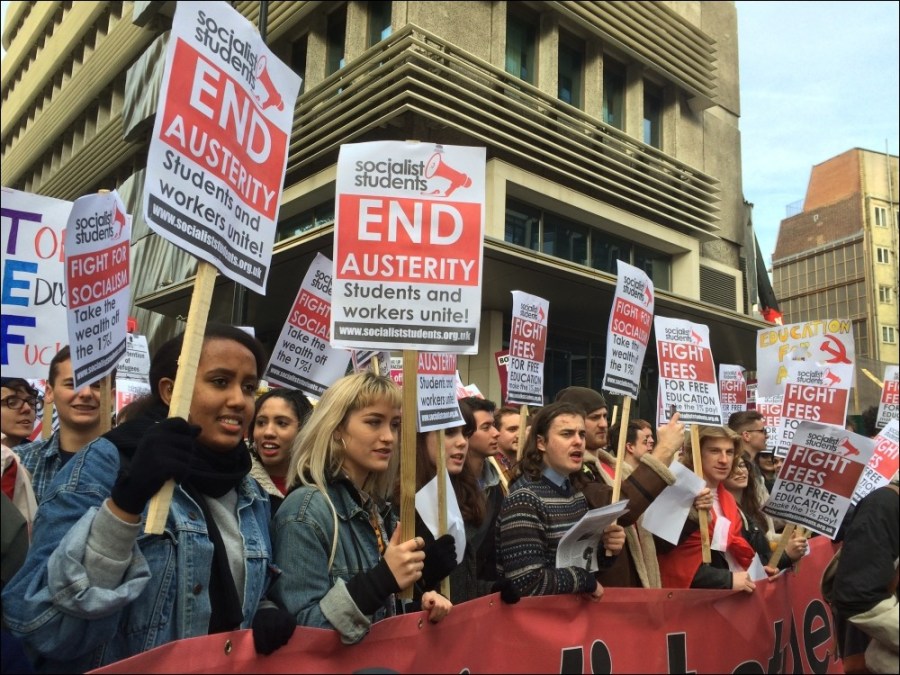
Socialist Students is calling for protests on Tuesday 7 November, the day of the King’s Speech in which the Tories will announce even more attacks on the working class and the futures of young people.
This year’s King’s Speech comes during the horrific war on Gaza in the Middle East. Hundreds of thousands of young people have been marching across the country and internationally to demand an end to the war and Israeli state terror. Socialist Students has been campaigning on campuses, calling for a mass united working class struggle to stop the war on Gaza and to fight for socialist transformation in the region, and a new mass political voice in Britain that stands for socialism and internationalism.
So join Socialist Students on a university campus or college near you to protest the King’s Speech, to kick out the Tories and fight for socialist change to end war and oppression. For information about a local protest, get in touch using the details below!
DEMONSTRATION: STUDENTS AT UNIVERSITY OF WEST SCOTLAND FIGHT THE COST-OF-LIVING CRISIS
TUESDAY 9TH MAY
ASSEMBLE FRONT OF CAMPUS HIGH ST 1PM
March to library Hub
ALL STUDENTS AND STAFF WELCOME
We say:
For emergency cost of living grants available for all students who need them. Replace student loans with living grants, rising with the rate of inflation. Scrap all Student debt
For subsidised university canteen meals for students struggling to feed themselves.
No early closures of campus spaces due to the energy cost crisis. For heated and safely staffed campus spaces available 24/7 to students and staff who need them.
Take third-party student halls under the control of our universities, as a step towards introducing democratic rent controls.
No more cuts to our education! Back the trade union strikers.
Campaign and fight for the funding our universities need from central government – fight for free education and make the super-rich pay for it! Fight for socialist change!
No to all tuition fees, for free fully funded education for all students including international, ROUK and Erasmus.
For properly funded support services including for mental health and victim support services, non-exploitative housing, and clear and democratic reporting procedures for abuse and harassment. A trade union and student-led inquiry into the true extent of sexual harassment and violence on UK campuses, as well as in schools and colleges. Democratic oversight of sexual harassment reporting procedures by joint trade union and student led committees.
No to cuts in NHS services. For above inflation pay rises for all NHS staff and the funding our health service needs.
For a minimum wage of £15 an hour on campus with no exemption.
Contact UWS Socialist Students – text/ring organiser Daniel on 07926495431
Students in 2023 are facing more cost of living crisis misery. Figures published by the ONS found that 91% of students at the end of last year were worried about living costs.
Rising costs aren’t only causing us stress and worry however – they’re having a direct effect on our ability to study. 29% of students reported they were skipping non-mandatory lectures or tutorials in order to save money, while around the same figure said they were choosing to study from home and attend lectures remotely.
Thousands of students have been forced to take on new debts just to get by – an indictment of the disgracefully low amount of financial support students have access to through student loans.
Under pressure from students, universities have been forced in some areas to commit extra funding to student hardship funds, and to pay small emergency energy grants to students living off campus, like at York University. The battle for genuine cost of living grants for all students, linked to the building of a movement which fights for the funding our universities need from central government, will be a key task for students who want to fight back against the cost of living crisis this term.
Despite the brief escape home many students will have enjoyed over the Christmas holidays, all of the worry and anger students felt last term will start anew in 2023. There is potential for this anger to be channelled into an organised fightback against the cost of living crisis and the marketisation of our universities.
In the fifth richest society on the planet, where the super-rich billionaires have increased their wealth by 1000% over the last three decades, the resources are there to scrap tuition fees and loans, and to replace them with living grants which are tied to the rate of inflation to provide every student with a high quality education. However those resources are in the hands of the bosses, put to work increasing their wealth instead of under the democratic control of workers and students for what we need.
Socialist Students is meeting this year on Saturday 18th March in Birmingham for its national conference. This conference will be open to any students and student societies who want to work to build a movement to say we will not be made to pay for the cost of living crisis. It will be a key event in the fight for cost of living grants, to end all cuts on campus and for free education.
Socialist Students campaigning on the student cost of living crisis at Birmingham University
Theo Sharieff, Socialist Students national organiser
The cost-of-living crisis is set to hit students incredibly hard this term. Inflation is effecting all the basic necessities of everyday living, with food, energy bills, and rent all on the increase.
Pay for the bosses of the top FTSE 100 companies jumped up by 39% in 2021, but wages for the majority of us stagnated as we face the biggest cost-of-living squeeze since the 1950s.
Students will not be isolated from this. With inflation now running well into double digits, the maintenance loan increase of just 2.3% will leave thousands of students facing hardship and crisis this term.
Even during the summer, one-in-three students were left with £50 a month to live on after paying rent and bills – to cover food, travel, and all the educational resources students are made to buy at the start of term, including textbooks. 11% of students use food banks, up from 5% at the start of the year.
As the cost-of-living crisis continues to bite, against the background of looming recession, the prospect of students running out of money altogether midway through term and going hungry is a very real. The average student maintenance loan falls £439 short, every month. The gap was £340 last year.
Student housing failure
Before even paying the first month’s rent, however, students will have already encountered the myriad of failures in student housing. With shortages, students at numerous universities have been forced to take accommodation in different cities, after being promised a place would be available for them. Some universities have outrageously written to students to request that they defer their studies for a year.
Even for students who have somewhere to live, there are extortionate rent rises and dodgy landlords offloading bill increases onto their shoulders. Socialist Students says that third-party student accommodation providers should immediately be taken into ownership and control of the universities, as a step towards introducing rent control, decided on by democratically elected committees involving students.
After years of cuts, universities can’t provide basics
All of these issues are a continuation of what students experienced during the Covid pandemic. Then university managements found themselves unable to provide the very basic necessities for students – including spaces to sit in lecture theatres – after years of doing the bidding of successive Tory and Labour governments in overseeing various cuts and failing to invest properly in our education.
Last year, the Tories announced cuts to funding for arts and humanities courses. This was the latest in a string of moves towards running the sector on a capitalist market model, starting with the introduction of tuition fees by Tony Blair’s Labour government in 1998.
Workers are striking back
Despite the myriad of attacks we are facing, the new Liz Truss government is not strong. With the backing of just a third of her own MPs in the Tory leadership race, a record breaking low, Truss faces a perfect storm of challenges – the cost-of-living crisis, incoming economic recession and above all else, the challenge thrown down by workers taking strike action to fight back against her government’s agenda of inflation austerity.
Socialist Students stands in solidarity with unions representing university workers, like the University and College Union (UCU), who are balloting for strike action to fight back against further attacks to courses, jobs, wages and working conditions. Uni support staff in Unison union are also striking over an insulting pay offer.
This presents a massive opportunity for students to go on the offensive at the same time, and launch a struggle for what we need. Socialist Students demands that university managements pledge to make readily available access to student hardship funds, ensure no price increases on campus canteens and restaurants, keep university spaces such as 24-hour libraries open, do not limit campus lighting or heating, and make no more cuts to jobs or courses.
Representing university management, vice-chancellors have been resolute in carrying through vicious attacks to university workers’ wages and conditions, and overseeing the marketisation of higher education. Now even UUK – the body bringing together vice-chancellors – has called for the replacing of maintenance loans with grants, revealing the extent of the crisis.
What UUK doesn’t address is how replacing loans with grants could be won. Socialist Students says that building a mass national student movement, and linking up with workers struggling against attacks to their living standards, could force the Tories to concede.
The money exists in Britain – the fifth richest country on the planet – to fund universities properly, and to provide students with living grants, to cancel all student debt and scrap tuition fees.
Just look at the £170 billion Truss has borrowed to subsidise the profits of the major energy companies. This measure, however, hasn’t stopped energy bills doubling on average.
It would have cost a fraction of £170 billion to take the energy companies into democratic public ownership with compensation paid to the shareholders only on the basis of proven need, and not to the fat cats. On that basis – running production and distribution of energy on the basis of need instead of profit – our bills could be slashed.
The strike wave has demonstrated to millions of students and young people the potential power of the working class when organised. Many students watching the strike wave could draw confidence from the fightback being waged by workers against the cost of living squeeze to launch a fightback of their own.
The industrial fightback is still only in its early stages. The coming weeks could see many more workers joining the strike wave, with civil servants, teachers, lecturers, healthcare and council workers all being balloted currently. Rail, Royal Mail, BT and dock workers are already on strike.
Students need to get organised
But in order to fully capitalise on these opportunities students need to get organised ourselves. This means building democratic and open student organisations which could provide a mass forum for students to discuss and debate. Discussions could involve trade unions and workers to draw up a list of demands, outline what funding is needed during the current crisis, and launch a campaign to win back that money from central government.
Student organisations could link up nationally to rebuild a movement to fight for free education. And together with workers on strike, we can build a united struggle for our demands, in addition to the battle against the cost-of-living squeeze.
The absence of student organisations, however, will not prevent struggles among students breaking out, over the cost-of-living crisis, and other stark failures of the capitalist system to deliver for young people. Just look in recent years at the explosions of anger around Black Lives Matter, the climate, and sexual harassment and violence on the campuses.
During the pandemic, thousands of students at the University of Manchester marched and protested over the issue of the university’s handling of Covid. They succeeded in removing metal fences put up around student accommodation.
We need a new party
But what mass political force exists which would fight for students and young people? Keir Starmer has: “Wiped the slate clean” of Jeremy Corbyn’s pledges at the 2017 and 2019 general elections – which included the pledge to scrap tuition fees.
That’s why Socialist Students says students and young people need a new political party. A party which would be able to raise the struggle for free education in parliament, and raise demands for the rights of students, young people, and workers in the council chamber as well. This could include licensing powers councils have to register landlords and force them to take action on the rundown and unsafe living conditions many second and third-year students face.
Young people’s experience of capitalism – poverty, crisis and austerity – has led many to search for a socialist alternative to what is happening. Join Socialist Students to help build a movement against the student cost-of-living crisis, for free education, to campaign on campuses, and fight for socialism.
The US Supreme Court’s decision to overturn the ruling on Roe v Wade, which recognised a constitutional right to abortion, has been met with protests across America and across the world. Echo Malkin from Cardiff Socialist Students spoke to Christine Thomas, author of ‘It Doesn’t Have to Be Like This: Women and the Struggle for Socialism’, about the way forward in the struggle for reproductive rights in the US and globally.
What are the immediate effects of the overturning of Roe v Wade in the US?
This is the biggest attack on women’s rights in the US for 50 years. Already one-third of women are living in states where abortion is banned, and that is set to spread, with up to 40 million women eventually affected. Because they don’t have the money to travel to states where abortion is still legal, it will be the poorest, working-class and minority ethnic women who will suffer the most. There have already been horror stories, like that of the ten-year-old rape victim who was denied an abortion in her home state. Unfortunately, those horrors are likely to get worse unless a movement is built to re-establish the right to abortion for all those who want one throughout the US.
In your article for Socialism Today you highlighted the surrounding social unrest of the period that led to the original ruling of Roe v Wade. Our current social climate is full of unrest from the Black Lives Matter movement, as well as the Me Too and Times Up movement, to the increasingly urgent climate crisis as well as human rights crises like the overturning of Roe v Wade taking place in Poland and 23 other countries. Do you believe this social unrest will help the restoration of reproductive rights as it was able to in the 70s? How could such a movement be built?
There are obviously things that need to be done immediately to help women access abortions, and this is happening now. Women’s organisations are fundraising to help women travel to ‘sanctuary’ states, offering accommodation to those seeking an abortion, and providing access to abortion pills. This kind of mutual aid is vital, but it needs to go hand-in-hand with building a mass movement, with roots in the workplaces, universities, colleges, schools and local communities. That is how the right to abortion was won in the first place – through grassroots organising by women’s organisations at a time when US society was in ferment. As well as the women’s movement there was the movement for civil rights and black liberation, the mass protests against the war in Vietnam and strikes of workers. This was the backdrop which forced the Supreme Court, with a right-wing majority, and under the Republican anti-abortion president Richard Nixon, to grant a constitutional right to abortion.
The current attacks on abortion rights are taking place at a time when the living standards of ordinary Americans are also facing an onslaught from the cost-of-living crisis. What’s more, over two-thirds of Americans think that abortion should be legal. If the movement for abortion rights was to link up with workers in the workplaces and trade unions fighting for higher wages and better working conditions, with Black Lives Matter and those fighting to save the environment, a formidable movement could be built. But for that to happen, the campaign for the ‘right to choose’ needs to be broadened from just fighting for the legal right to abortion to incorporating wider demands, including universal free health care, and easy access to abortion and health and reproduction clinics. Even before the US Supreme Court overturned Roe v Wade, thousands of poor women were denied an abortion because of the high costs or because there was no clinic in the area where they lived. Winning the legal right to abortion on its own is not sufficient if those who need an abortion don’t have the material means to exercise that right.
Also, ‘the right to choose’ is much more than the right to abortion. It means the right to access safe, reliable contraception, inclusive and non-judgemental sex education in schools, and the right to have children and bring them up free from poverty. By campaigning for jobs for all on a wage we can live on, free, quality, universal childcare, paid maternity, paternity and parental leave, decent social housing, etc. the link between the movement to defend and extend abortion rights could be forged with workplace struggles and other social movements, building a movement that could win.
Your article speaks of the importance of international solidarity in regard to reproductive rights. There have been a number of counter-protests of the overturning of Roe v Wade, not just in America but also in Australia, Mexico and Argentina, the last two being locations where many Americans have gone seeking abortions. Could you expand on the importance of international solidarity in a time such as this, when people’s reproductive rights are being threatened worldwide?
In the US the anti-abortionists started organising as soon as Roe v Wade was passed in 1973. They talk about the ‘right to life’ but for many right-wing conservatives it’s really about promoting traditional gender roles and the ‘sanctity of the family’. So they are opposed to contraception, LGBTQ+ rights and feminism. The anti-abortionists targeted the Republican party, and the Republicans have increasingly relied on the religious and anti-abortion right to mobilise the vote for them in elections. Trump’s nomination of anti-abortion justices to the Supreme Court was his reward for that electoral support. But they won’t be satisfied with overturning Roe. They want abortion to be illegal in every state. And they will also be pushing for further attacks on women’s rights and LGBTQ+ rights.
Unfortunately, the Democrats have consistently failed to legislate to defend and extend abortion rights. As a party of the big corporations they will resist any of the meaningful reforms that would be necessary for the real right to choose. The workers’ and social movements need their own party that will fight for their interests, not those of big business and the super-rich.
Internationally the situation is very contradictory. There have been big movements for the right to abortion in a number of countries, and victories have been won – in Ireland, in Argentina, Colombia, Uruguay etc. Since the 2008 financial crisis women have been taking to the streets in their tens of thousands to protest against gender violence, sexual harassment, sexism and denial of reproductive rights. Anger at gender and economic inequality has fused to create a combustible situation. But at the same time, the global economic crisis of capitalism has led to right-wing populists coming to power, in the US, Brazil, Poland etc, who have tried to win a social base by stoking anti-feminism, homophobia and transphobia. Even where those ideas are only supported by a minority in society they have been able to win elections, especially where there has been no viable alternative put forward by the left.
That’s why fighting to build a political alternative is so important, not just in the US but here in Britain and elsewhere. The US attack on the right to abortion has shown how, with capitalism in crisis, gains that have been won can be stripped away again. The movements for women’s rights, workers’ rights, LGBTQ+ rights, against racism and environmental destruction need their own political party, based on the economic power of the trade unions, which we have seen displayed in Britain over the past few months, and which fights for a socialist alternative to the inequality, oppression and destruction of the capitalist profit system.
University of Bristol students marching against cuts on campus last year
The management of the universities of Wolverhampton, Roehampton and De Montfort have unleashed a savage row of cuts to their programmes and their staff. Wolverhampton has stopped taking applicants for 138 distinct courses, mainly in Arts and Humanities (including its high-ranking fashion course), Roehampton is planning to lay off up to 226 academics after cutting many of its humanities courses, and De Montfort has announced the redundancy of 58 of its staff.
In a period when the cost-of-living crisis is making living in this country impossible for many, university staff are now seeing themselves made redundant and without an income. Socialist Students vehemently condemns these cuts and extends its solidarity to all students and staff affected by them.
These savage cuts have been approved by managements who see their institutions not as places of learning, but increasingly as businesses. Their attention is in massive infrastructure projects and business partnerships rather than the teaching and research that happens in their university. In their blind pursuit of “competitiveness” and “optimisation”, they are willing to cut even their best staff and their better programmes if they do not conform to the neo-liberal capitalist vision of society.
But these cuts are also a consequence of the unsustainable financial model of universities in this country. The lack of direct government funding encourages management to extort as much from students as possible in tuition fees, landing them in a lifetime of student debt. Because national tuition fees are not enough to compensate for the lack of funding, they rely heavily on international student fees, and a slight reduction of these students can make their whole financial model crumble, just as we saw during the COVID pandemic.
Another strategy deployed by universities is to pack as many students as possible into their courses to draw as much income as possible from them. Therefore, when a programme – no matter how prestigious or well-regarded – fails to attract corporate investment or is considered to not have enough students, it gets mercilessly cut, making the university all the more academically poorer.
As long as universities rely on a model of unrepayable student debt and class-packing, there will be more cuts and slashes to faculties, more laying off of staff, and a dramatic worsening of the quality of teaching and research. This is why Socialist Students campaigns for universities to be publicly funded by taking the wealth out the hands of the super-rich, for the scrapping of tuition fees and the introduction of living grants for students, open publication of the financial ledgers of the universities, and for the democratic control of universities by workers, trade unions and democratically elected student representatives.
The programme and staff cuts in Wolverhampton, Roehampton and De Montfort have clearly targeted humanities and arts courses. The reason for such a focus is that university bosses in their words want to focus on “developing programmes with practical skills and industry/employer engagements” – i.e., for meeting the needs of big business!
As well as fighting for free education, Socialist Students fights for decent jobs for all – including access to adult education, an end to bogus apprenticeship schemes combined with a guarantee of a job at the end of it, and the possibility of combining training for a trade and formal education.
We also say that the study of arts and humanities must not become the preserve of a small elite. Socialist Students fights for an education system run for the benefit of students, workers and wider society as a whole, not in the interests of the bosses and the super-rich.
This means struggling for a socialist alternative to the chaos of the system of capitalism. This includes the building of a mass movement of students and workers to fight for democratic workers’ control of society’s massive wealth and resources to ensure that everyone can study what they are interested in – not what is meted out to us by the Tories and the bosses.
We say – no to class divisions in university programmes! No to cuts in teaching and research! For free, high-quality and publicly funded education! Students need to organise and fight to ensure that what is transpiring at the universities of Wolverhampton, Roehampton and De Montfort cannot happen again.
Socialist Students national conference – our first in person since the start of the Covid pandemic – was full of enthusiasm for building a fightback on campuses. Socialist Students national organiser Theo Sharieff opened the meeting.
Students face a degraded future. But anger has grown as the pandemic has exacerbated the broken system created by the continued marketisation of higher education.
Staff have taken sustained strike action and students have fought back – becoming a powerful voice against university bosses and the rotten capitalist system. The student fightback has taken place through rent strikes, protests against A-level results, and against ongoing violence against women on campuses and in society.
But our student voice has not been amplified at a national level. A key question at conference was ‘where is the National Union of Students (NUS)?’
The NUS has been mostly absent from the struggle. Local student unions and student groups have been left to fight alone.
Socialist Students has been vital in combating this isolation. We have been fighting alongside rent strikers, at protests, and have mobilised students in organised action – notably on 21 April 2021 at 24 campus protests calling for fee and rent refunds. But we cannot build the student fightback alone.
Strike
Prior to our meeting, the NUS had called a ‘national student strike’ for 2 March, timed with the last day of strike action by the University and College Union (UCU). The small turnout to the demo, which looked likely at the time of the conference, has nothing to do with the lack of appetite on the part of students for struggle, but is down the failure of the NUS leadership to mobilise effectively.
Socialist Students conference discussed and agreed that 2 March should be the beginning of reflecting on what the student movement needs next in the struggle for free education. Socialist Students calls on the NUS to set a date for a national meeting that brings together all organisations – student groups like Socialist Students, student unions, and campus workers’ trade unions – to discuss the next steps in the fight. Socialist Students will continue to play a key role in this process.
Also at Socialist Students conference, motions on fighting sexual harassment and violence on campus and defending the right to protest were also discussed out democratically and voted on.
The day ended with an energetic rally that reinforced the need for youth and student organisation, in workplaces and on campuses, and for socialism, here and internationally.
The conference took place in Birmingham, and Socialist Party member Dave Nellist – Trade Unionist and Socialist Coalition (TUSC) candidate standing in the Erdington by-election – also spoke. He set out the need for a new political voice for students and young workers.
Socialist Students conference took place only a few days after the Tory government announced its plans to make it harder for working-class students to reach higher education. The Tories’ proposed changes in England include a 40-year tuition fee repayment scheme and a grade threshold to qualify for student finance loans in the first place.
A 40-year repayment scheme benefits the rich, and will enormously impact graduates who earn less. On top of this, young workers have also been hit most by recent increases to national insurance. Instead of making the rich pay, young workers pay almost 50% of their income in taxes. A fight against the capitalist chaos that rules our society, and our education system, must take place. Building Socialist Students is a first step towards this.
The financial screws are tightening on students. The government is freezing the threshold when students start to repay their loans, as opposed to raising it in line with inflation, meaning they will have to pay more.
I have been an avid Socialist Students member since I joined – visiting and supporting strikes both on campus and outside of uni. Socialist Students conference, 26 February, is our chance to participate in the fight back against the unfair marketisation of universities, campaign for free, democratised and good quality higher education, and help organise the 2 March student walkout called by the National Union of Students (NUS).
Inflation is reducing the value of student loans, meaning that the government is unfairly taking £2.3 billion from students. The parental earnings threshold has been frozen at £25,000, when it should have risen to £34,000, so fewer students are receiving what they deserve in maintenance loans. On top of all this, maintenance loans are set to increase by 2.3%, which is below inflation, meaning another real-terms pay cut for students.
We can build a socialist fightback and end the conditions that we have had to endure from both Tory and Labour governments. Under Jeremy Corbyn, students got a glimmer of hope of what a fair and proper education system could look like. But Labour has returned to its Tory-lite policies under Keir Starmer.
The Socialist Students conference has moved to Birmingham. So we’ll also get a chance to campaign for Dave Nellist in the Birmingham Erdington by-election. Socialist Party member Dave Nellist is the Trade Unionist and Socialist Coalition (TUSC) candidate – standing to be a workers’ MP on a worker’s wage (see pages 8-9).
Theo Sharieff, Socialist Students national organiser
Students need a fightback! After nearly two years of Covid, the effect of Tory and New Labour marketisation of our university campuses has been laid bare. In September 2020, students were lied to about in person teaching and then locked down on campuses across the country just so university management could keep our rent and tuition fee payments. This came on top of years of cuts to jobs, wages and conditions, and courses on campus, meaning a slow decline of the quality of education students receive while paying £9,250 a year fees.
Last year saw students organising rent strikes across the country, succeeding in winning millions of pounds in rent refunds. Far from just being a fight for compensation for the disruption to campuses caused by Covid, for many students the rents strikes were a first step towards fighting against marketisation, cuts on campuses, fees and student debt. It was during this time when the rent strike movement was in full swing that Socialist Students organised campus protests to demand tuition fee and rent refunds for students, funded by the government as the first step towards the complete scrapping of tuition fees.
Since then there have been further developments on campuses. The UCU took three days of strike action last term over attacks to staff pay and pensions, and is continuing with action short of strike this term with more possible strikes to come. And students have been protesting against the failures of management to effectively tackle the pandemic of sexual harassment and assault on campuses.
All of these events combined have been mounting pressure on the leaders of the NUS to act. The National Union of Students has launched its campaign for a ‘student strike for education’, calling for a national student demonstration in London on March 2nd. The NUS is demanding among other things “higher and further education to be funded by governments – free at the point of use for students – with proper pay, pensions and conditions for staff across education and beyond”.
Albeit a whole year after the campus rent strike movement developed, that the NUS has finally called for a national demonstration to stop these attacks is a welcome step. Given the depth of the crisis facing students, March 2nd could find a significant response from students looking to fight for free education.
However, guaranteeing the best possible turnout for such a demonstration will take a fighting campaign on the ground on campuses to link the day to day attacks on students and staff to the need for free education. This should include a campaign by Students’ Unions around the country to mobilise students, including the funding and organising of transport to London for students and staff.
This demonstration has been called at a time when rumours are swirling that the government are considering lowering the student debt repayment threshold, threatening to trap particularly working class students in a lifetimes worth of debt repayments. This is a prime opportunity for the NUS to put forward the cancellation of student debt, the replacement of loans with grants, as well as the scrapping of tuition fees, all funded by taking the wealth out of the hands of the super-rich.
Socialist Students is going to be organising local campus protests as part of the campaign to mobilise students for March 2nd, and will be demanding that Students’ Unions organise coaches for students to London. March 2nd could be a significant step in building the fightback against marketisation of the universities and for free education. Socialist Students is holding its annual conference Saturday 26th February in London to discuss how to rebuild the student movement and what next after March 2nd – visit socialiststudents.org.uk/sign-up-for-updates-about-socialist-students-2022-conference to sign up for updates about the conference.














 Socialist Students