From the dismantling of Roe v Wade in the US, which saw the removal of abortion rights from millions of women, to the mass movement in Iran following the murder of Mahsa Amini by the ‘morality police’, a movement which could have brought down the corrupt government. There are many examples of attacks on women and women’s rights being met with protests and resistance.
Here in Britain, when a woman was jailed for taking abortion pills after the legal limit, the anger was palpable. The woman was then released on appeal. This shows that the establishment fears a new generation of women beginning to fight for their rights.
FIGHTING TORY AUSTERITY
Today working-class people across the country are struggling from the cost-of-living crisis, from low pay and growing debt. This includes millions of women who are more likely to have childcare responsibilities and be in low-paid or precarious work. For students, even the highest level of student loans won’t cover the average rents. So how exactly are we supposed to make ends meet?
Tory austerity has seen the gap between the richest and the poorest in society grow. At the same time they have whipped up division as political cover for their disastrous policies. Back in 2011 when they trebled tuition fees to £9k, the Tory universities minister said that women were to blame for working-class men not being able to attend university!
Yet actually it has been Tory policies that has put a decent education out of the grasp of millions. We are crammed into overcrowded campuses; our staff are run ragged and there is little to no extra support. This is the real impact of Tory cuts in education.
University management can’t be trusted. Students and university workers need democratic oversight over all policies relating to sexual misconduct and violence to ensure they are fit for purpose and properly enforced. This would also show that sexism and violence will be properly dealt with and help challenge attitudes on campus.
A STARMER GOVERNMENT
There has to be a general election called this year, which Labour leader Keir Starmer is likely to ‘win’. We say ‘win’ because while he will most likely be the next prime minister, this doesn’t mean that working-class, young people or students have any faith that a Starmer-led government will stand up for us.
In fact, growing layers of big business are moving from supporting the Tories to supporting Starmer’s Labour because they think a Starmer government will help them grow their profits with low taxes and privatisation.
But no government can serve the interests of the rich and big business while also supporting working-class, young people and poor students, so a Starmer government will continue to attack the living standards of ordinary people in this country and internationally. That’s why we need our own independent voice, a new mass political party, which actually represents the interests of workers, young people and students.
FIGHTING SEXISM
Starmer’s government will offer no route to genuinely challenge sexism or the falling living standards of millions of people, mainly women. He says his government will “halve violence against women and girls”. But this is an empty pledge for a government which is sidling up to big business. The best way to fight for the movement needed to challenge capitalism is by getting organised on campus, including around a programme to improve students’ conditions and oppose sexual harassment.
We call for proper street lighting as well as free public transport so that students can go out and get home safely. There are far too many examples of university managements putting their interests before students, who have reported incidents of sexual harassment. We say they can’t be trusted to oversee this process. Instead, students and university workers need democratic oversight over all polices relating to sexual misconduct and violence to ensure they are fit for purpose and properly enforced. This would also show that sexism and violence will be properly dealt with and help challenge attitudes on campus.
But fighting these ideas on campus is not enough. They are perpetuated across society by institutions, corporations, and the capitalism system. To seriously challenge sexist ideas would mean building a movement against the capitalism system which is fundamentally unequal. Capitalism is underpinned by sexism, oppression and exploitation.
Therefore, we have to build a movement that can fight to take the wealth and power out of the hands of the rich and the elites. It will only be under a democratic socialist plan of production that the material basis for sexism can be removed and all of the ideas and attitudes that go with it can be properly challenged.
Read our article on The Origins of Women’s Oppression and How to Fight it ←
Despite the numerous advances in women’s rights that have been won through mass struggle over past decades, many on International Women’s Day in 2024 will be questioning why the basic problems that women face – lower pay, greater risk of violence, objectification in the media, to name a few – still continue to exist today.
To understand how we can end the oppression of women it is necessary to first analyse where it comes from and the conditions that led to its creation in order to understand what conditions are needed to remove it.
We republish here an article written by Christine Thomas (author of ‘It Doesn’t Have to be Like This: Women and the Struggle for Socialism’) on the contribution of Friedrich Engels, one of the founding figures of Marxism, to analysing women’s oppression, its evolution over time, and how it can ultimately be abolished.
The ‘Origin of the Family, Private Property and the State’, published in 1884, was Engels’ main contribution to the issue of women’s oppression. It showed that women’s second-class status in society, the inequality, discrimination and oppression we face, hasn’t always existed.
In the late 19th century this was explosive stuff. At the time, women’s inferior status was considered ‘natural’, explained by their biology or ‘God’s will’, and absolutely necessary for maintaining social stability. At the same time, the patriarchal family, with a male breadwinner and an economically dependent wife in the domestic sphere giving birth to and raising children, was a central, core institution of capitalism, and to challenge its universality was to challenge the entire fabric of society.
Of course, Engels’ book should be viewed in the context of the time in which it was written, and in conjunction with more up-to-date material. But the general ideas he outlined regarding women’s oppression are still relevant today, and still just as explosive.
He explained that gender inequality, discrimination and oppression are rooted in class society – in the emergence of societies where a small minority, an exploiting class, owns the means of producing wealth in society and exploits the class that actually produces the wealth.
Before that, in pre-class societies, people lived in communal, cooperative, egalitarian societies in which the main social unit wasn’t the nuclear family as we know it today, but a kinship group – that Engels called the ‘gens’ – which today are usually referred to as hunter-gatherer societies, based on how they made a living.
In these societies, in which humans lived for 99% of the time that we have been on the planet, there was no private ownership of the means of producing wealth, no classes and exploitation, no state apparatus and no systematic oppression of women.
Although Engels got some of the detail wrong, because of the scant anthropological and scientific evidence available at the time, the evidence that has come to light since backs up the general thrust of his ideas.
Pre-class societies
There was a gender division of labour in pre-class societies, although it was not necessarily a rigid one. In general, men were usually responsible for hunting and fishing, and women for gathering wild foodstuffs and looking after children. But this did not result in any economic or social disadvantage. The economic contributions of women and men were both vital for the maintenance of the group. Childcare was a public responsibility carried out on behalf of the group as a whole.
This was very different from the situation today. One of the main reasons why women are suffering so much more during the pandemic in terms of job losses, and pay and hours being cut, is because they are concentrated in the low-paid, part-time, often precarious jobs in retail and hospitality that have been the hardest hit by lockdowns and the economic consequences of Covid. And the principal reason why they are concentrated in those kind of jobs is that they are usually the main carers for children in the family.
During the first lockdown, women were responsible for 70% of home-schooling. In one third of the cases where women have lost their jobs or had their hours cut, it has been because they have been unable to access the childcare they need. Covid has turned an existing shortage of affordable childcare into a disaster for working-class women especially, which can only be solved by bringing childcare provision into the public sector, democratically run by service providers and users.
Engels wrote that the situation for women drastically changed following an economic revolution in which some hunter-gatherer societies discovered how to domesticate animals and cultivate crops. This unleashed economic and social processes which, in some societies, over thousands of years, led to the development of an economically exploiting class extracting surplus production from the labour of others, and expropriating it for themselves. A special state apparatus was also created to ensure that the exploited class continued to produce, and was kept under control.
As an intrinsic part of these processes, the individual household, or family, replaced the communal kinship group as the main economic unit in society. At the same time, women of the ruling class literally became the private property of men within the family.
Wealth and property
In order to ensure that their property and accumulated wealth could be passed on to legitimate heirs, the sexuality and reproduction of women of the ruling class came under the authority and control of husbands and fathers, including through the use of violence and physical chastisement. And, as the state apparatus developed, the legal system, religion, education, and ideology generally served to legitimise and reinforce women’s inferior, second-class status, and deny them basic rights.
This is the historic basis for all of the inequality, discrimination and oppression that women still face today. It is at the root of domestic violence and abuse, rape, sexual harassment, the double standards and stereotyping of male and female roles and behaviour, and sexism in general.
Many feminists believe that the main cause of women’s oppression is the patriarchy, but Engels showed that there isn’t a structure of patriarchy separate from class society. Women’s oppression and class society emerged together as part of the same process – they were inextricably linked together then, and still are under capitalism today.
Therefore, gender oppression, Engels explained, can only be eliminated by ending class society – a fundamental transformation in the way that society is structured, organised and run. Today, this would mean moving away from an economy based on the private ownership of the means of producing wealth by a small group of super-rich capitalists interested only in making a profit, to one where the principal industries are publicly owned, and democratically run and planned by working-class people.
It would then be possible to immediately release the resources for changing the economic and material situation for women. Everyone would be guaranteed a job on a decent wage, which would mean that women would have real economic independence.
It would be possible to do what Engels put forward in the ‘Origin of the Family’ – to socialise the unpaid labour of women in the family by the state providing flexible, quality childcare, social care, affordable community restaurants, affordable housing – things that would totally transform the lives of women, and working-class women in particular.
We would add, that ending gender inequality in the family and in the workplace would also lay the basis for eliminating gender violence and the sexual and cultural oppression women face.
The values in society would change. Capitalism is a system based on unequal wealth, hierarchies of power, and competition. The capitalist class is prepared to resort to the use of force and violence to defend its interests and control where necessary – against strikers, protesters, and in wars. Those values have an impact more broadly in society and affect how we relate to each other.
A socialist system would be based on cooperation and solidarity, and those values would be reflected in personal relations and culture, just as they were in pre-class societies.
And of course, there would no longer be a privately owned media, or beauty, fashion, and leisure industries, and all the other industries that turn women’s bodies into a commodity to make a profit, and promote stereotypical expectations and norms about how women and men should look and behave.
If we removed all of those things, while at the same time initiating a programme of awareness-raising and education, then all gender oppression could be ended over time.
Engels outlined the origins of women’s oppression and what would be necessary to end it – a socialist revolution led by a united working-class.
Socialist Students campaigns for:
● Government funding for what women need on campus – properly funded support and counselling services, campus lighting, childcare services and affordable housing. Scrap tuition fees, cancel student debt and replace loans with grants which increase with inflation.
● Democratic oversight of sexual harassment reporting and campus safety procedures by joint trade union and student-led committees
● For democratic trade union, staff and student control of university syllabuses and teaching procedures with proper training around handling inappropriate behaviour
● Fully funded and affordable public transport available at all hours to ensure students get home safely
● Students get organised! Rebuild fighting, democratic student organisations to campaign on campuses. Build a new mass workers’ party to give workers and students a political voice
● Fight for a socialist alternative to capitalist inequality and chaos to end all forms of oppression
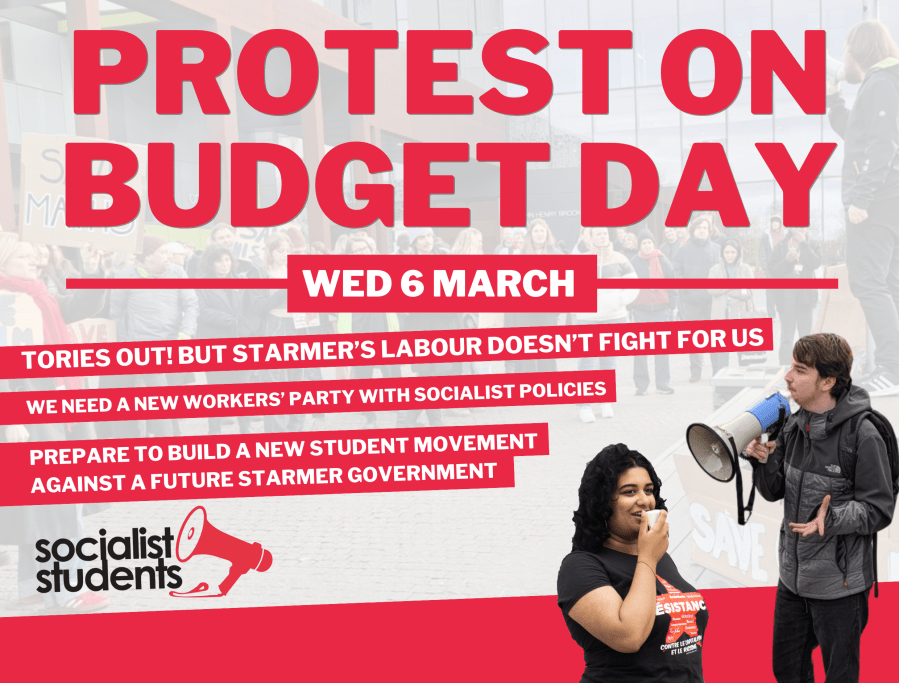
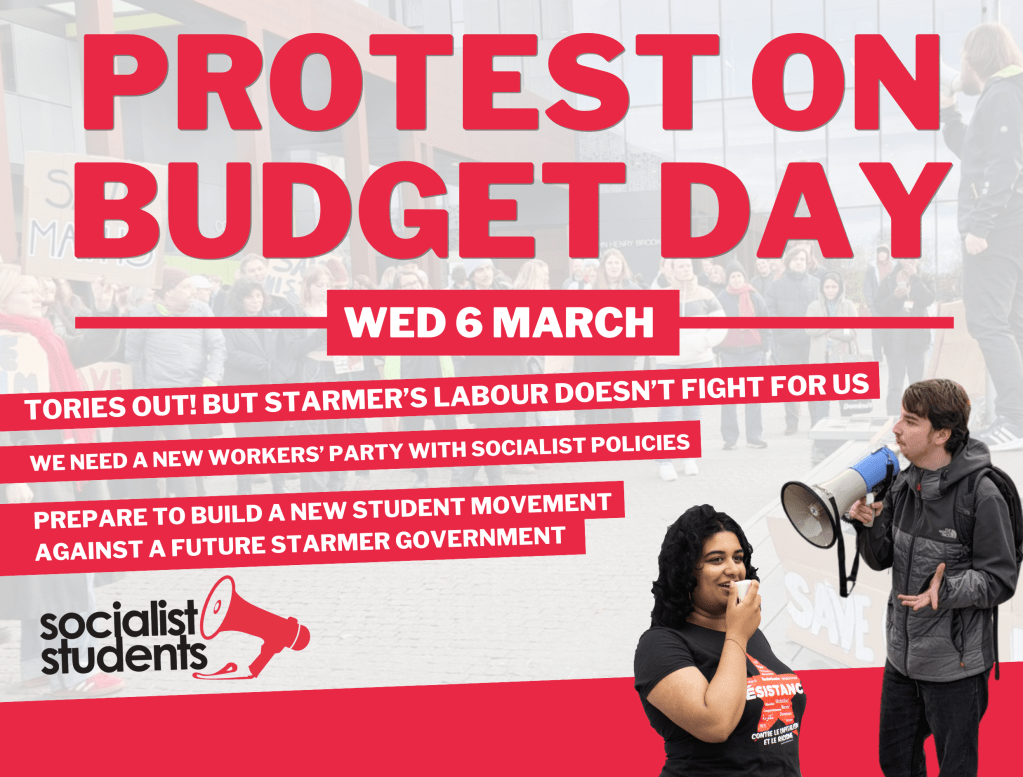
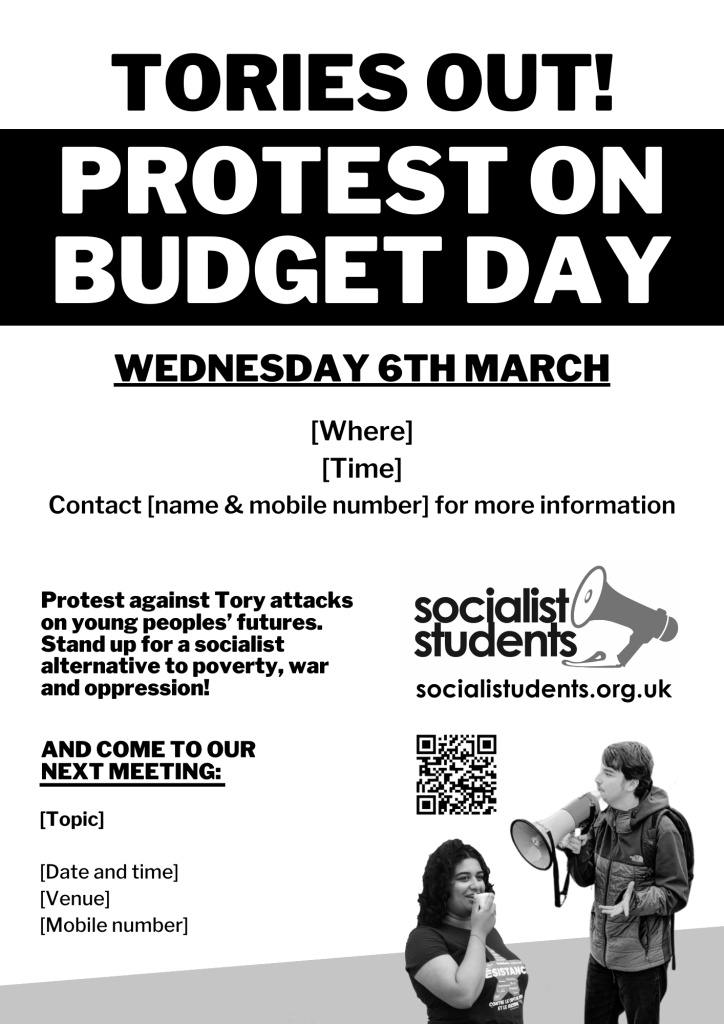
The Tories are set to announce their latest spending plans on 6 March, budget day. It will be yet another budget for the super-rich, enacted in the interests of big business and the banks.
Of course, the Tories will do nothing to solve the crises facing students and young people – a broken housing market, the sky-high cost of living, decaying public services, climate breakdown – the list seems endless.
So it’s no wonder the Tories are so hated. Plagued by infighting and scandals, they are headed for disaster in the next general election, which has to be called this year.
But who else can we vote for?
Many will look to Keir Starmer’s Labour Party as the best tool to get the Tories out, albeit as the ‘lesser of two evils’. Starmer has made clear that his Labour Party will rule in the same capitalist interests as the Tories, repeating his catchphrase of ‘fiscal discipline’ – a not-so-subtle codeword for more cuts and privatisation.
Starmer has transformed the Labour Party into a ‘safe pair of hands’ for big business, which puts capitalist profit-making before the lives of ordinary people, and young people’s futures. How can we trust a Labour leader, who has backed the slaughter of Palestinians, to defend young people and workers in Britain?
Socialist Students supports any election candidates prepared to make an anti-war, pro-working-class stand against the Tories, Starmer’s Labour, and all the other establishment parties. We also want to help stand student candidates in the general election, who put forward socialist demands to give young people a future – including free education, rent control, and a real living wage for all.
Socialist Students says:
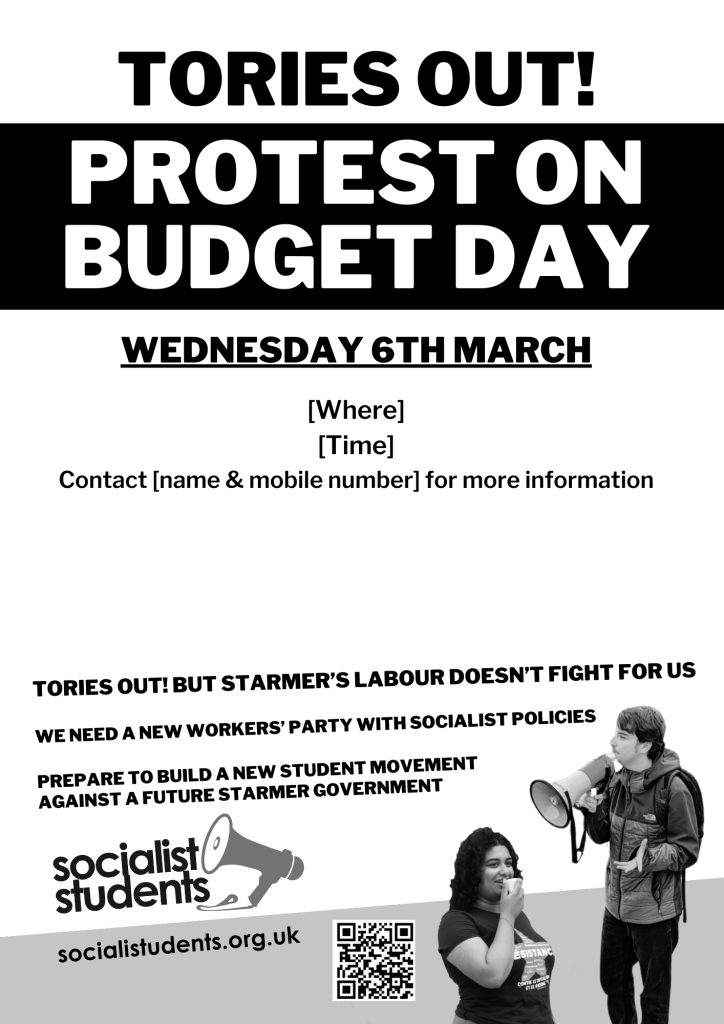
Tories out! But Starmer’s Labour doesn’t fight for us
We need election candidates who stand against poverty, war and oppression
Build a new workers’ party with socialist policies
Prepare to build a new student movement against a future Starmer government
Fight for the socialist transformation of society in Britain, and across the world
Queen Mary university security raided the campus office of the University and College Union (UCU), on 20 February, on the orders of uni management. They removed all posters and messages around the office showing support and solidarity with the people of Palestine and Gaza.
The previous day, management had requested access to the office. Management claimed the posters were having a “chilling effect on freedom of speech”.
The UCU agreed to allow them in, but explicitly said that all the posters and material should be left alone.
But instead, campus security broke into the office without permission and, before proper access was arranged, tore down any material in support of Palestinians or a ceasefire, damaging the office in the process.
Management’s defence was that prominently displayed signs may be misconstrued as the stance of the university itself, rather than the UCU. This is not even possible, as all these posters had a clear UCU logo on them.
This is a blatant attack on freedom of speech and freedom of association. Queen Mary management is infamous for its continuous attack on the rights of staff and students.
Just last year, Queen Mary management threatened to deduct 100% of pay from teachers taking part in a marking boycott, just one part of their job, and tried to have students snitch on striking lecturers. Queen Mary has a history of intimidating and threatening students protesting during rent strikes.
Queen Mary plays a national role for universities in testing and pushing these types of attacks. This serves managements on other campuses. They can say: ‘We’re only docking 50% pay, we’re not invading your union offices. So you should accept our ‘milder’ attacks’.
Students have been protesting Queen Mary university’s complicity in the slaughter in Gaza. Queen Mary invests in Barclays, a bank that provides financial services to arms companies supplying the Israeli army. In many on-campus student-organised protests, students have continuously called for our institution to divest funds from Barclays, and formally condemn what is being perpetrated by the Israeli state.
Of course, management just dance around these demands, and claim that this would be a ‘conflict of interest’, and that any condemnation of the Israeli state could be seen as antisemitic.
The Tory government has openly tried to stop students on campus from even talking about Israel-Palestine, not to mention protesting about it. And many institutions are following in their footsteps. SOAS university in London suspended several students who organised and participated in a rally in solidarity with Palestinians, before management was forced to back down.
This is a very clear attack on the democratic right of workers to organise. Rash and extreme acts such as this show just how worried university management and the Tories are by the collective efforts of students and unions.
We will not stand idly by as they try and strip us of these rights. Jo Grady, general secretary of the UCU, has recently launched the union’s ‘Exposed’ campaign, in order to challenge right-wing and Tory government attacks on free speech in education.
Jo Grady should go to Queen Mary, and tell the UCU branch that the whole of the union is behind them. Jo Grady should immediately release a statement, through the union, condemning this attack.
The UCU leadership should call and mobilise for a national demonstration in support of the Queen Mary branch, and against ongoing attacks on trade union organising rights and freedom of speech, as well as coordinating a solidarity campaign across the whole union. The student union should add its voice to mobilising people to oppose this attack too.
Queen Mary management can’t be allowed to succeed in this attack, and the whole of the student and workers’ movement must come to defend the UCU.
Solidarity with Queen Mary UCU!
Queen Mary management can’t be allowed to succeed in anti-union attacks on right to protest!
UCU leadership should call and mobilise for a national demonstration in support of QMUCU branch, and show the branch that the whole union is behind them
QMUL students’ union must mobilise students against this attack too – and appeal to the NUS and other students’ unions nationally to add their voice against this attack
Defend the right to protest and show solidarity with the people of Palestine and Gaza
The following article has been adapted from a discussion document submitted to this year’s Socialist Students national conference by the Socialist Students national steering committee.
Capitalism today is a system in turmoil, marked by mounting instability and increased upheaval everywhere. Life for billions of people is increasingly fraught with war, environmental breakdown, falling living standards and failing social infrastructure.
The dystopian character of this era of capitalism is epitomised by the catastrophic situation currently unfolding in the Middle East. The ongoing slaughter of the Palestinian population in Gaza – and increasingly in the West Bank – by the Israeli state is a step up even from its past brutal attacks on the Palestinians. Over 1% of the population of Gaza has been wiped out since October 2023. The Israeli military onslaught aims not only to displace the people of Gaza through mass, indiscriminate acts of terror, but to destroy the infrastructure necessary for maintaining a functioning society in this area.
At the same time, the Israeli state’s onslaught on Gaza has provoked huge anger among vast swathes of the world’s population. There have been massive anti-war protests in cities around the world, most significantly in the Arab and Muslim world. There is not only outrage towards the barbaric actions of the Israeli state, but also towards the role of capitalist governments in backing up or failing to oppose Israel.
Added to the equation, there is fear among the capitalist ruling classes that Israel’s onslaught could ignite a major regional war, which would have devastating consequences for profit-making in the Middle East and internationally. It would spell a further collapse in living conditions for millions of people in the region, bringing mass death and suffering. A widespread mood against war could quickly develop into a generalised mass movement. The staunchly pro-capitalist Arab governments are terrified of being overthrown by a movement like the one that developed in North Africa and the Middle East in 2011 – the ‘Arab Spring’, which deposed dictatorial regimes in Tunisia and Egypt.
Nonetheless, attempts by different capitalist powers to prevent the spread of the conflict have failed to this point. Not only has the Israeli onslaught not stopped, but the US government – backed up by the Tory government and Labour opposition here – has launched air strikes against the Iran-backed Houthis in Yemen. US imperialism has desperately hoped to stem the development of a regional war yet has taken measures which could have the exact opposite effect! This situation illustrates the weakening control that the capitalist class now wields over developments within its system.
New multipolar world
In particular, the recent increase in national conflicts and war globally – most strikingly illustrated first in Ukraine, then in Gaza – marks the end of an era in which the US was the completely dominant ‘superpower’ following the collapse of the Soviet Union and Stalinist states in Eastern Europe.
The Stalinist regimes were brutal dictatorships which bore no resemblance to genuine socialism, but they were based on planned economies which for a time took the productive forces forward, even despite their gross bureaucratic mismanagement. It thus represented an alternative system to capitalism and acted as a counterweight to US imperialism. After the collapse of Stalinism from the late 1980s, western capitalism – led by the US – went on the offensive, restoring profits by stepping up its exploitation of the working class globally. It did so through a ‘two-pronged’ attack: materially benefiting from the integration of 1.2 billion extra workers into the world capitalist economy; and ideologically gaining from the seeming triumph of capitalism as the ‘only possible system’. Both ‘prongs’ in turn reinforced one another, leading to a collapse in workers’ consciousness and organisation.
That brief ‘unipolar’ period of US dominance has now given way to a multipolar world of growing tensions between different national capitalist classes. The growing prospect of war globally has led to a dramatic increase in arms spending across the capitalist world.
Added to the growing threat of military destruction, there is the deepening environmental crisis, which threatens to destroy life and resources, and make vast parts of the world uninhabitable. The recent spike in inflation globally, accompanied by soaring interest rates, has significantly increased the cost of simply existing from day to day. This is especially the case in the neo-colonial world, but also in supposedly ‘advanced’ capitalist countries like Britain, where living standards have fallen at their sharpest rate since the 1950s. Beneath all these trends, economic growth across the whole capitalist system is slowing – and there is no prospect of a new, sustained period of economic growth.
Search for an alternative system
The capitalist system is being hit by a series of multiple crises – economic, political, environmental, geopolitical – which all impact on and exacerbate one another. All of this has meant further misery and suffering for the vast majority of the world’s population.
It is therefore increasingly difficult to not draw the conclusion that something is fundamentally wrong with the way that the world is currently organised. There is a widespread sense that the world is being dragged backwards. Large numbers of young people especially look upon the future with, at best, little to no enthusiasm. At worst, the outlook is one of despair. Capitalism itself is laying the basis for the ideas of socialism to gain mass appeal among workers and young people in the coming period.
Ultimately, capitalism will not collapse under the weight of its own crises; it will need to be overthrown. The capitalist class and ruling elites have a stake in maintaining this system, which grants them power and material comfort via profit. They will fight tooth-and-nail against any perceived threat to capitalism, even if that means inflicting further attacks on the living conditions of the world’s majority.
However, the tools at the disposal of the capitalists for doing so are severely rusted. They find themselves with an increasingly unreliable and unstable pool of political representatives, as many of the ‘traditional’ parties they used in previous periods have declined or collapsed. This process of decline will continue to threaten all parties who seek to work within capitalism, as they will be unable to deliver any substantial reforms.
The exceptional period of capitalist boom after the second world war, in which social-democratic and ‘communist’ (now former) mass workers’ parties were able to win reforms in the name of the working class, is not coming back. Now, the capitalist class is forced to rely on increasingly authoritarian measures; they are far less willing to offer concessions to the working class as they did in the past, because profits are much less reliable.
However, the capitalists are not guaranteed to get their way. A heavier use of repressive laws can only invite more social explosions. This was shown recently by the massive year-long movement that developed in Israel against the Netanyahu government’s judicial reforms. International youth-led movements like the school climate strikes and BLM movement are also increasingly likely to break out, and students will also find ourselves pushed into struggle. The mass movement in Sri Lanka in 2022, which swept aside the corrupt presidency of Gotabaya Rajapaksa, gives a glimpse of the important role that young people and students can play within political uprisings.
Students and workers unite
Moreover, the working class in a number of countries has re-entered the scene of history at a level not seen in a generation. In Britain, hundreds of thousands of workers have taken strike action and “refused to be poor”, in the words of RMT general secretary Mick Lynch. In the US, there were 4.5 million days lost due to work stoppages in October – the highest of any month for four decades. The significance of these developments is hard to overstate. While these strikes represent only the beginning of a process of the working class internationally finding its collective strength, they are the music of the future, as a capitalist system in crisis continues to provoke the working class into fighting back to defend its interests.
The working class is the only social force capable of leading the socialist transformation of society. In order to play this role, it will need its own mass parties, equipped with a socialist programme to take over the commanding heights of the economy – the banks, major industries and monopolies – and collectively run society through a democratic plan of the economy aimed at fulfilling all people’s needs. An island of socialism cannot survive surrounded by a sea of capitalism, so this socialist transformation would have to take place internationally.
Young people and students have a vital role to play in these processes. As people who have the rest of our lives ahead of us, we can be some of the most determined fighters for socialism. We also have to fight now to defend against every attack by the capitalists on our living standards and win what we need for a decent life. That includes helping to build movements against all the horrors of capitalism – war, climate change, sexism, racism, and all other forms of oppression – and linking all these issues to the wider need to transform society along socialist lines.
Any questions or comments about what you’ve read? Want to discuss more with a Socialist Students group near you? Get in touch using the form below
Organising the fight for a socialist world in schools, colleges and universities
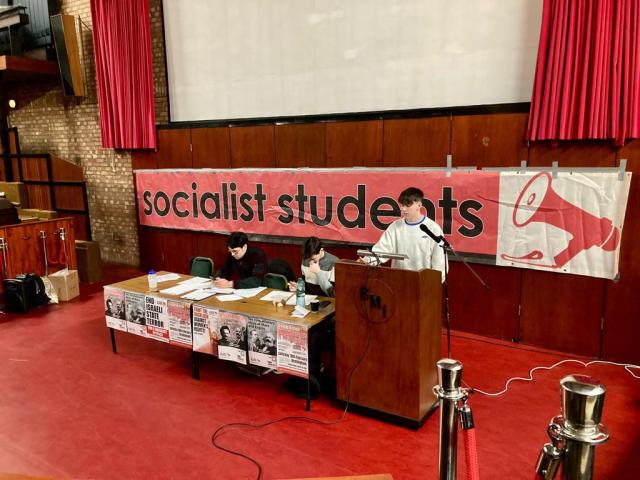
Queen Mary Socialist Students member addressing the conference(Photo: Berkay Kartav)
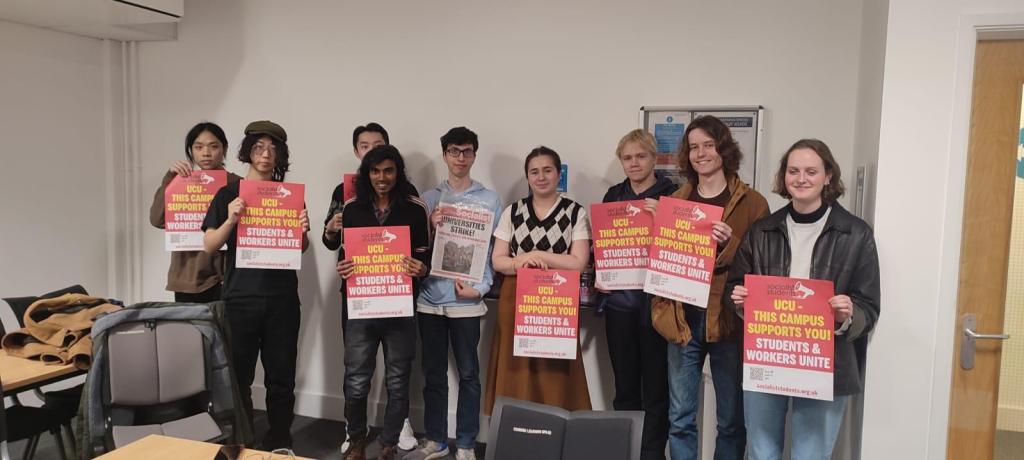
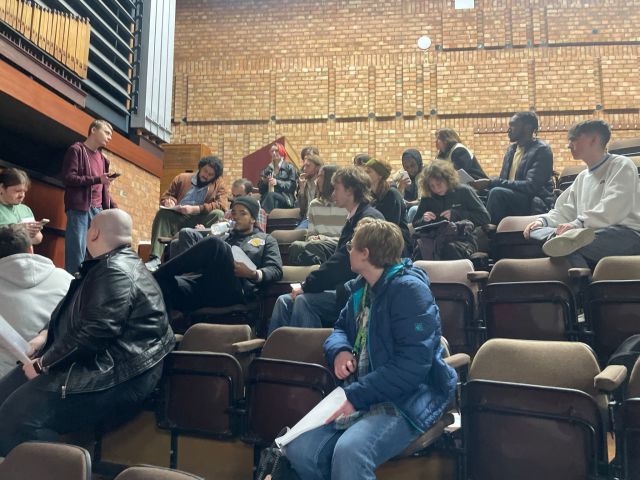
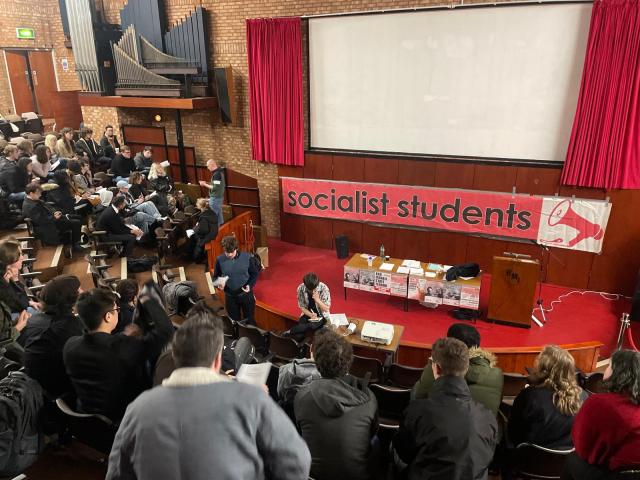
Nearly 100 young socialists met in Birmingham on Saturday 10 February for Socialist Students national conference. Held annually to decide the political direction of Socialist Students for the coming year, the conference brought together student organisers from over 30 university and college campuses, as well as young workers and trade unionists bringing solidarity as visitors.
This year’s conference took place in the midst of the huge protest movement against Israel’s brutal onslaught on Gaza, which has seen thousands of students across the UK protesting. Delegates from a number of Socialist Students groups reported on successful protests and walkouts they had organised in their colleges and universities. Conference agreed unanimously that Socialist Students should “continue its campaigning to build a young, socialist pole of attraction within the current anti-war movement”.
The importance of building support for socialist ideas to end war was underlined in the opening discussion on the global crisis of capitalism, which outlined the growing fault lines for conflict around the world. Added to the deepening environmental crisis, the soaring cost of living and attacks to our democratic rights, the recent outbreak of major wars – first in Ukraine and then in Gaza – shows the dystopian character of capitalism today. That’s why delegates voted for Socialist Students to “reaffirm our commitment to fighting for a socialist world, free of exploitation and oppression”.
The rest of the conference was all about how Socialist Students groups go about doing just that – practically putting forward what steps we can take now to organise the fight for a socialist world within our schools, colleges and universities.
Socialist Students organisers reported different initiatives that they had taken, or were planning to take, on their campuses – campaigning for things such as rent controls in student housing and standing candidates in student areas in the upcoming local elections. Speakers emphasised the need to link our immediate campaigning demands to the fight for a socialist system, as the only way for improvements to our lives to be won on a stable basis.
All of those demands – whether it’s defending our right to protest, or ensuring we can afford to keep a roof over our head – point to the need for a political voice to fight in the interests of students and young people in parliament and the council chambers. This year’s conference identified the upcoming general election as a crucial opportunity for Socialist Students to organise a political fightback among students – not just to kick out the Tories, but also to offer a socialist alternative to Keir Starmer’s Labour Party.
Multiple speakers reminded conference about Jeremy Corbyn’s time as Labour leader, which saw the biggest youth movement of the past decade in support of his left, anti-austerity policies – including the call for free university education.
Socialist Students organisers have previously stood as part of the Trade Unionist and Socialist Coalition (TUSC) in local elections. This year, conference decided that Socialist Students should approach TUSC about affiliating nationally, as the best way to coordinate with other groups putting forward a “working-class challenge to the pro-austerity and pro-capitalist parties at the next election”.
The mood of delegates throughout the day was determined and optimistic. There was a real back-and-forth exchange of ideas among all the young people gathered, which continued into the breaks and the post-conference evening social. Dozens of speakers came in to speak throughout the day, including many attending their first Socialist Students conference. The sense among organisers was that we’ve got work to do now, and a world to win – and this year’s conference has put us in the strongest possible position to do that.
The wealthiest 1% hope to make social change seem like an impossible goal. But the various capitalist crises are taking their toll on young and working-class people in a way that cannot be ignored. This is why more and more young people consider themselves socialists.
This is why the Socialist Students conference is a great opportunity for anyone who wants to get involved, but doesn’t know where to start. It is an opportunity to link up with others to share and develop ideas.
It is very easy to feel politically isolated, that every effort made to fix the system is meaningless. By attending Socialist Students conference you get to see how a democratic organisation operates.
It is also a great opportunity to meet and socialise with other young socialists from up and down the country.
Socialist Students groups have a lot to prepare for.
As the Tories continue to splinter and break apart, Keir Starmer’s Labour looks set to run the country. This government will not be run in the interests of students. Starmer has shown himself to be no friend of the working class.
It’s imperative that we discuss how best to tackle capitalist policies, and defend our right to an education that doesn’t cause a mountain of debt once we’re finished.
Starmer’s Labour doesn’t just threaten students. His refusal to promise to scrap all the Tory anti-union laws means that workers will still find their rights under attack. Students and workers need to link our causes together.
The majority of Labour MPs voted with the Tories against a ceasefire in the brutal and relentless war on Gaza. Many MPs that did back a ceasefire, only did so because of the immense pressure felt by the continuous protests.
Rishi Sunak was also forced to sack ultra-right-wing home secretary Suella Braverman. This proves our actions have results. The next step forward is to discuss what we can do to put pressure on this government, with student walkouts and more.
Teachers can’t teach lessons properly because they are way too overworked and underpaid. Because there aren’t enough teachers, PhD students are heavily relied on, which drives the wages even lower.
Students enter higher education to experience what it is like to live like an adult for the first time, and to discover themselves. But they can’t even afford that. At 18 years old, they have to take a loan, almost equivalent to a downpayment for a house. It’s a predatory practice.
They then have to deal with accommodation. In the first year, you are lucky if you get a place that doesn’t smell of mould, or isn’t the size of a coat closet.
After that, you have to fight every year to get a basic room that won’t cost you your life savings. Almost all educational institutes in the UK give no support to students either, from meals or tutoring, that the teachers have to do off-hours. The system has beaten everyone. This is why students should be socialists.
As energy bills and other running costs soar to unprecedented levels, universities across the country plunge head first into a funding crisis. The Tory government stands by and watches.
Domestic tuition fees have been maintained at £9,250, so universities will rely more on international students, who can be charged more, to make up the shortfall from rising costs from record-high inflation. Top universities, including York, have resorted to lowering grade boundaries for international students in an attempt to make up this funding deficit.
The Tories are preventing international graduate students bringing their families to the UK, reviewing cutting the international students two-year window in the UK after graduation to find work, and cracking down on ‘low-value courses’.
This places a new Starmer-led government in a position where inaction will be catastrophic for the university system. Their plan of “fiscal responsibility” means course closures, staff layoffs, and universities turning to increasing accommodation rents to try and bridge the funding gap.
Without pressure from students organising across the country, Labour will be able to shirk their responsibility of fixing the higher education system. Under Jeremy Corbyn, Labour stood for free education, so a record number of young people turned up to support him. For higher education to be accessible to all, we need a complete funding overhaul before there is irreversible damage.
Socialist Students calls for a free higher education system, which is properly funded, based on what universities actually need. Not based on the number of students they can cram into a lecture hall.
This would allow us to replace tuition fees with grants that we can all actually live on, end predatory rents in university-owned accommodation, and introduce fair pay and working conditions for all university staff.
Let’s make these policies a reality. We need to build a student movement that aligns itself with the struggle of the working class to demand that the Labour government fix what the Tories have left broken.
On Saturday 10 February, Socialist Students will hold our annual conference in Birmingham. A key discussion session will be ‘How should students prepare for the general election and a Starmer-led government?’
If you think we need to take action on a broken education system, if you can’t trust the Tories and Labour to fix this financial mess, if you think free education is something worth fighting for, then come to the conference. And let’s build a movement in the interest of students and the working class to stand up for us when no one else will.
The COP28 climate summit, an annual conference for countries to discuss the ongoing climate crisis and attempt to agree concrete steps that they can take to combat it, began last week.
As reports emerge that this year’s COP president, Sultan Al-Jaber, has planned to use the conference to broker business deals with his state-run oil company, it looks as if this year’s COP summit will be no different to the same capitalist talking shops that have come before.
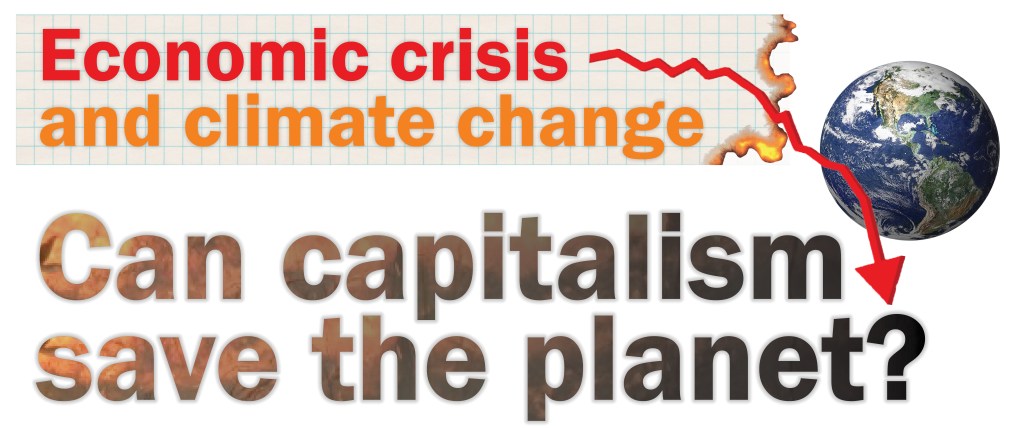
In this article written for the Socialist Students magazine in September, Manchester Socialist Students member Sam Hey asks: what is really needed to save the planet from catastrophic climate change?
The planet is burning. July 2023 was just the latest month to be dubbed ‘hottest in history’. Wildfires have engulfed Canada, putting over 50 million people under air quality alerts. Similar fires have raged through Europe, North Africa and Hawaii this year.
Meanwhile, the British government has announced over one hundred new fossil fuel licenses to extract as much oil and gas from the North Sea as possible, in a move that Tory prime minister Rishi Sunak claims is “entirely consistent with our plan to get to net zero”!
How can we trust pro-capitalist politicians like Sunak to save us from this real-life dystopian nightmare? To reverse the impact of climate change a coordinated global effort is needed, but while we live in a capitalist system that promotes competition over collaboration, short-term profits will always come before people’s lives and the planet. Based on competition between nation-states, each acting in the interests of their own capitalist class, capitalism cannot foster the level of coordination and cooperation necessary to reverse the impact it has already made.
According to a report by the One for One campaign, banks could need as much as $4.9tn in international bailouts if net zero emissions were achieved by 2030. This would be due to what are known as ‘stranded assets’, infrastructure and resources that would become virtually worthless if fossil fuels stopped being used for generating electricity. These stranded assets present another obstacle to putting the brakes on the climate emergency, as different capitalist governments seek to prevent financial crisis while also protecting the fossil fuel assets of their country’s energy companies, banks and financial institutions.
The climate emergency confronts capitalism with an inescapable dilemma. If governments continue to sit by and allow the environment to collapse further, then they risk trillions of dollars of infrastructure being swallowed up by rising sea levels, or rendered unusable due to heat. But if they move towards seriously reducing greenhouse gas emissions, then they still stand to lose trillions of dollars in stranded assets! In either scenario, the capitalists and their politicians would try to make ordinary people pay for their lost profits. We cannot leave control over stopping the climate crisis in their hands.
We need a socialist alternative
Just look at Britain. When it comes to the ballot box, the choice is between broken climate promises in blue, or broken climate promises in red. Labour have scaled back their pledge to invest £28bn a year into green jobs and industry under the guise of ‘fiscal responsibility’. Under Keir Starmer, the Labour Party has abandoned the working class.
Capitalist parties like the Tories and Starmer’s Labour have no solutions to the climate crisis. The only solution to this crisis is a socialist one. Under a socialist system, all banks, major industries – including the major energy companies – and the monopolies would be placed in the hands of workers, not the capitalists. By cooperating and discussing together, it would be possible to democratically draw up a plan of production based on human need, including the need for a healthy environment. The world’s massive wealth, resources and technology could be steered towards ensuring we live sustainably. Millions of high-quality, eco-friendly jobs would be created as societies shift rapidly towards green energy. Decisions about where to locate renewable energy production could be made democratically, with proper community consultation.
Achieving a socialist transformation along these lines would require mass movements, based on the working class, to overthrow capitalism internationally. However, that does not mean that workers and young people cannot fight for measures right now, which could at least slow the pace of environmental degradation. At the same time, by linking our immediate demands around climate change to the need to ultimately overthrow capitalism and replace it with a democratically planned socialist system, socialists can build support for revolutionary ideas within the climate and wider workers’ movement.
For example, Socialist Students calls now for a free, integrated, publicly owned transport system, run democratically, to help reduce environmental pollution. Because most public transport is run privately for profit, or operated by unaccountable local authorities looking to supplement budget cuts by charging rip-off fares, a large number of workers have no other option than to use their own car. Currently, many working-class people are being fined for using their cars due to so-called ‘Clean Air Zones’. But a public transport system run by workers and services users can be expansive, reliable, affordable, and much more environmentally conscious. This would actually lay the foundation for a massive shift away from individual vehicle usage.
How we process and purchase our food also has an immense environmental impact. Socialist Students stands for a food processing and retail industry under democratic control and management by consumers, small farmers and workers involved in the production, processing, distribution and retail of food. Through this we can produce food and reduce overproduction to minimise the environmental impact of wasted food and overfarming.
Socialist Students also calls for the nationalisation of the energy companies, under democratic workers’ control and management, alongside a publicly funded insulation and energy transition plan for existing housing stock, which could dramatically reduce our energy consumption quickly and cheaply. The Tories promised to insulate homes as part of a policy that committed them to net zero, but they failed to deliver. Their own Climate Change Committee said: “the UK continues to have some of the leakiest homes in Europe and installations of insulation remain at rock bottom.” It is clear, as the big energy companies continue to achieve record profits, that the Conservatives have no intention of carrying out any green policies that would impact on these, and therein lies the problem at the heart of the government’s inaction.
Build a mass party that fights for us
All of these demands also point to the need for a political party that could begin to implement them. As Labour leader, Jeremy Corbyn’s 2019 manifesto included a £250 billion green transformation fund, a commitment to a publicly owned national grid, and for the “supply arms of the big six energy companies to be brought into public ownership”. His manifesto, which also included other bold policies such as the scrapping of tuition fees, electrified millions of young people. However, Corbyn’s anti-austerity programme has been ripped up by Starmer and his Blairite leadership, which is now firmly in control of the Labour Party. That’s why Socialist Students calls for a new mass workers’ party, armed with a socialist programme, which stands for a very different agenda than just lining the pockets of the capitalists.
It cannot be overstated how devastating the climate crisis will become if left to the hands of capitalism. Socialist Students wants to take the issue of the climate crisis into workplaces, trade union branches, and universities, and organise around it. We want to work with any groups who want to fight climate change – for example, holding joint meetings, debates on the way forward, and organising protests together. We say that the only way to end climate change is through socialist change. If you agree, then join us!
Get the latest issue of Socialist Student, the magazine of Socialist Students, to read this article and more. Written and edited by members of Socialist Students.
Available from our resources page, or to purchase from your local Socialist Students group
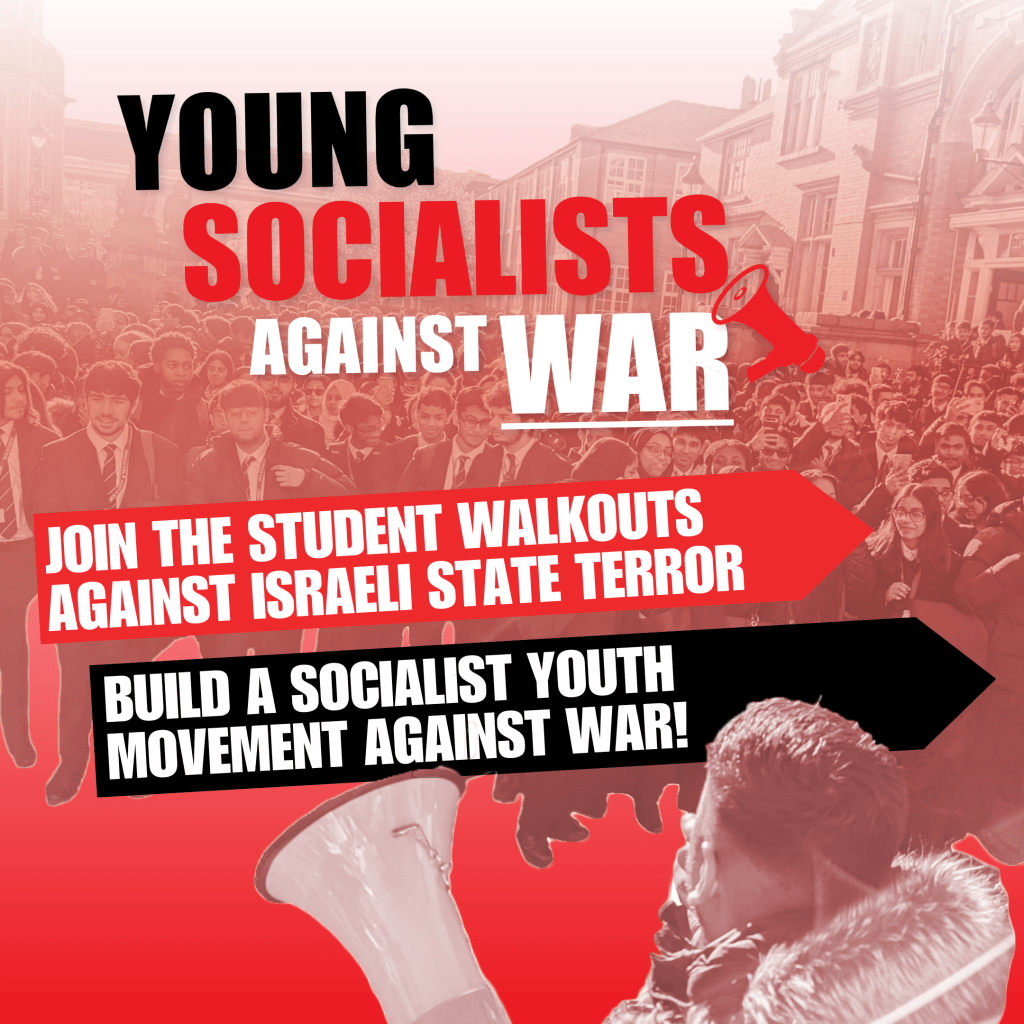
Build the student walkouts against Israeli state terror!
Join young socialists against war!
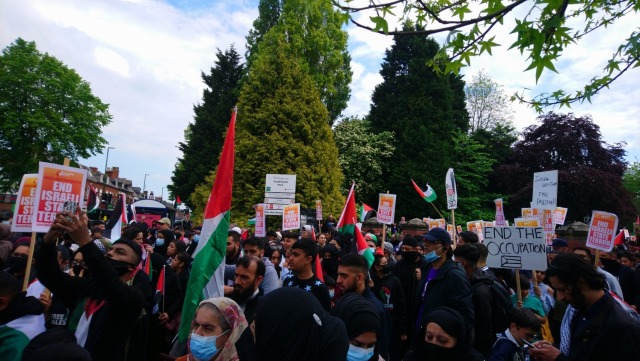
Thousands of young people have been part of the millions who have marched in recent weeks against the murderous siege of Gaza by the Israeli state.
We’re furious at the hypocrisy of the Tories, Starmer’s Labour Party and pro-capitalist governments around the world which claim to stand for peace and democracy, yet support the brutal onslaught of the Israeli state against innocent Palestinians because it suits their interests. This is on top of them turning a blind eye to the daily oppression and persecution the Palestinian masses have suffered for decades.
Now, students are taking the struggle back to their schools and colleges. Thousands have walked out of classes and marched to demand an end to the onslaught on Gaza. Students in Bristol and London marched to the offices of their local MPs to voice their anger at the Israeli state’s bombardment of Palestinians.
The fact that some Labour MPs, under mass pressure from their constituents, were forced to vote for a ceasefire in Parliament against Labour leader Keir Starmer’s orders shows that when they think their cushy parliamentary careers are on the line, they can be pushed back!
It also shows the role that students and young people can play in building the struggle for Palestinian liberation here in Britain. That’s why we need to build our movement, organising gate protests and marches locally to keep up the pressure on and expose all politicians who support war and cutbacks.
A key way to strengthen our movement would be the establishment of students unions at our schools and colleges. Such organisations could provide a democratic forum through which students could come together to discuss how to most effectively build the movement against the siege of Gaza, help mobilise and protect students from any attempts to restrict our right to protest, and to organise future campaigns against attacks to our futures and education here in Britain.
Alongside getting organised in our schools and colleges, students need a political fightback as well. As the vote in Parliament on the question of a ceasefire demonstrated, all the establishment parties back war and the capitalist system which demands it. We can’t put any trust in Starmer, or the other parties which represent capitalism, to stand up for the oppressed Palestinian masses or working class and young people here in Britain.
That’s why we need to challenge them at the next general election – part of the struggle to build a new mass political party that fights for socialist change and stands on the side of the oppressed masses in Palestine and the working class internationally.
The truth is that no capitalist governments or institutions can win liberation for the Palestinian masses or establish lasting peace in the region, because they all represent and defend the profit-before-all-else system of capitalism, which relies on division and oppression to maintain its rule.
But the global mass movement in support of the Palestinian masses points towards the force capable of ending this rotten capitalist system – the working class – and the need to establish a new socialist society based on the democratic public ownership of society’s wealth and resources, and solidarity and cooperation, not profit and war. Join the socialists to be part of that fight.
Adam Powell-Davies, Socialist Students
Over ten thousand slaughtered at the hands of the Israeli state in Gaza. It’s no wonder that the demos across Britain and the world have been so big.
Young people have been spearheading the movement, motivated by anger at what the Israeli state is doing, but also anger at the hypocrisy of politicians, Tories and Labour.
Suella Braverman tried to stop us from protesting, she tried to brand the marches as ‘hate marches’, but now she is out of her job. The Tories are there for the taking. We don’t have to stop at getting Braverman out, we can get the whole lot out!
Thousands of students have already walked out of their classes to protest against the war on Gaza. We want to see more of that, and discussion about the ideas needed to end war and oppression.
We want to see protests outside of school gates, marches to local MPs’ offices or a lobby to demand they explain their position on the Israeli state’s onslaught in Gaza.
We should say to those politicians that if they are unprepared to stand against war and to fight for a decent future for young people, then we are going to organise to stand candidates against them.
We have to continue to build this movement against war and capitalism. Young people can be the fiercest fighters for that kind of movement and for a socialist future. Because we have only ever known capitalism as a system in crisis – with a lack of affordable housing, cost of living rising and our education system crumbling.
Black Lives Matter, the Sarah Everard protests, and now over Gaza – young people are fighting back against racism, sexism and war. We need to fight for an end to the system that produces and reproduces all these horrors.
That’s why Socialist Students is joining Young Socialists in campaigning to build a socialist youth movement against war – centred on schools, colleges and universities.























 Socialist Students