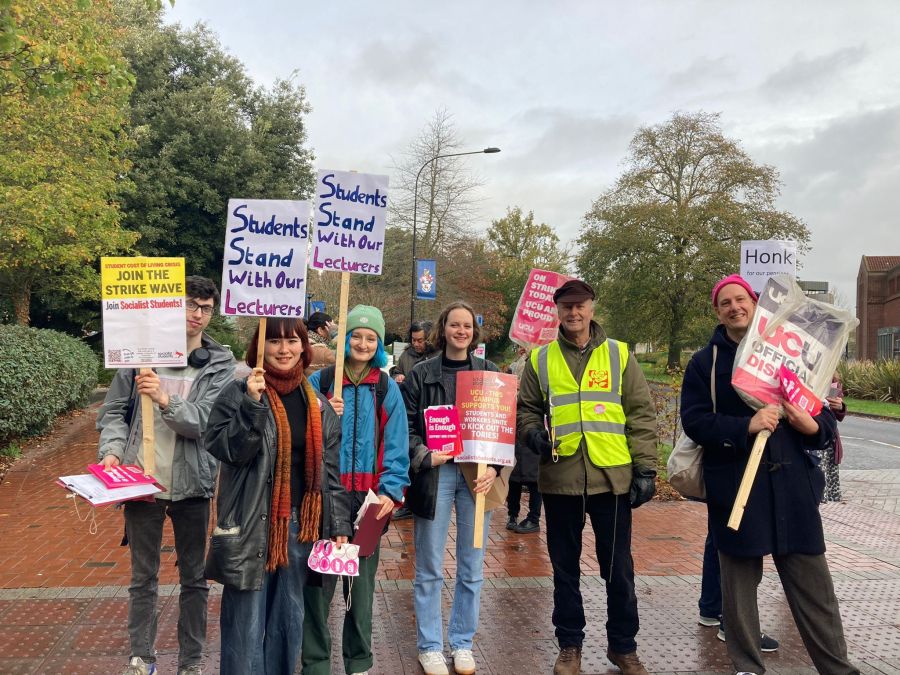
Socialist Students Conference 2023: Organising, fighting and striking back against the student cost of living crisis

Here we publish the main motion from the Socialist Students 2023 conference, Organising, fighting and striking back against the student cost of living crisis. Conference delegates passed the motion unanimously, resolving to launch cost of living campaigns on all university and college campuses where Socialist Students groups are present.

The crisis facing students – of soaring living costs, inadequate funding, dilapidated housing, and deteriorating mental health, all part and parcel of a rotten capitalist system – totally eclipses the current low level of student organisation. The motion below outlines what Socialist Students argues is needed to begin rebuilding fighting, democratic student organisations, which could at some stage link up to organise students in a movement for free education and for socialism.

From the discussion on the main motion, ‘Organising, fighting and striking back against the student cost of living crisis’. (Credit: Liverpool Socialist Students)

Organising, fighting and striking back against the cost of living crisis

Socialist Students steering committee

The student cost of living crisis

  • At the same time that workers are taking strike action against the biggest single drop in living standards since the 1950s, students face a severe cost of living crisis of our own.
  • With inflation at the end of last year reaching the 41 year high of 14%, maintenance loans for the 2022/23 year only increased by 2.3%. The average monthly shortfall between students’ loans and living costs has risen to £439 this year, up from £340 in 2021/2022, and nearly double the position in 2020/2021, at £223.
  • The financial squeeze has already had a devastating effect on the day to day lives of students. The Office for National Statistics found last year that 40% of students are studying at home more to save money. A fifth are attending lectures remotely. An additional survey by the Sutton Trust found that 18% of students have avoided buying educational resources needed for their courses.
  • But it isn’t only in the realm of study that students are feeling the cost of living squeeze. 11% of students now use foodbanks. 28% reported skipping meals to save on food costs, 47% are going out less with friends, and 14% are travelling to campus for free energy use.
  • With inflation projected by the Bank of England to continue running high throughout 2023, the Tories’ decision to increase maintenance loans by only 2.8% will be another vicious cut in the living standards of hundreds of thousands of students. This will in particular affect students from working class backgrounds who are less able to rely on financial support from their families.

The roots of the cost of living crisis

  • The student cost of living crisis is fundamentally the result of the marketisation of higher education.
  • The introduction of tuition fees by Tony Blair’s New Labour government in 1998 marked the beginning of the gradual ‘weening’ of universities off public funding, and taking its place a self-funding model, leaving universities’ income increasingly  reliant on student tuition fees.
  • What followed was a decades-long expansion of student numbers as universities attempted to make up for funding lost from government. This massive increase in student numbers however has not been met with increased investment in the educational resources both students and staff need. For students this has meant overcrowded lecture theatres, a lack of student support services available on campuses, overcrowded and unaffordable student accommodation, and the overall decline of the quality of education.
  • This expansion has been financed through a massive piling up of government debt. Government owned student debt – which reached £201 billion across the UK in 2022 – was at one stage tolerable for British capitalism.
  • But with a new stage of crisis in the long term historic decline of British capitalism – underscored by the Truss/Kwarteng budget crisis – this mountain of state-owned student debt is an increasingly intolerable economic burden for British capitalism.
  • Despite splits within the Tory leadership over the question of how to handle the crisis in Higher Education, the currently prevailing approach being forwarded by the Tory leadership is to now attempt to limit student numbers, particularly numbers of students enrolled in arts and humanities courses, which the Tories deem as ‘low value for money’.
  • The resulting Tory policy – to in effect freeze maintenance loans, as well as the tuition fee cap at £9,250 – is to pass the costs of the inflationary crisis further onto the shoulders of universities, students and staff to pay for the current crisis.
  • The scale of the current inflationary crisis means not only a cost of living crisis facing students, but also a massive real terms decrease to the value of tuition fee payments to universities, and therefore university funding.
  • As the student cost of living crisis drags on, the possibility exists for a spike of student dropouts from university, as well as decreased enrolment on future university courses, threatening to exacerbate this funding crisis even further. 
  • Indicative of the scale of the funding crisis is the growing level of disquiet and in some cases open protest from university Vice Chancellors at the government’s policies.
  • This includes in September 2022 when the head of the UUK – a body bringing together university management from across the country – publicly called on the government to provide a new funding model for HE. This is significant from university management who have and continue to oversee on the campuses the implementation of Tory attacks to our education, including course closures, jobs cuts, and attacks on staff wages and conditions.
  • The funding crisis has now reached such heights that some universities, including Brunel and Worcester, have moved to introducing medical courses which are only open to international students in order to secure higher tuition fee payments, in effect circumventing the current domestic tuition fee cap.
  • The question however is what funding model ought to be implemented, and who in society should be made to pay for it. Socialist Students says that the tuition fee system and marketisation as a whole should be scrapped and replaced with free, fully funded education – financed by taking the wealth off the super-rich in society.

Fighting student organisations needed

  • Despite the level of crisis facing students, no generalised fight back has yet emerged on the campuses against the attacks students face. The general response of students so far has been to ‘grin and bear it’ – with figures showing that 62% of students are now cutting back on essentials, while 52% are using their savings, and a staggering 25% have reported taking on new debt to finance their living costs.
  • This is largely down to the massive weakening of student organisation over the last decade, which includes the abdication of the NUS and local Students’ Unions from helping to organise and lead students in struggle. This was underscored by the last national demo called by the NUS – now a whole year ago – which only around 500 students attended.
  • This was not a reflection whatsoever of a lack of appetite on the part of students to struggle. It reflected the complete lack of programme and strategy put forward by the NUS at that stage, as well as the complete failure organisationally to mobilise students.
  • Central then to the building of a fighting student movement in this period is the rebuilding of democratic and fighting student organisations on the campuses, capable of linking up nationally in the fight for free education. The key task facing the student movement as a whole – and Socialist Students – is not only to build our own forces, but to aid in the rebuilding of broader student organisation too.
  • That isn’t to say that student struggles will be delayed until such organisations are built. On the contrary, with continued attacks on students, spontaneous outbursts of struggle on the campuses, like those which broke out on campuses during the Covid pandemic, are likely.
  • Out of these spontaneous struggles can emerge new forms of student organisation. The rent strike movement, which involved 55 universities at its peak at the start of 2021, is an example of what can be thrown up by students in the course of struggle.
  • Despite the political and organisational limitations of the rent strike’s national leadership, Socialist Students intervened into meetings on campuses and at a national level as well to put forward a programme and strategy to help further organise students and broaden the struggle against marketisation. Socialist Students should continue to take the same approach of attempting to act positively as a lever on new student campaigning organisations which may be thrown up in the course of future struggles.
  • Also lacking in this period is any kind of political alternative to the policies of the Tories. Starmer’s Labour has completely ruled out the possibility of introducing free education, as well as continuing to demonstrate to big business that Labour is now a safe party to represent the interests of big business and capitalism. That’s why Socialist Students fights for a new workers’ party.
  • Notwithstanding the weakening of student organisation and leadership in this period, the strike wave is demonstrating in practice the power of the working class and the potential of mass collective action. This gives Socialist Students a massive opportunity to argue the need for students to also get organised, not only to more effectively link up with workers in struggle and to support the strikes on campuses, but also to formulate our own programme of demands in the cost of living fightback.

The programme

  • Any steps taken to help resolve the crisis of student organisation on the campuses and nationally would be positive.
  • Being organised in and of itself however is not enough. Also central is the question of around what programme and set of demands can students be mobilised in the struggle against the cost of living crisis and for free education.
  • Socialist Students has almost alone raised the need to build a movement to fight for free education. The new student cost of living crisis however means it’s necessary for Socialist Students to adapt to the concrete situation with a set of demands which offer a way forward for students looking to fight back on the cost of living.
  • Developments in recent months of universities giving small emergency energy grants to students, like at York University, and small rent relief, like at Manchester University, can lift the confidence of students to struggle for the same elsewhere and more.
  • This raises the opportunity for Socialist Students to build on these developments a programme of demands which students could mobilise around in the battle against the cost of living crisis on campuses.
  • These demands include but are not limited to:
    • For emergency cost of living grants available for all students who need them. Replace student loans with living grants, rising with the rate of inflation.
    • For subsidised university canteen meals for students struggling to feed themselves; against early closures of campus spaces due to the energy cost crisis.
    • For heated and safely staffed campus spaces available 24/7 to students and staff who need them.
    • To take third-party student halls under the control of our universities, as a step towards introducing democratic rent controls.
    • For an end to and a reversal of cuts to our education, including courses, jobs, and student support services.
  • Any and all of these demands can be campaigned for locally on the campuses, directed at university management and Vice Chancellors to take action to alleviate the crisis facing students.
  • But campaigning for any of them would also pose to students the need for a struggle to win the funding our universities need from central government in order to secure them on a permanent basis – and therefore the need to build a national student movement to fight for a new funding model in our interests, of free education.
  • The crisis of capitalism is pushing students and young people towards socialist ideas and conclusions. The Institute for Economic Affairs (IEA) found in 2021 found that 67% of under 35 year olds in Britain today consider themselves socialist. That’s why vital in this period is to boldly raise socialist ideas as well as explaining what a socialist transformation of society would mean – i.e. the democratic public ownership of the banks, monopolies and major industries to provide young people with a future.
  • But the current cost of living crisis has the potential to affect and radicalise a whole layer of students not yet familiar with socialist ideas or having yet reached socialist conclusions. The potential exists for all Socialist Students groups then to build and lead campaigns on the cost of living crisis, not only involving current Socialist Students members but students not yet politically active on the campuses. 
  • Part of this process will sometimes mean reaching out to other campaigning organisations on campuses in order to discuss and when necessary to debate democratically around what programme of demands students should organise around as part of building broad cost of living campaigns.

This conference resolves:

  • To launch cost of living campaigns on university campuses and colleges where Socialist Students is present.
  • To campaign as widely as possible to build such campaigns – including stalls on campuses, building for public meetings, campus protests, open letters and petitions to management, to Students’ Unions and course reps, and inviting trade union branches and other campaigning organisations to participate within them.

Redundancies, closures and dropouts – fight for fully funded, free education to end campus chaos!

Quinn Gray, Birkbeck University of London graduate

Birkbeck, University of London and the University of East Anglia (UEA) are proposing dramatic job and budget cuts to cope with deficits of millions of pounds. On the eve of its 200th anniversary, Birkbeck plans to cut 140 jobs by July 2023, with more to be announced, due to a deficit of £13 million. UEA has had a £13.9 million loss in 2021-22, and has proposed compulsory redundancies, savings across all departments and want services such as cleaning, libraries, security and student support to reduce budgets by 10-20%. UEA has also asked staff to temporarily reduce their hours, take unpaid career breaks, or voluntarily reduce their salary!

Birkbeck vice-chancellor Professor David Latchman is one of the best-paid university leaders in the country with a salary of more than £385,000. Both Birkbeck and UEA University and College Union (UCU) branches have passed a vote of no confidence in their senior leaderships.

UEA and Birkbeck have been suffering from falling student numbers in recent years. Birkbeck saw its intake fall more than 10 per cent in 2021-22 compared to the previous year. ‘Concrete’, UEA’s student newspaper, reported: “In 2022, UEA fell short by 8% of their entry targets (following a 17% shortfall in 2021) – which had… an ‘adverse financial impact of £6.4 million.’” Concrete also revealed: “Rising energy costs were… stated as a reason for the debt, standing at ‘circa £5 million in the last year.’” The cost-of-living crisis has been cited as a reason students are choosing not to go to university, in a recent article published by the Financial Times.

Entry requirements for some UEA courses have risen for the 2023-24 year, in part to deal with the increased competition among more prestigious universities. Birkbeck markets itself as ‘London’s evening university’, boasting accessibility for working students by hosting classes between 6-9pm.

I graduated from Birkbeck with my postgraduate degree in 2022, having to study online during a period of extreme turmoil in my life due to being a victim of domestic violence during the 2020 pandemic. I was working and studying to secure financial independence for myself. The academic and administrative staff were sympathetic towards my situation, and if it were not for their support I would not have chosen Birkbeck as my place of study. Cutting staff may solve these deficits in the short term, but will have long-term effects on their reputations and the quality of education students receive.

Socialist students calls for

  • No redundancies, no course closures! Support university workers taking action to save jobs, courses and departments. To build fighting student organisations to link up with staff and campaign for the resources we need
  • Fully funded, high-quality free education. Scrap tuition fees, take the wealth off the super-rich to fund education and living grants
  • Nationalise the energy companies alongside the banks and big business to be run under democratic working-class control and end the cost-of-living crisis

Come to the Socialist Students conference in Birmingham on Saturday 18 March to discuss the next steps for building a renewed student movement against the cost-of-living crisis and marketisation. Register here.

Picket line reports: Socialist Students link up with university strikes

While the UCU has now suspended planned strike action for the next two weeks – undemocratically bypassing discussion with members and reps – some national strike action did go ahead as planned last week. Here are some reports from Socialist Students members on the picket lines.

Cardiff: “Students need to be organised too” – walk out alongside workers on March 15

George Phillips, Cardiff Socialist Students

Each of my four years at Cardiff University has seen disruption from strikes, Covid or both. Students are understandably frustrated at more disruption. But the biggest disruption to our studies is the cost-of-living crisis.  Student maintenance loans are set to increase by just 2.8% in the 2023-24 year, compared to RPI inflation of 14% in November 2022.

Universities should not be run like profit-making businesses, they should be run by students and staff, for students and staff and wider society. Socialist Students campaigns for free education – scrapping tuition fees and the return of university grants, available to all and funded by the government. All third-party student accommodation must be brought into university ownership and rent controls put in place, so students are not being ripped off by money-grabbing landlords. The money is there but those in power make a choice not to use it.

Strike or no strike, many students do not feel we are getting the quality of education £9,000-plus a year warrants due to the conditions faced by staff. The learning conditions of students is directly related to staff working conditions. Lecturers and staff who are overworked and underpaid are not able to deliver the quality of teaching they desire and we deserve.

Students should join picket lines and show support for UCU members. Students need to be organised too, so we can more effectively link up with striking workers and fight for our own demands – for cost-of-living grants, free education and rent control.

On 15 March, Budget Day, the National Education Union has called its next nationwide strike day and is organising a mass protest in London, civil servants’ union PCS will also be taking national strike action. Other unions could join to have a day of strikes even bigger than that on 1 February. We are all on the same side, in the same fight against the bosses. Why not make this a massive day of coordinated action with students in schools and universities organising walkouts alongside striking workers?

Liverpool: Casualisation, low pay and underfunding offer me uncertain future

Chloe speaking at the Liverpool UCU rally last week

Chloe Hawryluk, Liverpool Socialist Students

At the University of Liverpool, we have an incredible student-staff solidarity presence; at picket lines I have not only made friends, but learned more about the poor working conditions of our lecturers. On Thursday, I was invited to speak at the student-staff solidarity rally, representing the University of Liverpool Feminist Society as their President. As a society, we have always supported the strikes, and this year is no different. 

Standing at the front of the rally, I spoke about how staff working conditions are student learning conditions, about how the higher education sector is second only to hospitality as the most casualised sector in the UK, and about how the fight for equal pay is somehow still going in 2023; the gender pay gap in UK universities is 16%, and the disability pay gap is 9%. In fact, in 2021 it was revealed that there were twice as many (66%) female staff at the University of Sheffield who are on zero-hours contracts than men. 

As a working-class student, the £9250 a year I pay will have a massive impact on me; I look ahead to years of debt, however that money isn’t going to the right people. Our lecturers; the ones who make our university experience, the ones who put hours of hard work into preparing lectures and seminars for us, are severely underpaid, under-appreciated, and overworked. University is becoming a place of exploitation and marketisation, not a place of learning. I want to progress to study at masters level and for a PhD; yet as a working-class, disabled, queer woman, the future doesn’t look too good to me, or anyone who wants a career in academia. And to my fellow students – don’t be angry at your lecturers for striking, be angry at the way that they’re being treated.

Many people question if the strikes are effective, but in 2021, strikes at the University of Liverpool ended 47 redundancies; so we know they work. Yet, the fight still goes on, and although UCU are entering into intensive negotiations with UCEA, the solidarity doesn’t stop here; who knows what the future holds? Perhaps the negotiations will fall through. Perhaps the negotiations will go well. But as a socialist student, I know I will always remain in solidarity with striking academic staff, as staff working conditions are student learning conditions, and the fight against the elite continues until we have justice for everyone.

Southampton: University management and government won’t distract us from real cause of strikes: their cuts

Southampton Socialist Students on the UCU picket line last week

Thomas Priestley, Southampton Socialist Students

As students, University management and the government have done all they can to try and divide us from striking university staff. They try to convince us that what strikers are doing is somehow a waste of our fees and that we should take out our anger on them. However, it becomes increasingly important to note that the wellbeing of our educators is directly tied to the quality of our education we pay for, so should we not express concern and support for them?

While there are some who would have us believe this is an isolated issue of self-interested staff attempting to brute force their way into a fatter paycheck, this is in fact the result of years of pay reductions and decreases in job quality that we can only blame their employers and the Tory government for. Without our lecturers, there are no degrees.

I ask any students who are dissatisfied with their university experience to turn their attention to the true perpetrators and stand with their lecturers. I ask that we hold those who are truly responsible accountable and ensure that promises are kept and the staff that are essential for our education are treated with dignity. It is easy to scoff at the strikes and see them as the surface level inconvenience they may appear to be, but know that if they are successful, they serve to benefit us all.

Walk out with striking workers on budget day 15 March!

While workers in increasing numbers are taking strike action against the biggest cut to their living standards since the 1950s, students face our own cost -of-living squeeze.

Already inflation is creating a nightmare for students on the campuses. Prices everywhere are up – rent, bills, travel, food are all increasing well past the value of our student loans. Many of us now are missing classes to save money. Even before the spiralling of inflation, one in three students were left with £50 a month to live on after paying rent and bills.

And now the government has announced yet another massive attack to our living standards with a 2.8% increase to the maintenance loan for next year, a huge real-terms cut compared to inflation which peaked at 14% in November 2022. This is nothing but an attack on working class young people, many of whom will now be considering if they can afford to continue attending university, let alone starting at all.

But none of these attacks are inevitable. The richest 250 individuals alone in Britain now own £710 billion, up from £658 billion in 2021. The estimated cost of scrapping fees and introducing maintenance grants in Jeremy Corbyn’s 2019 manifesto was £12 billion. So the wealth exists in society to provide every student with a free, fully funded and high quality education. The problem is that wealth isn’t under our control!   

That’s the same reason why hundreds of thousands of workers from across the trade union movement have been taking strike action to demand above inflation pay rises, funded by taking the wealth off the super-rich.

February 1st was the biggest day of coordinated action so far involving five national trade unions – the NEU, UCU, PCS, RMT and ASLEF. That day saw 500,000 workers taking strike action collectively and was a huge show of strength.

But workers are already looking to what the next steps in building the strike wave could be. March 15th will be the Tory government’s budget day – when the Tories are expected to announce more attacks to workers and students to drive up the profits of big business. Trade union activists are fighting within their unions to tell their leaders to coordinate the various strikes on that day. If all workers with live ballots came out together on that day, joined as well by students, it would be a massive show of our strength as well as the Tories’ weakness.

But what voice do students and young people have in Parliament and the council chamber? Starmer has in his own words ‘wiped Labour’s slate clean’ of Corbyn’s pledges at the 2017 and 2019 general elections, which included the pledge to scrap tuition fees. That’s why Socialist Students says students and young people need a new political party.

March 15th could also be a day that students across the country walk out of their universities and protest shoulder to shoulder with workers to demand action on the student cost of living squeeze from university management and the Tories. By building a united movement of workers and students, we can win the funding students and our universities need to get through the cost of living crisis, and scrap fees altogether!

Join Socialist Students on March 15th to demand action on the student cost of living crisis – for emergency cost of living grants, for rent controls, and for free education.

Socialist Students says:

  • No more cuts to education! Back the UCU strikes!
  • For emergency cost-of-living grants available for all students who need them. Replace student loans with living grants, rising with the rate of inflation
  • For subsidised university canteen meals for students struggling to feed themselves
  • No early closures of campus spaces due to the energy cost crisis. For heated and safely staffed campus spaces available 24/7 to students and staff who need them
  • Take third-party student halls under the control of our universities, as a step towards introducing democratic rent controls
  • Campaign and fight for the funding our universities need from central government – fight for free education, and make the super-rich pay for it!
  • Solidarity with students and young people in struggle internationally
  • Kick out the Tories! We can’t trust Starmer’s Labour to fight for us. We need a new workers’ party.
  • Fight for socialist change! For democratic public ownership of the banks, monopolies and major industry to provide us with a future

Socialist Students backs call for UCU to coordinate action on March 15

Southampton Socialist Students members standing with UCU strikers on the picket line in November

The University and College Union (UCU) has announced 18 days of action in universities as part of its ongoing disputes over pay and conditions, and pensions.

These dates include 16 and 17 March, but do not include 15 March – Budget Day, when NEU has scheduled a nationwide teachers’ strike and demonstrations in London and Cardiff.

Socialist Students supports the call put out by socialists in the UCU for further days of coordinated action, including calling on the UCU leaders to amend the strike timetable to include striking on 15 March. The following is a model resolution, which students can support by forwarding to their university’s UCU branch.

This branch notes:

  • The significant impact of the 1 February strikes, with five trade unions taking action nationally, including UCU, as part of their own timetables of substantial industrial action
  • The potential of other trade unions also in national disputes, to join further days of coordinated action, in addition to those involved on 1 February
  • That NEU has announced 15 March, the day the Tory government is set to announce its budget, as a nationwide teachers’ strike, to be accompanied by demonstrations in London and Cardiff

This branch believes:

  • Coordinated action is a powerful tool, to be used alongside a timetable of escalating strike action 
  • That UCU should do all it can to work with other campus trade unions, Unison and Unite, to discuss strategy and coordinate strike action where possible, maximising impact
  • That another day of wider coordinated nationwide strike action would be a show of strength of the trade union movement, and show further opposition to new anti-trade union laws

This branch resolves:

  • To call on the UCU leadership to modify the existing timetable of action to include 15 March as a strike day, in addition to or as an alternative date in the existing strike calendar 
  • To call on the UCU leadership to publicly appeal to other trade unions to also strike on 15 March 
  • To back further coordinated action beyond 15 March

PhD student speaks: “It’s time to show politicians and businessmen who really makes the country go around!”

Below is a recording and transcript of a speech given by Birmingham Socialist Students member Lluís at the NEU strike rally in Birmingham on February 1st

Hello everyone, my name is Lluis and I am a PhD student and teaching assistant at the University of Birmingham.

The effects of the cost-of-living crisis are biting students like never before. Some have had to go through this winter with almost no heating, with houses reaching as low as 7 degrees inside. Students must complement their meagre maintenance loan with one or two part-time casualised jobs. 29% of students around the country reported they were skipping non-mandatory lectures or tutorials to save money, while around the same figure said they were choosing to study from home and attend lectures remotely. All the while they receive an increasingly substandard education, thanks to management cutting every single corner when it comes to the workload, pay, and permanence of their staff. There comes a moment where all the passion, sacrifice, and enthusiasm for teaching of academic lecturers, however immense, is not sufficient to mitigate the effects of their appalling work conditions in their teaching.

All of this can happen because when you look at Westminster there is no voice battling for students. Labour introduced tuition fees in 1998, raised them in 2004, and the Tories and Libdems raised them again to absolutely unaffordable levels in 2010. These decisions force students to face a lifetime of unrepayable debt, only to be told that their “contribution” is not enough to maintain the budgets of unis. No, they depend on international students being fleeced even harder! They went to universities with grants and no debt, but to them the suffering of students is almost like an inevitability, like it is in our nature to live in squalid homes with dodgy landlords and worrying about how to pay for groceries. It should be possible in this country to both be a student and live in a modicum of dignity! No student and no worker in this country should be deprived of their dignity!  

And after their education, what can students expect? Casualised jobs with low pay and terrible working conditions! It is so encouraging to see you all striking, because in doing so you are not only protecting your work and life conditions, but you are also protecting the future work and life conditions of today’s students.

Lecturers will be striking for 17 days more in the next two months, and I hope that in many of those days they can be accompanied by the warmth of their striking peers in other unions, a fraternal warmth that is like hellfire to the employers. You all provide a living example to students, and hopefully your courage shall prove to be contagious. It is time to put a stopgap on the constant erosion of our living conditions and show politicians and businessmen who really makes the country go around. Enough excuses, enough dilly-dallying: students and workers united in struggle can and will reconquer their life conditions and their dignity.

The night they have plunged us into is dark, but now we are bringing in the dawn of a new day, let’s make it ours, let’s win our lives back together.  

Student housing mess

What’s the socialist solution?

Amy Sage, Bristol Socialist Students

Student housing has reached crisis point. The number of UK students facing homelessness is on the rise. A study conducted by Student Beans – a discount website – revealed that one third of students face housing insecurity. Students are struggling to secure themselves a place to stay for their studies. Instead, they are being forced to live in Airbnbs or hotels, couchsurf, or even live in their cars. This is only set to get worse.

Since 2021, demand for university education has risen by 8%. There are now over two million full-time students currently studying at UK universities. Many universities, faced with a funding ‘black hole’ due to a fall in student numbers during 2020, have been desperate to cram more and more students onto courses, particularly more lucrative international students. However, they have been over-recruiting to courses knowing full well that they are unable to provide these students with residential accommodation.

There is a student housing shortage across all UK universities with an estimated shortfall of 207,000 student beds. For those fortunate enough to have found accommodation, one third say that they don’t think they will be able to afford next month’s rent. University students now spend between 68% and 74% of their student maintenance loan on accommodation (private and university-owned housing respectively) with rents rising faster than inflation. Leaving, on average, just £150 per month for food and other living expenses, it is forcing one in ten students to use food banks.

Quality housing needed

It is not just the price of housing that is an issue, however. Many students find themselves living in poor quality, unsafe accommodation. Problems with damp or mould, lack of water or heating, and rat and insect infestations are just some of the problems students face.

Others have found themselves forced to live far away from their university. In Bristol, for example, students have been offered accommodation in Newport – about an hour away from Bristol on the train. Of course, the stress and isolation this situation causes will only exacerbate the existing mental health crisis among students.

It is clear that there is a structural undersupply of student accommodation across the UK. This shortage of housing stock has allowed predatory pricing and exploitative practices by both private landlords and third-party student accommodation providers. Universities have a responsibility to provide good-quality, affordable housing to all their students.

An expansion of purpose-built student accommodation should not be done at the expense of local communities. To stop working-class people being priced out of their cities, and to reduce strain on austerity-hit local services such as bin collections, healthcare etc, we need a democratic plan. A socialist society based on democratic public ownership of big business and the banks would be able to plan and provide good-quality homes, jobs, and services for all, students and local residents alike.

It is also clear that students need a political voice. Starmer’s Labour has ditched its pledge to scrap tuition fees for university students and offers no clear solution to the problems faced by students and working-class people, including the housing crisis. Students and young people need a new political party that can fight for its interests and fight for a socialist alternative.

Socialist Students demands:

  • Scrap fees, cancel student debt, and replace maintenance loans with living grants tied to the rate of inflation
  • Bring third-party halls into ownership and control of the university with compensation paid only on the basis of proven need
  • Introduce rent controls in all student accommodation, to be decided by democratically elected committees including campus trade unions, staff and students
  • For councils to use their powers to compulsorily register all private landlords as a means to improve housing standards and implement rent controls
  • No evictions for students who can’t afford rent. Ensure access to emergency cost-of-living grants for all
  • Ban agency and contract fees
  • Launch a mass building programme of good quality, affordable student housing under the democratic oversight of students and local communities, alongside building the council housing people need
  • For a fully funded higher education system to end the student housing crisis – take the wealth off the 1%

Campaign report: Solidarity with the struggle in Sri Lanka

Séamus Smyth, Nottingham Socialist Students

The Aragalaya (Sinhalese for “struggle”) protests in Sri Lanka, fuelled by a cost-of-living crisis, inspired students and young people across the world. People saw images of masses of protesters taking over the presidential palace and swimming in the presidential pool! These protests led to the resignation and flight of the president Gotabaya Rajapaksa and his family.

But his replacement, President Ranil Wickremesinghe has announced more cuts and austerity measures. It is obvious that this new government holds no solution for the people of Sri Lanka. Rather than changing the economic situation after he was brought into power, he has intensified the crisis through further mass repression and financial instability. He is representing the interests of the bosses not the mass of workers and poor.

Ultimately, this reflects the rottenness of capitalism: a crisis of a profit-driven system where the vast majority of wealth is accumulated by a few, and the inflating prices of goods means that people can’t afford food, fuel, or energy. It’s a system in which former colonial countries are shouldered with massive debt from the advanced capitalist countries, and the masses pay the price.

Just like in Sri Lanka, workers and young people here in Britain and around the world are experiencing a cost-of-living crisis. In Britain, one in ten students has to rely on the use of food banks as they enter higher education.

In Sri Lanka, after the protests ebbed, the government turned to repression. Many have been detained under the draconian Prevention of Terrorism Act (PTA). Among them, Wasantha Mudalige, convenor of the Inter University Students Federation (IUSF), the largest student’s union in Sri Lanka, has been detained for over 140 days.

Socialist Students has been campaigning in solidarity with the movement in Sri Lanka and those facing repression. We want to learn the lessons from the struggle to forward socialist ideas for workers and students fighting against brutal repression and the economic crisis.

We have organised stalls and public meetings where we put forward student and trade union motions which called for the release of protesters detained under the PTA, the repeal of all oppressive laws, and to fight for the freedom of assembly, free speech and protest.

Campaigning at Coventry University
Building for the meeting at Leicester University with Prasad (right), one of the leaders of the Aragalaya

At Nottingham Trent University, we organised stalls, and mobilised on campus when the IUSF called for an international day of action on 9 November.

Prasad Welikumbura, one of the leading organisers of the movement and a member of the United Socialist Party, came to Nottingham and Leicester as part of a national speaking tour and described how the movement was developing and how the government attempted to suppress the protests. Parallels can be drawn between the Tories’ plans for new anti-strike laws to try and head off the movement here.

Socialist Students will continue to campaign in solidarity with the workers and students in Sri Lanka. With further public meetings around the country, we will continue passing motions and raising this in the movement. The solidarity campaign will be a feature of the upcoming Socialist Students conference on 18 March.

We say that the only way for workers and young people to have any future, whether in Sri Lanka, Britain or internationally, is to fight for socialist change, where society can be free of continuous economic hardship and oppression.

New year, but the student cost of living crisis continues – come to Socialist Students 2023 conference!

Register to attend Socialist Students national conference here: socialiststudents.org.uk/sign-up-for-updates-about-socialist-students-2023-conference/

Students in 2023 are facing more cost of living crisis misery. Figures published by the ONS found that 91% of students at the end of last year were worried about living costs.

Rising costs aren’t only causing us stress and worry however – they’re having a direct effect on our ability to study. 29% of students reported they were skipping non-mandatory lectures or tutorials in order to save money, while around the same figure said they were choosing to study from home and attend lectures remotely.

Thousands of students have been forced to take on new debts just to get by – an indictment of the disgracefully low amount of financial support students have access to through student loans.

Under pressure from students, universities have been forced in some areas to commit extra funding to student hardship funds, and to pay small emergency energy grants to students living off campus, like at York University. The battle for genuine cost of living grants for all students, linked to the building of a movement which fights for the funding our universities need from central government, will be a key task for students who want to fight back against the cost of living crisis this term.  

Despite the brief escape home many students will have enjoyed over the Christmas holidays, all of the worry and anger students felt last term will start anew in 2023. There is potential for this anger to be channelled into an organised fightback against the cost of living crisis and the marketisation of our universities.

In the fifth richest society on the planet, where the super-rich billionaires have increased their wealth by 1000% over the last three decades, the resources are there to scrap tuition fees and loans, and to replace them with living grants which are tied to the rate of inflation to provide every student with a high quality education. However those resources are in the hands of the bosses, put to work increasing their wealth instead of under the democratic control of workers and students for what we need.

Socialist Students is meeting this year on Saturday 18th March in Birmingham for its national conference. This conference will be open to any students and student societies who want to work to build a movement to say we will not be made to pay for the cost of living crisis. It will be a key event in the fight for cost of living grants, to end all cuts on campus and for free education.

End violence against women on campus

Text from a leaflet produced by Socialist Students for International Day for the Elimination of Violence against Women on 25 November.

You can order or print this leaflet to help with your campaigning on campus here.

A recent National Union of Students (NUS) study showed at least 75% of female students have had an unwanted sexual experience while at university. One in four women in their lifetimes will be raped or sexually assaulted.

Huge gains have been won for women’s rights in recent decades, and all have had to be hard fought for. But these gains are not reflected in our experiences on campus at university, on nights out, or at work.

There is still a gender pay gap, including among university staff, which is one of the reasons for the recent strikes by the University and College Union (UCU). Women are more likely to be lower paid and in insecure employment.

During the pandemic, domestic violence was on the rise. Two women a week are still killed by a current or ex-partner.

Despite all the gains and struggles for better living conditions, against gender discrimination and for equality, sexist and misogynist attitudes still persist.

Discrimination, sexism and abuse are rooted in inequality and associated ideas about gender roles. The capitalist system we live in is based on inequalities of wealth and power that reinforces these ideas. Therefore we can’t trust capitalism, its political representatives or its institutions to end sexism.

On campus, it’s university management, intent on cutting costs, who make the decisions around procedures dealing with sexual harassment. We say its students and staff who make the university – not management. We demand a democratic say over how our universities are run, to make sure that all procedures are fit for purpose and under democratic oversight.

On nights out, Tory MPs suggest we should moderate our behaviour. Police suggest there should be more of them undercover in nightclubs. As if that would make anyone feel safe, given the recent WhatsApps between police officers which have been uncovered.

Whereas, a safer night out is possible if there is minimum staffing levels and proper training for staff to deal with different situations. But we can’t trust night club owners, looking to profit out of young people to protect us. We need a democratic say in safety and stewarding though trade unions, local communities and young people.

Also hospitality staff should feel safe and secure at work. They too shouldn’t experience sexism and should feel able to stand up to sexism at work, backed up by a trade union. We need a fully funded, free public transport network, so that people can get home safely.

We are campaigning to win these demands. Huge gains can still be made to make our lives easier and safer.

But to end sexism, gender violence and abuse means challenging the unequal and violent capitalist system. That means fighting all the forms of exploitation which exist today. From low-paid work, to the beauty industry, to care in the family and sexism.

Such a struggle will need to unite the mass of working-class people for a socialist alternative to capitalism. Huge wealth exists in society, in the hands of a tiny few. That wealth could be used to save the planet, liberate people from the daily struggles and offer a decent future for all.

That’s what Socialist Students is fighting for. Join us in that fight.