


Hannah Ponting, Liverpool Socialist Students
Originally published in the Autumn 2025 edition of Socialist Student
Climate change has got the world hurtling towards disaster. The disarray flowing from capitalist governments across the globe has left a trail of destruction, with wildfires raging, sea levels rising, and a potentially very bleak future for young people on the horizon.
The internationally agreed target of capping global warming at 1.5% above preindustrial levels, deemed essential by climate scientists to prevent the worst effects of climate change, is looking dangerously out of reach, with the effects of climate change being no longer predictions of the future, but current events. In early 2025, the LA wildfires burned over 40,000 acres of land, resulting in the loss of the homes of tens of thousands of people. Around 40% of glaciers are already beyond saving and doomed to melt, which will have a massive impact on the billions of people reliant on glaciers to regulate the water used to grow food.
We have also been feeling the effects of climate change in the UK. The summer of 2022 saw temperatures hitting 40 degrees in the UK for the first time in history, leading to rail lines buckling, 20% of hospital operations being cancelled during the peak of the heatwave, and over 3000 people dying prematurely due to the heat. Following this, at the start of July 2023, the planet endured the two hottest days ever recorded.
No Climate Justice Under Capitalism
There is no solution to the climate crisis under capitalism. Capitalism, driven by competition and big business profits before all else, cannot deliver the coordinated, long-term planning required to address the climate crisis. In fact, 71% of all global greenhouse gas emissions since 1988 can be traced to just 100 fossil fuel producers.
This Labour government defends the interests of capitalism, and has demonstrated its lack of willingness to fight the climate crisis head-on. Even before the election, Keir Starmer abandoned Labour’s policy of investing £28 billion into green investment funds, despite the ongoing climate crisis.
The same unwillingness to act can be seen in country after country, where capitalist governments prioritise the profits of ‘their’ capitalist class over the needs of ordinary people and the environment.
While many may hope that international climate agreements may offer a step in the right direction, this has been demonstrated to not be the case. Even if every commitment made at the 2016 Paris Agreement was met, global warming would still go beyond the 2-degree limit that the summit declared as an essential cap. Furthermore, not a single industrialised country is even on track to meet the commitment that it made in 2016.
Donald Trump’s withdrawal from the Paris Agreement is a clear indication that capitalist politicians are willing to abandon climate targets in favour of national interests and short-term profit motives. The US is a massive contributor to climate change, ranking second in the world after China, with the US still having a higher rate of emissions of planet-warming gases per capita.
Rather than attempting to tackle this problem, Trump is ignoring the scientific evidence and encouraging further acceleration of fossil fuel and oil extractions as part of his ‘Drill, Baby, Drill’ pledge! The Trump administration has also launched attacks on universities, pulling funding from diversity, equality and inclusion (DEI) programmes, many of which are based around climate change, which will limit further research into environmental studies.
At a time when global cooperation to end the climate crisis is needed more than ever, Trump’s divisive politics and use of trade tariffs globally make him a clear example of the unplanned chaos that capitalism means for the world today.
Clearly we can’t trust our planet in the hands of the capitalists and their politicians. By fighting to take big businesses into public ownership, including nationalising polluting oil and gas companies under democratic workers’ control and management, the working class could run these industries for social need not profit, and focus on taking co-ordinated steps to make the switch towards environmentally friendly energy sources.
If workers had a democratic say in how society is run, a planned ‘green transition’ away from fossil fuels and towards environmentally friendly alternatives could be achieved without mass job losses for workers in those industries.
Workers’ control
The ‘Lucas Plan’ in the 1970s gives a glimpse of how workers currently employed in environmentally harmful industries could redirect their skills and expertise to lead the charge for a green transition.
Over fifty years ago, workers at Lucas Aerospace – a company making electronic systems for missiles – were threatened with mass redundancies due to deindustrialisation. Instead of accepting these losses, the workers, organised in trade unions, proposed a shift in production from military manufacturing to socially useful goods.
Over 150 ideas with detailed technical designs were included in the plan, offering a glimpse into the opportunities that can arise when workers are given the chance to repurpose their technical expertise into socially useful goods.
Tragically, due to resistance from the management and the lack of workers’ control in the company, the plan was ultimately blocked. Nonetheless, the Lucas Plan is perhaps relevant now more than ever before. It highlights why we need democratic, fighting trade unions to play a central role in the fight against climate change and towards a sustainable future.
The impact of war
This era of capitalist crisis means horror on end – not just seen in the deepening climate crisis, but also in increasing wars, including the genocidal horrors suffered by the Palestinians in Gaza.
War not only displaces millions of people and causes devastating loss of life. It also wreaks havoc on the climate. Russia’s war in Ukraine, for example, has severely damaged biodiversity and inflicted lasting harm on Ukraine’s natural environment.
Examples of capitalist war’s devastating effects on the climate can also be seen throughout history. During the Vietnam War, over 5 million acres of forest and 500,000 acres of farmland were destroyed, with over 400,000 tons of the toxic chemical Napalm being sprayed over the Vietnamese countryside by the US. In Iraq, marshlands were reduced by 90% after President Saddam Hussein ordered major rivers be stopped in order to crush an uprising. Furthermore, Afghanistan has lost nearly 95% of its forest cover in recent decades.
Even during ‘peacetime’, militaries use vast amounts of dirty energy. For example, the US Department of Defense’s 566,000 buildings make up 40% of its fossil fuel consumption. These structures include training centres, dormitories, factories, and other facilities across the department’s nearly 800 bases worldwide. As nations continue to boost military spending in an increasingly multipolar and unstable world, the climate continues to bear the consequences.
Youth vs climate chaos
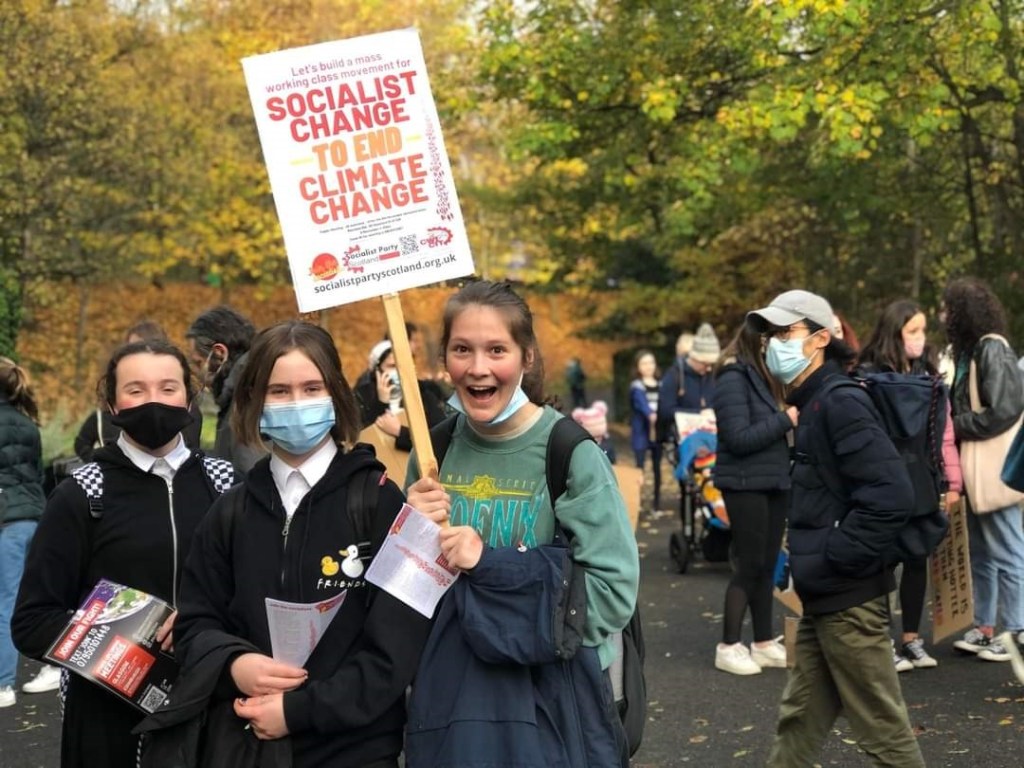
The message is clear: young people aren’t willing to pay the price for capitalism’s exploitation of the climate, and failure to give us a future. The climate crisis is pushing more and more students and young people into action. As well as countless grassroots youth-led campaigns taking shape in various communities, the ‘School Strike for Climate’ movement saw millions of students across the globe mobilise in protest against climate change, demonstrating that a new generation of young people have been pushed into action. After all, young people are now entering into a world of climate breakdown, increased militarisation, and vast economic inequality. Now, more than ever, young people are seeking an alternative system which can provide a genuine way forwards.
While many young people may have looked to the Green Party, hoping that they may provide an alternative, their actions have fallen short. For example, the party voted through £51 million in cuts to Bristol City Council, a move defended by Green council leader Tony Dyer as a necessity, as he explained in a BBC interview that they were simply having to “work within the constraints that are placed upon us.” This just exposes the Greens’ lack of a clear, transformative vision for a socialist society, which is vital for any party looking to stand up to the capitalist system and its demands that the working class pay for the bosses’ climate catastrophe.
As Labour leader, Jeremy Corbyn’s 2019 manifesto included a £250 billion green transformation fund, a commitment to a publicly owned national grid, and for the “supply arms of the big six energy companies to be brought into public ownership”. His manifesto, which also included other bold policies such as the scrapping of tuition fees, electrified millions of young people.
Now Corbyn has joined Zarah Sultana in pledging to build a new party to take on Starmer’s Labour. Socialist Students welcomes this as a potential major step forward in fighting climate change and capitalism. As a bare minimum, Corbyn’s green policies from 2019 would be a starting point, from which a mass movement for socialist change, not climate change, could be built.
Under a socialist system, the banks and major industries – including the major energy companies – would be placed in the hands of workers, not the capitalist bosses. By cooperating and discussing together, it would be possible to democratically draw up a plan of production based on human need, including the need for a healthy environment. The world’s massive wealth, resources and technology could be steered towards ensuring we live sustainably. Millions of high-quality, eco-friendly jobs would be created as societies shift rapidly towards green energy. Decisions about where to locate renewable energy production could be made democratically, with proper community consultation.
Socialist Students campaigns at schools, colleges, and universities across the country – to allow young people to make their voices heard in the fight for a viable socialist future, in which the needs of people and the planet which we live on are no longer secondary to profit. If you agree, then join us this term.

 Socialist Students