Behind closed doors, a major university policy change is being discussed and, typically, its not good news! Vivienne Stern, the CEO of employers’ organisation, Universities UK, insists that students finance the gap in university budgets yet again, through ever-higher tuition fees. This is off the back of a broad financial report, which outlines the very real mess that university managements have found itself in, where issues such as an exodus of international students, whose higher tuition than domestic students many universities rely on, have been compounded by unprecedented inflation.
Yet there are no illusions about the popularity of such a move: “Political suicide”, Stern describes it – very hot in Westminster right now. She urges whoever is in power to implement it that they “act quickly” before an inevitable wave of student outrage. Yes, ‘before anyone notices’ seems to be the strategy they’re going for here!
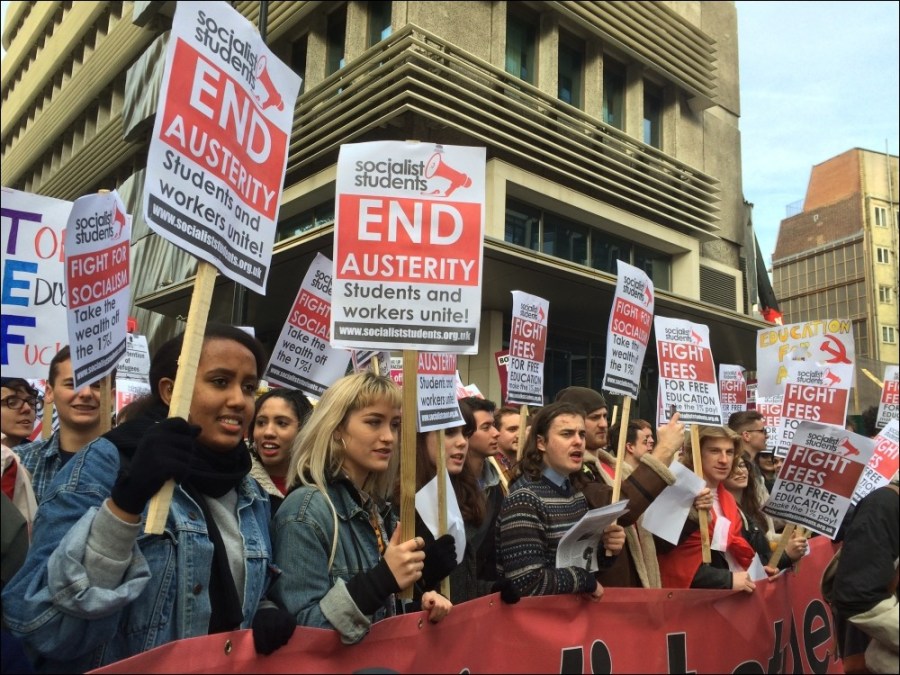
And no doubt such outrage would be fierce: students are already bearing the brunt of major systemic failings. With the confidence built during the continuing wave of agitation for Palestinian liberation, no doubt we would be on the streets in our thousands, as students did over a decade ago the last time tuition fees were tripled.
But why wait for things to get worse? We students don’t need permission to organise and fight to make university life bearable. Stern says raise tuition fees, we say: ‘Abolish them!’ And secure ample student maintenance grants in turn. Keir Starmer, likely future prime minister, U-turned on Jeremy Corbyn’s free education policy. We need a new mass party that will stand up for students and workers.
Socialist Students says:
Fight for fully funded free education – scrap and refund tuition fees, cancel student debt, replace student loans with living grants tied to the rate of inflation. Make the super-rich pay!
Take universities under the democratic control of elected bodies of campus trade unions, students and communities
Build democratic student organisations to link up with the campus trade unions and fight for what our universities need
Build a new mass party that will stand up for students and workers
Fight for socialist change – for democratic public ownership of the banks, monopolies and major industry to provide us with a future
Despite the numerous advances in women’s rights that have been won through mass struggle over past decades, many on International Women’s Day in 2024 will be questioning why the basic problems that women face – lower pay, greater risk of violence, objectification in the media, to name a few – still continue to exist today.
To understand how we can end the oppression of women it is necessary to first analyse where it comes from and the conditions that led to its creation in order to understand what conditions are needed to remove it.
We republish here an article written by Christine Thomas (author of ‘It Doesn’t Have to be Like This: Women and the Struggle for Socialism’) on the contribution of Friedrich Engels, one of the founding figures of Marxism, to analysing women’s oppression, its evolution over time, and how it can ultimately be abolished.
The ‘Origin of the Family, Private Property and the State’, published in 1884, was Engels’ main contribution to the issue of women’s oppression. It showed that women’s second-class status in society, the inequality, discrimination and oppression we face, hasn’t always existed.
In the late 19th century this was explosive stuff. At the time, women’s inferior status was considered ‘natural’, explained by their biology or ‘God’s will’, and absolutely necessary for maintaining social stability. At the same time, the patriarchal family, with a male breadwinner and an economically dependent wife in the domestic sphere giving birth to and raising children, was a central, core institution of capitalism, and to challenge its universality was to challenge the entire fabric of society.
Of course, Engels’ book should be viewed in the context of the time in which it was written, and in conjunction with more up-to-date material. But the general ideas he outlined regarding women’s oppression are still relevant today, and still just as explosive.
He explained that gender inequality, discrimination and oppression are rooted in class society – in the emergence of societies where a small minority, an exploiting class, owns the means of producing wealth in society and exploits the class that actually produces the wealth.
Before that, in pre-class societies, people lived in communal, cooperative, egalitarian societies in which the main social unit wasn’t the nuclear family as we know it today, but a kinship group – that Engels called the ‘gens’ – which today are usually referred to as hunter-gatherer societies, based on how they made a living.
In these societies, in which humans lived for 99% of the time that we have been on the planet, there was no private ownership of the means of producing wealth, no classes and exploitation, no state apparatus and no systematic oppression of women.
Although Engels got some of the detail wrong, because of the scant anthropological and scientific evidence available at the time, the evidence that has come to light since backs up the general thrust of his ideas.
Pre-class societies
There was a gender division of labour in pre-class societies, although it was not necessarily a rigid one. In general, men were usually responsible for hunting and fishing, and women for gathering wild foodstuffs and looking after children. But this did not result in any economic or social disadvantage. The economic contributions of women and men were both vital for the maintenance of the group. Childcare was a public responsibility carried out on behalf of the group as a whole.
This was very different from the situation today. One of the main reasons why women are suffering so much more during the pandemic in terms of job losses, and pay and hours being cut, is because they are concentrated in the low-paid, part-time, often precarious jobs in retail and hospitality that have been the hardest hit by lockdowns and the economic consequences of Covid. And the principal reason why they are concentrated in those kind of jobs is that they are usually the main carers for children in the family.
During the first lockdown, women were responsible for 70% of home-schooling. In one third of the cases where women have lost their jobs or had their hours cut, it has been because they have been unable to access the childcare they need. Covid has turned an existing shortage of affordable childcare into a disaster for working-class women especially, which can only be solved by bringing childcare provision into the public sector, democratically run by service providers and users.
Engels wrote that the situation for women drastically changed following an economic revolution in which some hunter-gatherer societies discovered how to domesticate animals and cultivate crops. This unleashed economic and social processes which, in some societies, over thousands of years, led to the development of an economically exploiting class extracting surplus production from the labour of others, and expropriating it for themselves. A special state apparatus was also created to ensure that the exploited class continued to produce, and was kept under control.
As an intrinsic part of these processes, the individual household, or family, replaced the communal kinship group as the main economic unit in society. At the same time, women of the ruling class literally became the private property of men within the family.
Wealth and property
In order to ensure that their property and accumulated wealth could be passed on to legitimate heirs, the sexuality and reproduction of women of the ruling class came under the authority and control of husbands and fathers, including through the use of violence and physical chastisement. And, as the state apparatus developed, the legal system, religion, education, and ideology generally served to legitimise and reinforce women’s inferior, second-class status, and deny them basic rights.
This is the historic basis for all of the inequality, discrimination and oppression that women still face today. It is at the root of domestic violence and abuse, rape, sexual harassment, the double standards and stereotyping of male and female roles and behaviour, and sexism in general.
Many feminists believe that the main cause of women’s oppression is the patriarchy, but Engels showed that there isn’t a structure of patriarchy separate from class society. Women’s oppression and class society emerged together as part of the same process – they were inextricably linked together then, and still are under capitalism today.
Therefore, gender oppression, Engels explained, can only be eliminated by ending class society – a fundamental transformation in the way that society is structured, organised and run. Today, this would mean moving away from an economy based on the private ownership of the means of producing wealth by a small group of super-rich capitalists interested only in making a profit, to one where the principal industries are publicly owned, and democratically run and planned by working-class people.
It would then be possible to immediately release the resources for changing the economic and material situation for women. Everyone would be guaranteed a job on a decent wage, which would mean that women would have real economic independence.
It would be possible to do what Engels put forward in the ‘Origin of the Family’ – to socialise the unpaid labour of women in the family by the state providing flexible, quality childcare, social care, affordable community restaurants, affordable housing – things that would totally transform the lives of women, and working-class women in particular.
We would add, that ending gender inequality in the family and in the workplace would also lay the basis for eliminating gender violence and the sexual and cultural oppression women face.
The values in society would change. Capitalism is a system based on unequal wealth, hierarchies of power, and competition. The capitalist class is prepared to resort to the use of force and violence to defend its interests and control where necessary – against strikers, protesters, and in wars. Those values have an impact more broadly in society and affect how we relate to each other.
A socialist system would be based on cooperation and solidarity, and those values would be reflected in personal relations and culture, just as they were in pre-class societies.
And of course, there would no longer be a privately owned media, or beauty, fashion, and leisure industries, and all the other industries that turn women’s bodies into a commodity to make a profit, and promote stereotypical expectations and norms about how women and men should look and behave.
If we removed all of those things, while at the same time initiating a programme of awareness-raising and education, then all gender oppression could be ended over time.
Engels outlined the origins of women’s oppression and what would be necessary to end it – a socialist revolution led by a united working-class.
Socialist Students campaigns for:
● Government funding for what women need on campus – properly funded support and counselling services, campus lighting, childcare services and affordable housing. Scrap tuition fees, cancel student debt and replace loans with grants which increase with inflation.
● Democratic oversight of sexual harassment reporting and campus safety procedures by joint trade union and student-led committees
● For democratic trade union, staff and student control of university syllabuses and teaching procedures with proper training around handling inappropriate behaviour
● Fully funded and affordable public transport available at all hours to ensure students get home safely
● Students get organised! Rebuild fighting, democratic student organisations to campaign on campuses. Build a new mass workers’ party to give workers and students a political voice
● Fight for a socialist alternative to capitalist inequality and chaos to end all forms of oppression
Organising the fight for a socialist world in schools, colleges and universities
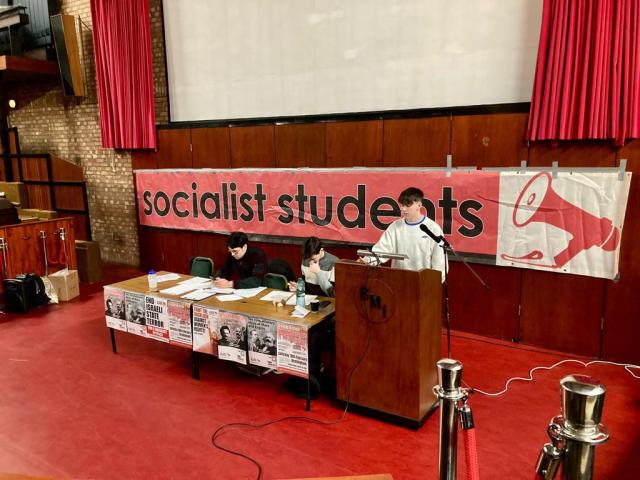
Queen Mary Socialist Students member addressing the conference(Photo: Berkay Kartav)
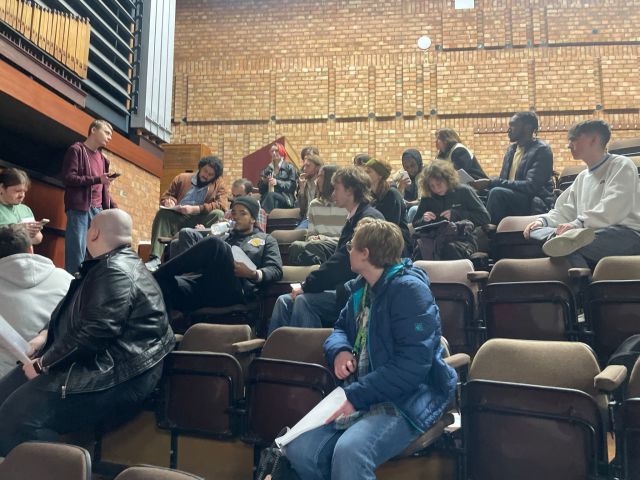
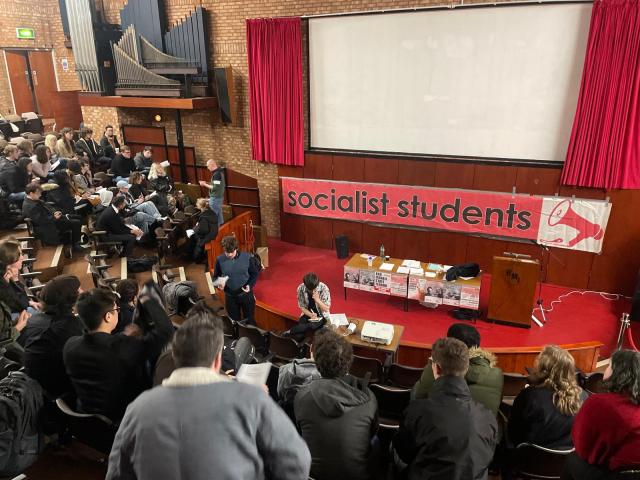
Nearly 100 young socialists met in Birmingham on Saturday 10 February for Socialist Students national conference. Held annually to decide the political direction of Socialist Students for the coming year, the conference brought together student organisers from over 30 university and college campuses, as well as young workers and trade unionists bringing solidarity as visitors.
This year’s conference took place in the midst of the huge protest movement against Israel’s brutal onslaught on Gaza, which has seen thousands of students across the UK protesting. Delegates from a number of Socialist Students groups reported on successful protests and walkouts they had organised in their colleges and universities. Conference agreed unanimously that Socialist Students should “continue its campaigning to build a young, socialist pole of attraction within the current anti-war movement”.
The importance of building support for socialist ideas to end war was underlined in the opening discussion on the global crisis of capitalism, which outlined the growing fault lines for conflict around the world. Added to the deepening environmental crisis, the soaring cost of living and attacks to our democratic rights, the recent outbreak of major wars – first in Ukraine and then in Gaza – shows the dystopian character of capitalism today. That’s why delegates voted for Socialist Students to “reaffirm our commitment to fighting for a socialist world, free of exploitation and oppression”.
The rest of the conference was all about how Socialist Students groups go about doing just that – practically putting forward what steps we can take now to organise the fight for a socialist world within our schools, colleges and universities.
Socialist Students organisers reported different initiatives that they had taken, or were planning to take, on their campuses – campaigning for things such as rent controls in student housing and standing candidates in student areas in the upcoming local elections. Speakers emphasised the need to link our immediate campaigning demands to the fight for a socialist system, as the only way for improvements to our lives to be won on a stable basis.
All of those demands – whether it’s defending our right to protest, or ensuring we can afford to keep a roof over our head – point to the need for a political voice to fight in the interests of students and young people in parliament and the council chambers. This year’s conference identified the upcoming general election as a crucial opportunity for Socialist Students to organise a political fightback among students – not just to kick out the Tories, but also to offer a socialist alternative to Keir Starmer’s Labour Party.
Multiple speakers reminded conference about Jeremy Corbyn’s time as Labour leader, which saw the biggest youth movement of the past decade in support of his left, anti-austerity policies – including the call for free university education.
Socialist Students organisers have previously stood as part of the Trade Unionist and Socialist Coalition (TUSC) in local elections. This year, conference decided that Socialist Students should approach TUSC about affiliating nationally, as the best way to coordinate with other groups putting forward a “working-class challenge to the pro-austerity and pro-capitalist parties at the next election”.
The mood of delegates throughout the day was determined and optimistic. There was a real back-and-forth exchange of ideas among all the young people gathered, which continued into the breaks and the post-conference evening social. Dozens of speakers came in to speak throughout the day, including many attending their first Socialist Students conference. The sense among organisers was that we’ve got work to do now, and a world to win – and this year’s conference has put us in the strongest possible position to do that.
The wealthiest 1% hope to make social change seem like an impossible goal. But the various capitalist crises are taking their toll on young and working-class people in a way that cannot be ignored. This is why more and more young people consider themselves socialists.
This is why the Socialist Students conference is a great opportunity for anyone who wants to get involved, but doesn’t know where to start. It is an opportunity to link up with others to share and develop ideas.
It is very easy to feel politically isolated, that every effort made to fix the system is meaningless. By attending Socialist Students conference you get to see how a democratic organisation operates.
It is also a great opportunity to meet and socialise with other young socialists from up and down the country.
Socialist Students groups have a lot to prepare for.
As the Tories continue to splinter and break apart, Keir Starmer’s Labour looks set to run the country. This government will not be run in the interests of students. Starmer has shown himself to be no friend of the working class.
It’s imperative that we discuss how best to tackle capitalist policies, and defend our right to an education that doesn’t cause a mountain of debt once we’re finished.
Starmer’s Labour doesn’t just threaten students. His refusal to promise to scrap all the Tory anti-union laws means that workers will still find their rights under attack. Students and workers need to link our causes together.
The majority of Labour MPs voted with the Tories against a ceasefire in the brutal and relentless war on Gaza. Many MPs that did back a ceasefire, only did so because of the immense pressure felt by the continuous protests.
Rishi Sunak was also forced to sack ultra-right-wing home secretary Suella Braverman. This proves our actions have results. The next step forward is to discuss what we can do to put pressure on this government, with student walkouts and more.
Teachers can’t teach lessons properly because they are way too overworked and underpaid. Because there aren’t enough teachers, PhD students are heavily relied on, which drives the wages even lower.
Students enter higher education to experience what it is like to live like an adult for the first time, and to discover themselves. But they can’t even afford that. At 18 years old, they have to take a loan, almost equivalent to a downpayment for a house. It’s a predatory practice.
They then have to deal with accommodation. In the first year, you are lucky if you get a place that doesn’t smell of mould, or isn’t the size of a coat closet.
After that, you have to fight every year to get a basic room that won’t cost you your life savings. Almost all educational institutes in the UK give no support to students either, from meals or tutoring, that the teachers have to do off-hours. The system has beaten everyone. This is why students should be socialists.








 Socialist Students