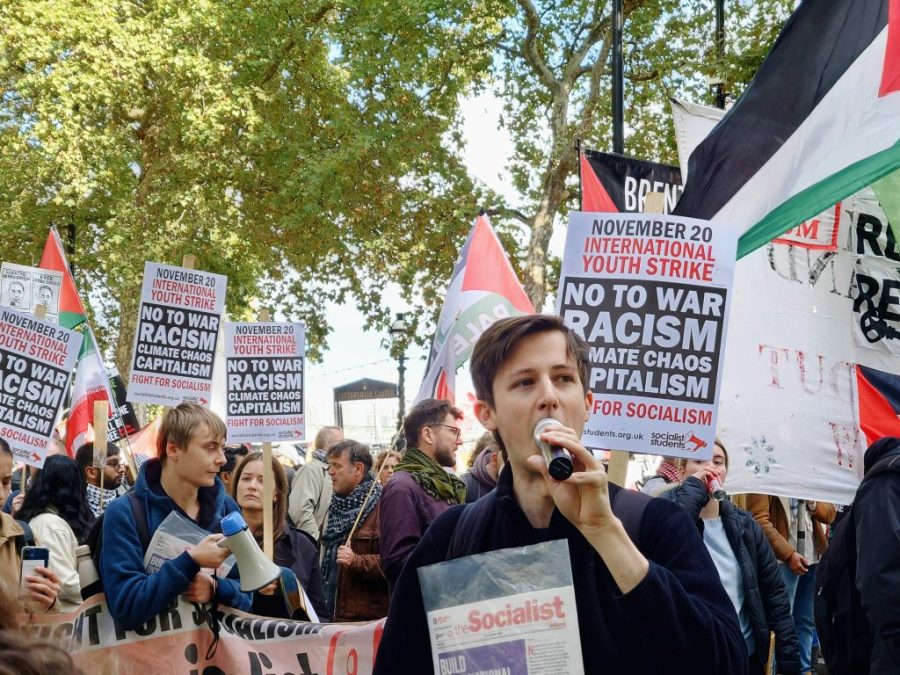
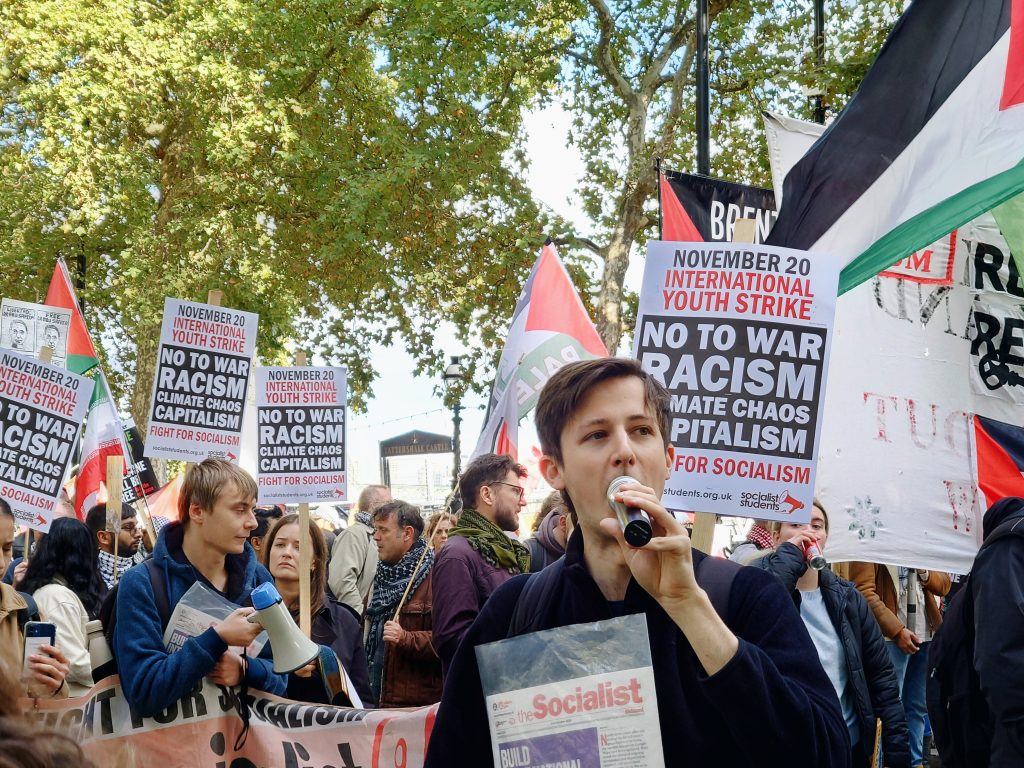
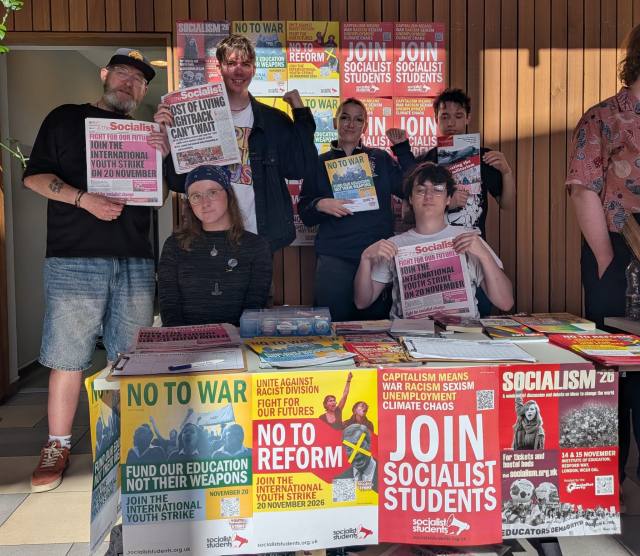
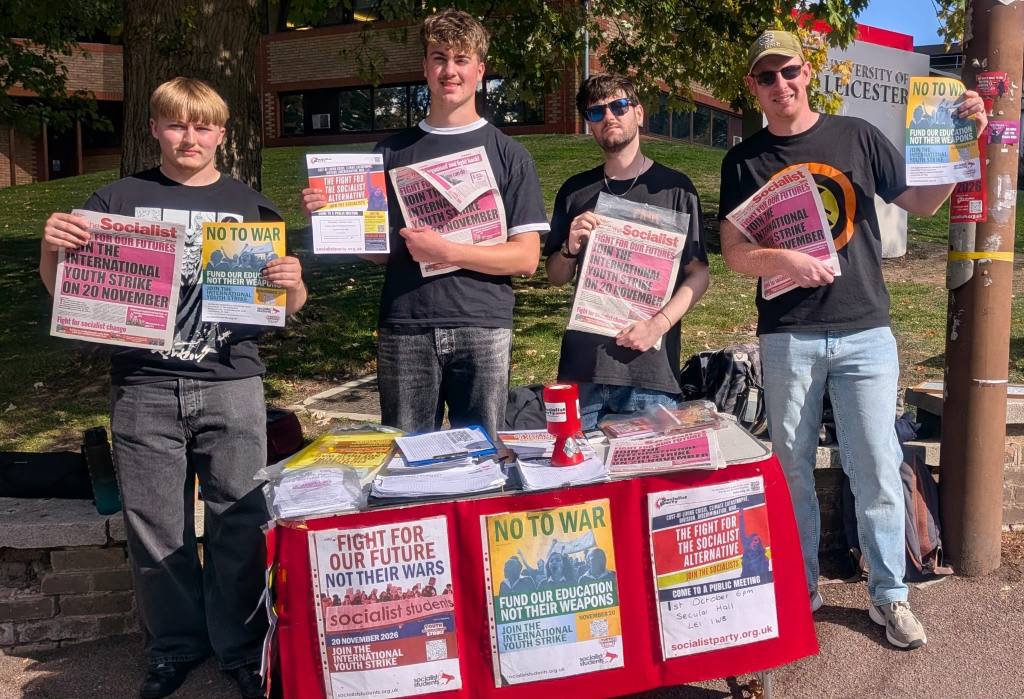
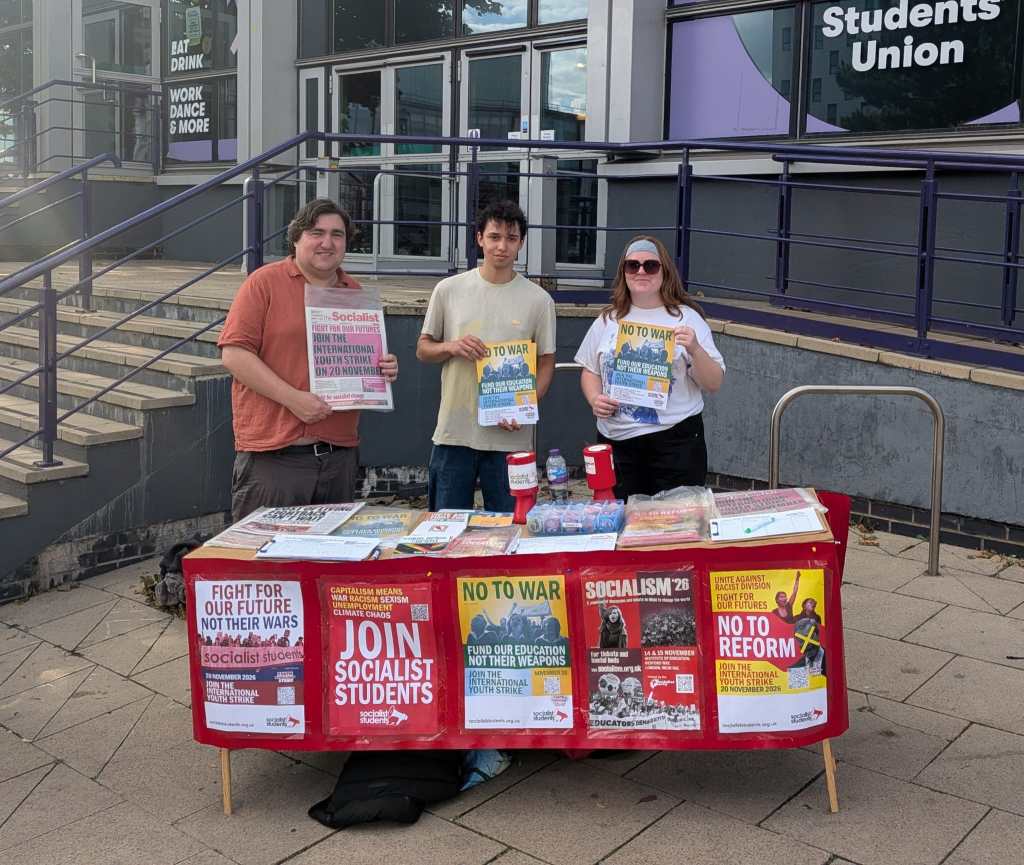
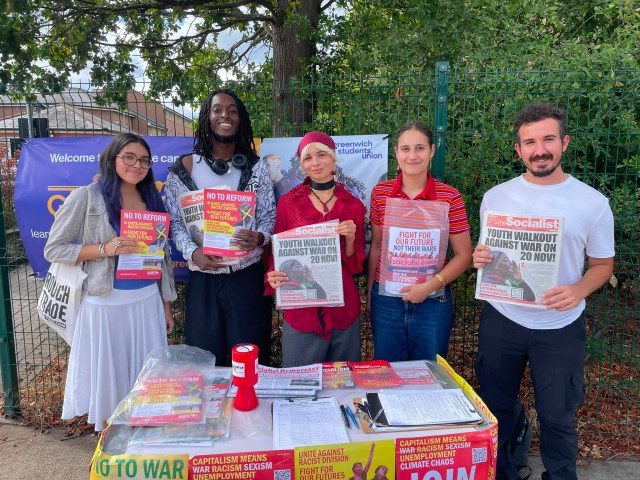
The largest education union in Europe, the National Education Union (NEU), has voted to support the International Youth Strike taking place in Britain and all across Europe on November 20.
The motion to support the International Youth Strike, which was passed by the NEU’s national executive yesterday, included resolutions to:
“Express support for the right of young people to peacefully organise, protest and make their voices heard, including those taking part in the N20 day of action.”
“Oppose disciplinary action against students participating in peaceful protest activity, including detentions or other sanctions, and to support campaigns defending students’ rights where required.”
“To provide members with information about the N20 International Youth Strike through NEU communications channels, providing members with how they can safely and responsibly support participating students’ rights in line with safeguarding requirements and legal obligations.”
! Socialist Students enthusiastically welcomes the support of the NEU.
As students, we stand united with workers organising against attacks on our education. From Albania to France, India to Argentina, the fight for high-quality, free education has been a central part of the international youth movements that have spread globally this year.
For us, a major aspect of the International Youth Strike slogan – ‘fight for our future, not their wars’ – is the fight against education cuts, student debt, tuition fees, and for fully funded public services. Socialist Students says that means building a movement to take wealth, resources and technology out the hands of the billionaires – towards a socialist society based on meeting the needs of all, not the profits of a tiny few and their wars.
We also warmly welcome the initiative of the NEU to offer practical solidarity to students choosing to protest on November 20, such as stewarding peaceful protests on the day, and backing any campaigns against disciplinary action that students might face.
Across the world, young people are beginning to take to the streets expressing anger at the lack of a future being offered to us under capitalism, and in opposition to war and militarisation.
This wave of youth demonstrations is particularly visible in Europe, where the threat of increasing militarisation and military conscription looms. In Germany, nationwide school strikes against conscription have mobilised 55,000 young people. Inspired by these mobilisations, an anti-war youth assembly was formed and met in-person in June, bringing together 20 socialist youth organisations from 8 countries across Europe to organise an international youth strike ‘fighting for our futures, not their wars’, on 20 November. Socialist Students was invited to be part of this.
Students and young people in Britain have been a feature of the mass movement in solidarity with Palestinians and against Israel’s war on Gaza – including through university campus encampments. And in 2025, when Donald Trump was invited by the Labour government for a state visit, Socialist Students led school and college walkouts.
It was the success of this action, and coverage of it in the press internationally, that helped us find other youth groups internationally.
But it is necessary to build on these successes. The growing anger among young people provides an opportunity to build a united fightback of youth internationally, against war and militarisation.
However, to do this we need to understand what is driving the increase in war and why governments across Europe are pouring billions into rearmament, at the expense of our public services and education. The threat of increasing wars and conflict is rooted in the increasing tensions between capitalist powers internationally. Fighting for an end to war therefore means fighting the rotten capitalist system that produces it and building a socialist alternative.
Capitalism is in crisis. Across the world, economic growth is slowing and productivity has stagnated in many of the major capitalist economies. At the same time, governments face growing debt and are driving down the living standards of the working class in an attempt to protect the profits of the capitalist bosses. International capitalist institutions like the IMF and OECD have warned of a weakening global outlook due to trade tensions and instability.
But crisis is inherent to the capitalist economic system, based on profit and competing capitalist interests and competing capitalist states. When crises happen, competition between capitalist powers sharpens. The struggle for resources and political influence becomes increasingly backed by military power, fuelling further conflict.
The US, China and other powers are competing to protect their economic interests and expand their influence. In doing so, governments and states are not simply choosing to be aggressive but are responding empirically to the pressures created by the unstable capitalist system.
Growing international tensions
One element of this is the growing tensions between the US and China. The US has dominated the global economy and international political system for decades, but China’s rapid economic growth has challenged that dominance, and the US is now in relative decline. China has expanded its trade and investment across the world, while the US is attempting to defend its position. As each power strengthens its position, the other is pushed to respond.
In Europe, Russia’s invasion of Ukraine in 2022 was a turning point. The British government’s 2025 strategic defence review describes the Ukraine war as marking a ‘new era’, with “state-on-state war returning to Europe”.
This is driving increased militarisation across Europe. In Britain, before he left office, Starmer announced the plan to raise annual military spending to £80 billion per year by 2029 – an increase of £25 billion from the previous year. This funding is lifted directly from the pockets of the working class, with the Labour government making cuts in the form of increased taxes, reduced disability benefits, and reduced investment in the NHS, schools, housing, and other public services.
Working-class and young people won’t simply accept cutbacks to our services to pay for weapons and war. Many will however, have anxieties about increasing military threats. These threats are ramped up by the capitalist politicians and the media to try to justify spending on the military in the name of ‘defence’. The whipping up of nationalism by the capitalist class is part of that.
In fact, young people and workers in Britain have more in common with workers and young people in Germany, Italy or China than with a British billionaire.
We all face rising unemployment, unaffordable housing and climate catastrophe, while they live in luxury. And it is us and our friends and relatives who are most likely to be fatalities in wars and conflicts.
Young people across Europe are coming together to take part in the international youth strike on 20 November. The fight against war must be international. A socialist transformation of society would be the basis by which to replace competition between capitalist states with solidarity between the international working class.
However, an international approach begins with understanding and organising against our own governments. In Britain the drive towards militarisation is already having consequences for workers and young people.
We are already seeing militarisation creeping into our education system. 35 UK universities have entered the Defence Universities Alliance, which is a competitive arms research programme partnered with the UK government. Universities receive some income from this alliance. Amid an education funding crisis, this shows why we need universities and colleges to be fully publicly funded, and under the democratic control of the working class and students.
There are limits to how far governments can go to increase militarisation at the expense of the working class. Economic stagnation means that governments have less to spend. Former Defence Secretary John Healey resigned over Starmer’s reluctance to increase defence spending as far as he wanted. While Burnham has refused to commit to Healey’s target by 2030, he has retained Starmer’s £80 billion spending commitment and appointed Healey as Chancellor.
But pressure from the working class has also limited the government’s power to act. It was working class anger at Starmer’s cut to winter fuel payments for pensioners and disability benefits cuts that forced U-turns.
In 2023 Tory home secretary Suella Braverman was sacked due to her threats to ban protests against the genocide on Palestine. This is the largest and most sustained protest movement in the UK since the historic 2003 protests against the invasion of Iraq.
The fight against war and militarisation is happening across the world as well. Across Europe, governments are using the threat of war to justify increased military spending while workers face austerity and attacks on living standards. The EU has relaxed its fiscal rules to allow increased defence spending, while governments continue to impose restrictions on other areas of public spending. Rearmament is being prioritised as public services are starved of investment.
The German government is planning a dramatic increase in military spending, with an aim to match the combined totals of the UK and France by 2030. Furthermore, they have introduced the deeply unpopular conscription, sending out a survey to young people to which only 0.07% responded in favour of going to war for Germany. Tens of thousands of young people have mobilised against the threat of conscription. School strikes have shown that young people are not prepared to accept a future in which they expected to pay for militarisation, either through cuts to living standards or through being sent to fight.
In Italy, a one-day general strike in solidarity with Palestinians in autumn 2025 showed what the organised working class can achieve, students joined the walkouts and protests too. Workers have taken action at ports, demonstrating the industrial power they have to disrupt the movement of military cargo. This demonstrates that workers have the power to stop the machinery of war themselves.
We have also seen the power of youth movements outside Europe. In India, the youth-led ‘Cockroach’ movement mobilised hundreds of thousands around leaked examination papers, corruption and the lack of opportunities facing young people. After weeks of protests, Education Minister Dharmendra Pradhan was forced to resign and the government conceded to several of the movement’s demands.
These struggles all point to the fact that pro-capitalist governments have limits to their power. When workers and young people organise, they can disrupt the plans of governments and force them to make concessions. But this also raises a more fundamental question. If workers and young people have the power to force concessions from the government, why shouldn’t they have the power to decide how society is run? Winning individual demands is important, it can boost the confidence of workers and young people to struggle, but it does not bring an end to the rotten capitalist system.
The role of the working class
The working class has a unique position in society. It is workers that produce the wealth and keep society functioning. When organised, workers have the potential not only to resist government’s decisions, but to take democratic control of how that wealth is used.
Capitalism is based on competition between companies for profits and between capitalist states for markets, resources, and economic and political influence. While society is organised around these competing class interests, the pressures that drive militarisation and war will remain.
Working-class and young people therefore need a political organisation that genuinely represents their interests. The Labour government has shown that it is not prepared to challenge the interests of big business, including the arms industry. The Greens have opposed the government’s approach to rearmament and called for greater investment in diplomacy. However, their ideas do not challenge the capitalist system. Officially, they call for Britain to remain in the NATO military alliance with other capitalist powers including the US. The Greens ask how we can make capitalism more peaceful, but we must argue to change the system that produces war.
We need a political alternative that represents the interests of workers and young people and fights for the socialist transformation of society. A socialist society would mean democratically taking control of the wealth and productive resources of society and using them according to social need rather than private profit.
Workers in the arms industry, for example, have valuable skills and productive capacity. With that industry nationalised under democratic workers’ control, decisions could be made collectively to decide how those skills and resources could be used for socially useful production rather than for the creation of weapons and the generation of profit.
However, this does not mean workers should just accept physical attacks against them. Fighting for demilitarisation does not mean denying people the right to defend themselves. The question is which class controls defence, and in whose interests is it carried out? Workers should be able to organise to defend themselves through their own democratic organisations, rather than being forced to fight in the interests of governments and big businesses. The struggle for working-class self-defence can be connected to the wider struggle for workers’ control.
Ultimately, socialism provides the basis for overcoming the divisions between workers of different countries. The working class has no interest in fighting other workers for the profits of their respective ruling classes, they have directly opposed interests.
Workers and young people need peace, decent living standards, and secure futures, while arms companies want profit from instability and rearmament. An international socialist transformation would replace competition between capitalist states with democratic cooperation between working people, removing the material basis on which nationalism and war are continually reproduced.
This is why the fight against war is inseparable from the fight for socialism. The 20 November youth strike is a step towards building the organisation and solidarity of the international working class, and a chance for young people to demonstrate their need to fight for our futures and not their wars.
Becca was a Socialist Students delegate to the June meeting in Cologne, which set the initial plans for the Youth Walkouts on 20 November
As temperatures globally go up and up, many are increasingly worried about the effects of climate change. Young people today are heading into a world of climate crisis, vast economic inequality and militarisation, with little certainty as to what the future holds.
The extreme temperatures across the UK this summer have led to rail lines buckling, over 1000 hospital operations being cancelled, and millions of people being forced to work in unbearable heat. An estimated 2,700 people died prematurely due to the heatwaves in England and Wales in May and June 2026 alone.
At a time when we desperately need massive investment in green energy and other measures to stop the climate crisis, this Labour government is instead pouring billions into military spending, while calling for further cuts to education and public services in order to pay for it.
Once again we see that the current world establishment, representing the interests of the billionaire capitalist class, have no plan to keep us safe. That’s because they defend a capitalist system driven by increasing the profits of a few at the expense of the overwhelming majority and our planet. Competing capitalist nation-states, putting the short-term profit interests of ‘their’ elites before all else, prevents the long-term global planning and collaboration that would be needed to solve the climate crisis.
That’s why we need socialist change to end climate change: a system where the control lies in the hands of the working class, instead of capitalist billionaires; where wealth, resources and technology would be used as part of a democratic global plan of production to meet the needs of all, while also protecting the environment.
Build the International Youth Strike on November 20
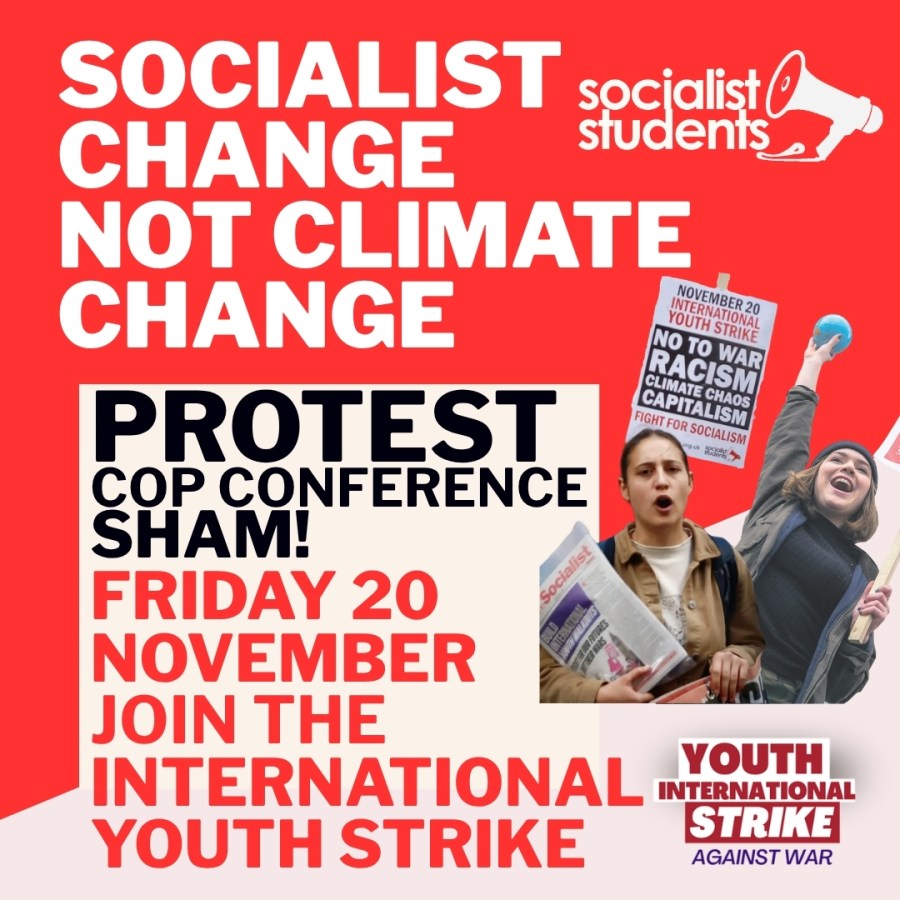
On Friday 20 November, Socialist Students will be taking part in a day of protests and walkouts all across Europe as part of the International Youth Strike, in coordination with thirty other European youth and student organisations under the slogan, ‘fight for our future, not their wars’.
Coinciding with the final scheduled day of this year’s UN Climate Change Conference (COP31) in Turkey, the International Youth Strike is a chance to take aim at all the ruling elites who will gather to talk a load of hot air while doing nothing to stop this crisis.
Over 100,000 students are expected to walk out and protest across Europe on November 20. Join Socialist Students to be part of a movement for socialist change, not climate change, war and all of capitalism’s crisis!
York uni: no shops, no reception, no security, no bus – paying more for less
Louie Nardini, University of York Socialist Students
We kicked off freshers with door knocking at Halifax College. This is an underfunded part of the university. Over years it has been deprived of its Nisa, its local reception, and its bus stop. Students coming back from a night out or shopping now have to walk 15-20 minutes back home through a darkly lit alleyway, with no proper lighting.
During the muddy times of the year, the alley becomes impossible to walk down. The bus company, First, which made millions of pounds in profit last year, says it can’t afford to put a bus stop at the college.
But Halifax is the largest college at the uni, with over 1,000 students. The cheapest accommodation here is St Lawrence Block – HMOs (houses of multiple occupancy).
The rent has gone up
You share with 20 other students, with only one proper kitchen, four toilets, and four showers. The rent went up this year from £99 a week to over £150 a week.
Halifax College was even gifted by Lord Halifax to be cheap and affordable accommodation for students. Not anymore!
This is nothing new in the University of York. The amount of accommodation that is less than £200 a week has shrunk from 47% to 15%, just in the past year. All while tuition fees are rising. We are getting less and less out of our education, while paying more and more.
We got 37 signed up for Socialist Students. And we’re going around the rest of the college and uni this week.
These pressures on students are only getting worse. We hope that the 20 November walkout builds the breadcrumb trail to fight against this cost-of-living crisis, and push forward socialist change for students and young people.
Sheffield Hallam – students worry about future and cost of living
James Hooper, Sheffield Hallam Socialist Students
Speaking to students during freshers week, we heard time and time again, that their biggest worry was their future after university, and the hefty cost during it.
The government wants students to take on a generational amount of debt for an education that only garnishes the pockets of the bosses and the landlords of the city. The University and College Union (UCU) is taking ongoing industrial action against ‘voluntary’ redundancies, cutting some departments in half.
We had a powerful reception from students, getting details of nearly 80 who are interested in attending meetings. During our first two socials, we spoke about the 20 November walkout, the rise of the modern far right – Sheffield had a far-right march that week – and how students can fight for better conditions during our education.
Birmingham building youth walkout and backing bin strike
James Taylor, Birmingham Socialist Students
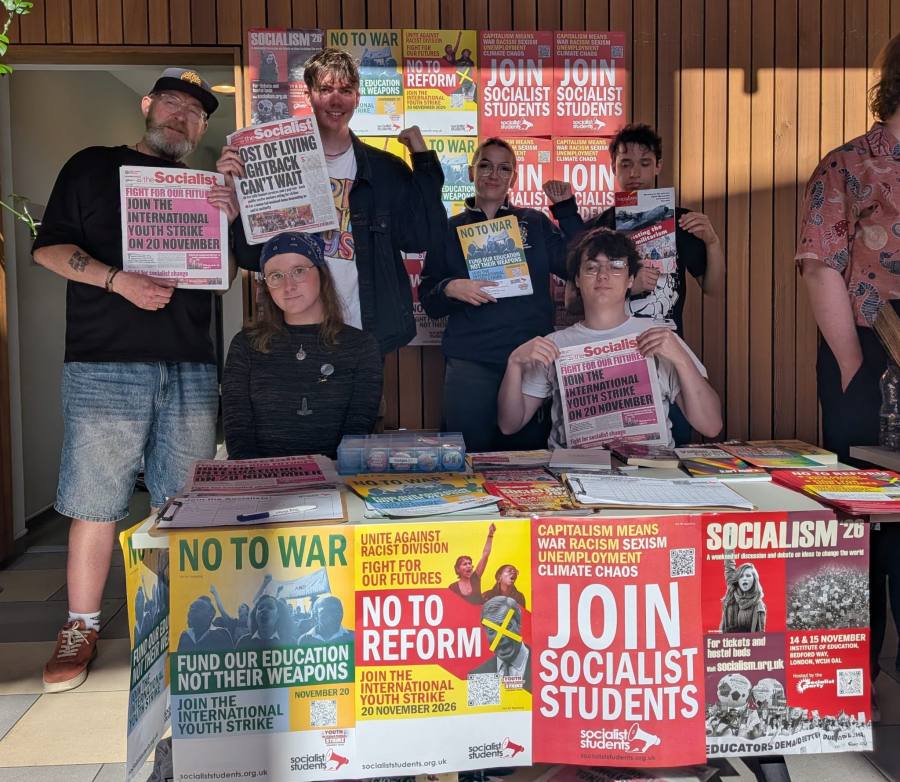
Socialist Students had a campaign stall every day of freshers week. On each day, several students walked straight towards us, having arrived at the University of Birmingham actively searching for a socialist group to join.
Over 200 students, and some staff, wrote down their names to be contacted and updated on our activity. We gave out more than 2,500 leaflets.
A layer of students have been inspired and disgusted by the events of the last year. The election of Zohran Mamdani in New York, and the rise of the Green Party in the polls.
But also the Iran war and victories of far-right parties across Europe. Tuition fees and the cost of living came up repeatedly in conversations with students.
Our action-focused approach attracted these people to Socialist Students over other campus groups. Our involvement in the Birmingham bin strike, and building the 20 November youth walkout, excited students ready to get involved and fight for socialism.
We got a good amount of students along to a casual meet-and-greet on campus, and hopefully we will be joined by even more of the 200+ contacts at our first proper meeting of the year this week.
York St John – my first time campaigning
Tamsin Allanson, York St John Socialist Students
This was the first time I’ve ever done anything with Socialist Students. And it was my first time ever helping out at a campaign stall.
I was nervous at first. For the first hour or so, I mostly kept quiet.
But as the day went on, I really settled in. I watched how others were campaigning, and ended up having conversation with passersby myself. It improved my confidence to do similar things in the future.
People were really receptive. We counted 39 sign-ups at the end of the day.
Queen Mary, east London – Climate crisis, AI, and war
Luca, Queen Mary Socialist Students
Students agreed with our grievances against the new nearby AI data centre, our previous campaign winning gender-neutral toilets and changing facilities at Queen Mary, safe and affordable housing, and protesting the government’s complicity in genocide in Gaza.
We had two campaign stalls on each day of the freshers’ fair, collecting more than 80 contacts. Students asked ‘what is socialism’, how data centres impact communities, and about the climate crisis.
We held discussions on both days at a nearby café. There, students expressed interest in participating in rallies, campaigns, and discussions about political theory.
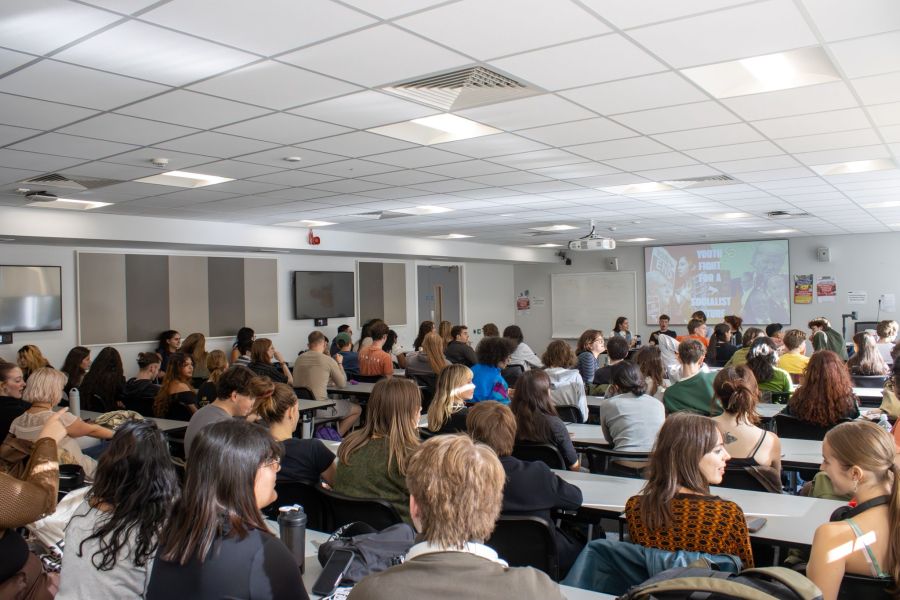
Our first meeting was ‘Climate crisis, AI, and war: what is the socialist solution?’ 12 attended, 8 new faces.
We discussed action, we planned for what next. Students were very enthusiastic about contributing.
USW Trefforest – we’re gonna need a bigger room
Students are calling for a change. And at the University of South Wales (USW) freshers’ fair, they are turning to Socialist Students in dozens for that very change. At the University of South Wales,
Socialist Students attracted the interest of 173 students at the freshers’ fair. 14 came to our first Socialist Student meeting.
Socialist Party members also invited students to our local Rhondda Cynon Taff Socialist Party branch meeting, more than doubling attendance.
Cavan Griffin, USW Socialist Students
Leicester – enthusiasm into action
Adam Tyas, Leicester Socialist Students
Each day campaigning at the University of Leicester, the level of our activity grew. On the final day, we had two stalls, and a Socialist Students team walking around talking to students.
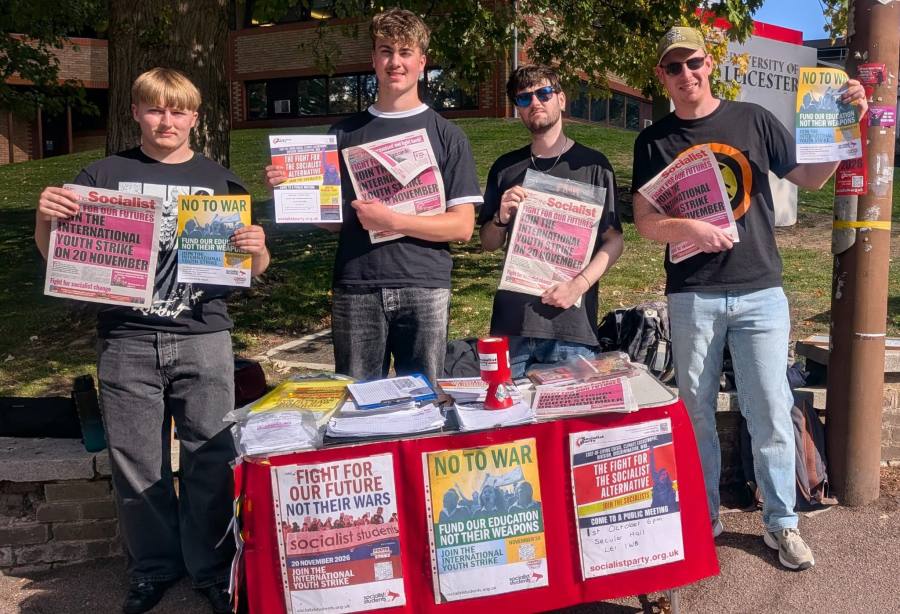
Leicester uni campus overlaps with WQE College. Over 150 students showed interest in Socialist Students and the ‘Fight for our future, not their wars’ 20 November walkout.
Although students supported us, the student union and university prevented us from leafleting the freshers’ fair queue, claiming that we needed to be an official formed society to do any activity. That’s what we were campaigning to do!
Young people are becoming increasingly politically conscious. Students openly identified as ‘communists’. Others declared that “we should have a revolution”.
What came through most strongly was growing anger at our futures being squandered by government after government, and a desire to fight for a society that works for us, rather than the wealthy.
Students showed particular interest fighting the climate crisis, and challenging the capitalist system that continues to put profit before people and the planet. Our task now is to turn that enthusiasm into sustained organisation and action on campus. We’ve organised four student meetings in the first week. And we’ve already been getting in contact with students who had signed up.
We need to build for 20 November youth strikes, and develop a proper Socialist Students society on campus. So the university has no excuse to stop our activity!
Pensioners back youth strike
Roger Bannister, North West Pensioners Association delegate
The North West Pensioners Association is composed of retired people, who are delegates from retired people’s organisations and trade unions, throughout the north west of England.
Whilst concentrating primarily on issues directly affecting older people, we are totally opposed to ‘divide and rule’. For example, being pitted against young people by government ministers in an ‘either/or’ squabble over cash and resources.
There is enough money to give pensioners a decent living in our retirement, and to give young people decent, free education, and genuine apprenticeships, with a job at the end, as well as jobs for new graduates.
So the following motion was carried unanimously by the North West Pensioners Association (NWPA) at our meeting on 25 September:
“This meeting notes that a recent meeting of youth organisations across Europe was held in Cologne, which included representatives from the British Socialist Students organisation, and that this meeting called for a Youth Strike to take place across Europe on 20 November 2026 in protest against war, youth unemployment, and austerity policies. This meeting supports this walkout and urges NWPA affiliates to support any rallies held locally, and to publicise our support in the local news media.”
Scrolling online, it doesn’t take long to see the horror of war, climate change and racist ideas being stoked. Meanwhile, we are being forced to pay for increasing rents, tuition fees and the cost of living.
But we refuse to accept that future. That’s why we will be joining the international youth strike on 20 November – walking out and protesting to fight for our future, not their wars.
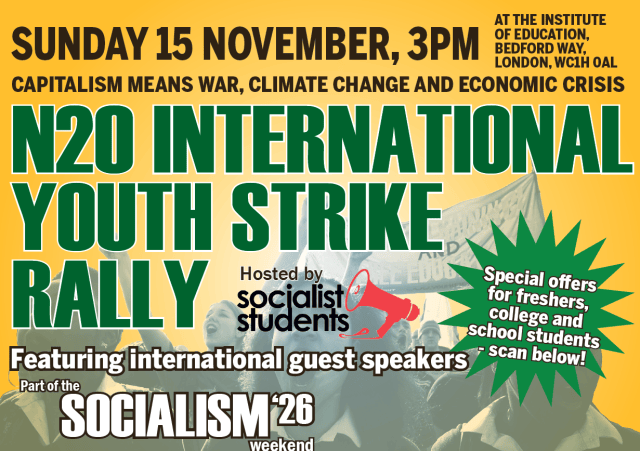
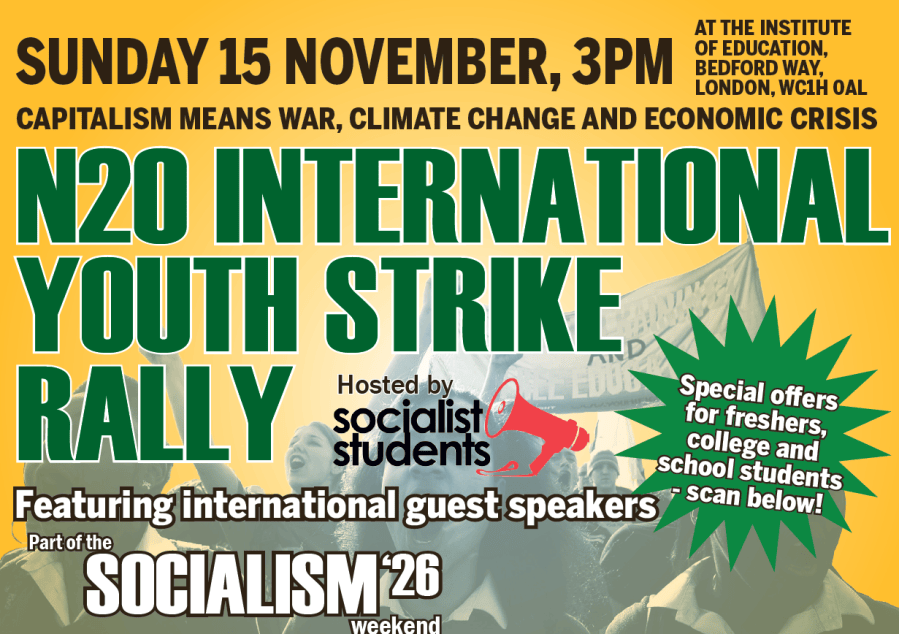
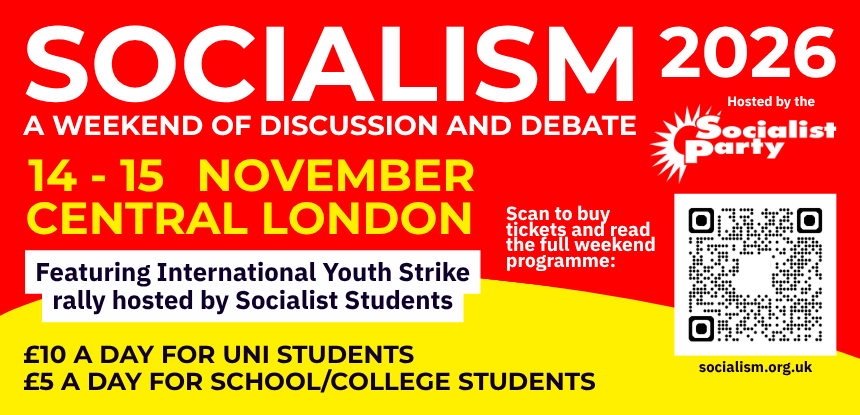
If you are preparing to be a youth striker, or a socialist campaigner at your school, college or uni, you can’t miss Socialism 2026, taking place less than a week before N20.
A thousand socialists, students and young people will meeting in London 14-15 November. On Sunday 15 November, Socialist Students has been invited to host a youth rally. It will invite youth strikers from across Europe to speak, including from Germany where on 25 September 40,000-plus walked out of lessons to protest. Socialism 2026 will be the best possible preparation for the big day – N20.
Across the weekend of discussion and debate, there will be the chance to meet and discuss with hundreds of other students building the youth strike at their school, college or uni.
Cumbria uni – linking war, climate, and cost of living
Mollie Nixon, Cumbria Socialist Students
Every year, students arrive at Cumbria, expecting an escape to nature, only to find a university much like any other – prioritising profit over academic integrity. Socialist Party and Socialist Students members from Carlisle and the rest of the north west hosted street stalls outside freshers’ fair.
Climate change came up frequently. Many students pick Cumbria for its proximity to impressive natural landscapes. Students fear this environment being lost.
Many jumped at the chance to sign up to start an official Socialist Students society on campus, after finding out about the ‘Defence Universities Alliance’, which Cumbria uni is part of. The Ministry of Defence is using university funding to covertly funnel students into pro-military research and job roles.
This led many students that we spoke to expressing interest in the youth strikes on 20 November. Some even took posters to put up in communal kitchens.
In conversation, students made the connection between climate and other struggles. Cumbria uni is promoting the military, whilst simultaneously raking in student fees for being located in a UNESCO World Heritage site.
Students raised how much they are paying for their ‘Circuit Go’ laundry – some over £6 per wash at student accommodation. This gave us a great opportunity to raise Socialist Students’ previous dealings with Circuit Go, and the possibility for a local campaign.
40 people signed up to Socialist Students – a testament to students’ desire for action. We have since heard that the university bosses weren’t happy about us being there!
It’s no wonder. The uni is currently threatening staff with ‘fire and rehire’, if they don’t downgrade their pension scheme.
The last thing the uni wants is an organised Socialist Students presence on campus, who would fully back a staff strike!
Southampton uni – capitalist system links the crises
James Gretton, Southampton Socialist Students
We held a public tally, asking participants which issue on the agenda for the 20 November international youth strike resonated most for them. The climate crisis – an existential threat – was the most voted-on issue. Others recognised that all the issues are interconnected, and exacerbated by capitalism.
The runner-up issue was war and militarisation. Many students were aware about Germany’s increased military spending and possible reintroduction of conscription. The new UK Labour chancellor in Andy Burnham’s government, John Healey, has hinted at similar public spending cuts to pay for the military in next month’s Budget.
In the coming weeks, Southampton Socialist Students workshop meetings will cover the alleged ‘Burnham bounce’; an introduction to socialism; real alternatives to Labour and the capitalist system it presides over; and issues for the 20 November walkout.
We’re working with the Young Greens, and other local organisations, including Southampton Uni Green Society, to build for the biggest possible student strike. Socialist Students is prepared to engage with both newcomers and returning students, putting forward the need for socialist change.
Exeter uni students reject future of debt and climate destruction
Myles Hatcher, Devon Socialist Students
Students saw the International Youth Strike as compelling, and something they wanted to get involved with. Discussions around the housing crisis, spiralling debt, and endless wars were echoed by many students. A large number identified themselves as socialists or on the left.
On the second day, university security eventually asked us for our credentials, and moved us on from campus. We moved to the exit away from the university grounds, and continued our leafleting and discussions unabated.
We cleared through all of our material. Over 30 students signed up to the International Youth Strike.
Exeter uni currently lacks a Socialist Students society. But there is clearly a keen interest in getting involved in campaign activity and building something. We hope this will develop into a student society with regular meetings, political discussion, and action on campus.
Even the Labour society showed an interest, letting slip that their numbers are dwindling. The Labour Party is unable to offer young people anything to fight for.
Students are looking forward, and beginning to see what they are going to inherit. Not the prosperous future they were promised, but climate destruction, debt, and a continuing cost-of-living crisis. More young people see through capitalist lies.
York College students support £15-an-hour minimum wage
Dan Bassey, York Socialist Students
We had a large volume of students come by our campaign stall.
At first, students were hesitant. But after handing out a few leaflets, an increasing number came over to talk, eager to hear what we had to say.
Conversations covered the rise of Reform and the far right, workers’ rights, and the climate crisis. The campaign to increase the minimum wage to £15 an hour particularly resonated. This would double what college students aged 16-18 currently earn, as a minimum.
Young people are becoming increasingly disillusioned with mainstream politics, and are searching for something that can actually improve their lives. We help bring socialist ideas to them. Seven new people signed up to our walkout on 20 November.
Farnham – University for the Creative Arts – students take action
Huw James, Aldershot and North Hants Socialist Students
The university’s facilities are being run into the ground, despite increased tuition fees. Students rightly wonder where their fees are actually going. One student even organised a sit-in protest against proposed cuts to library services.
Students are worried about being saddled with debt when they graduate, then struggling to find employment in an increasingly harsh jobs market. They support the Socialist Students and Socialist Party policies of free education, nationalisation, and a £15-an-hour minimum wage.
Young people want better than what is being offered to them by capitalism. And frankly, who can blame them? 12 new students signed up to get involved with Socialist Students, and find out more.
Leicester WQE college – chats and debates
Ikra Rehman, Leicester Socialist Students
This is the first time in recent memory that we have organised campaign stalls at WQE sixth-form college in Leicester. Now, regularly, students come up to chat or debate, or we see them discussing the ‘no to war’ leaflets we’re handing out.
More young people are becoming interested in politics, consider themselves socialist, and have a desire to want to make difference and be part of something.
Notre Dame college, Leeds – crowds at socialist stand
Iain Dalton, Leeds Socialist Students
Calling out ‘No to Farage, no to Trump, join the Socialist opposition’, we had Notre Dame sixth-form college students taking leaflets and crowding round our stall near the college.
15 students left the details to join Socialist Students, including some from the nearby university walking past. We spoke to an organiser with the newly formed Green society at Leeds Arts Uni about how we could work together, to build for the 20 November international youth strike.
Nottingham Trent uni – money for war, nothing for youth
Seamus Smyth, East Midlands Socialist Students
There was anger about the constant wars around the world, particularly the British government’s role in supporting and financing them. This opened up wider discussions about why there always seems to be money for war, while young people face rising costs, insecure futures, and pressure around education and the cost of living.
There was willingness to discuss the wider political situation, and what a socialist alternative could look like. We distributed 250 leaflets in just two hours.
Students: What you can do
1 Build for the N20 international youth walkout!
On 20 November 2026, Socialist Students will be joining over 20 other youth organisations across Europe, walking out of classes to say: ‘Fight for our futures, not their wars!’
Can you collect names of fellow students who can build for the biggest possible walkout where you are?
2 Build Socialist Students at your campus, college or school
Socialist Students is a democratic nationwide socialist organisation which has groups active in over 50 schools, colleges and universities. In September 2025 it organised youth walkouts against the state visit of Donald Trump. Groups discuss socialist ideas, and put them into practice, fighting for decent services, against oppression and for socialist change.
Sign up to help build a group where you are.
3 Buy your Socialism 2026 ticket
On 14-15 November, days ahead of the N20 international youth walkout, over 1,000 socialist activists will come together in London for a weekend of discussion and electric Saturday night rally.
What role for direct action in the struggle for socialism? Are the Greens the type of party we need to transform the world? Does AI mean the end of the working class? They are some of the 30 discussion workshops taking place.
Sofia Pandolfi, South London Socialist Students organiser
On 25 September, German students will again be walking out of lessons against military conscription and rearmament. This is following ongoing youth strikes which have already mobilised 55,000 students in recent months, taking to the streets across the country. In response to government changes to military service policy aimed at assisting Germany’s militarisation plans, young people are showing they are not willing to fight for a government and establishment that attacks their rights, education, and futures.
Our own government is no better. While military spending continues to increase, more policies of austerity are being implemented as the government cuts down on the services young and working-class people depend on. 35 universities across the UK have become part of the UK government’s Defence Universities Alliance initiative to support future ‘defence capability’. Meanwhile, our higher education is plunging deeper into a funding crisis. As militarism becomes more entrenched in our universities, we have to build a socialist fightback on our campuses.
From meeting and discussing with students at various university freshers, we are seeing young people frustrated by a government and a system that offers us only wars and exploitation. Students have expressed worry over the uncertainty of our futures, the lack of opportunities that exist for us, and the international chaos we are living through. Hundreds of students so far have already signed up to find out more about joining Socialist Students because they recognise the need to get organised against a system that sacrifices our futures for the profits of the capitalist bosses.
Socialist Students is organising a solidarity demonstration with German youth strikers on 25 September, building international action amongst young people. Join our solidarity rally to show we are standing up against militarisation, war, and austerity. Build the international youth fightback for our futures, not their wars!
The world is in crisis: wars, climate catastrophe, youth unemployment and the rising cost of living. Meanwhile, the big-business billionaires only get richer.
Millions of young people despair at the prospect of our futures being torn up and thrown away, while the powerful elites compete for evermore power and profits.
But we won’t accept that. That’s why we will be joining the international youth walkouts on 20 November, together with over 20 other youth organisations across Europe.
We are fighting for our futures. Billionaire-funded politicians like Nigel Farage want to divide workers and young people – encouraging us to point fingers at each other rather than the big-business capitalists whose interests this rotten system serves.
Instead, young people across Europe will be taking united action together. Socialist Students will be building for the biggest possible walkouts and raising the need to take the wealth and power out of the hands of the capitalist bosses – so it can be put to use to meet the needs of all.
This September, almost 300,000 18-year-olds will enter the student housing market. Most of them will be making the first steps, praying a degree can secure them a stable job, into a spiral of debt which will follow them through decades of their working lives.
Putting themselves on average £50,000 in the red, students will hope against hope that they can cover their expenses whilst succeeding in full-time higher education. As young people suffer, Paragon Bank found that 91% of uni landlords reported positive returns – the highest of any sector. This has come by bumping rents up by 60% over the last decade, whilst cutting costs and leaving young people in cramped, mouldy houses.
On dozens of campuses around the UK, Socialist Students is already leading the way in putting forward what is needed to end market misery and housing hell at university. We are fighting alongside community activists and trade unionists for rent controls to cap rents and enforce decent standards, for a mass council house building programme, for living student grants not loans, and for fully funded, free education for all.
Rent strikes
At the beginning of the 2020s, a national wave of rent strikes erupted – and things have only got worse since. New struggles will come as the crisis of the profit-based capitalist system progresses.
It is clear that Burnham’s crumbs won’t offer any way out for young people under the thumb of the cost-of-living crisis. Socialist Party members will be taking part in Socialist Students activity at freshers fairs around the country, making the case that we need a party which will.
On 20 November we are planning to stamp our mark on our futures, fighting for affordable, safe housing and decent jobs – not more money for their wars. Fight for our futures!
In college, I was told that you could afford to go to university, no matter your personal background. And that loan repayment was merely an extra ‘tax’, that would be offset by the higher-paying job opportunities that a degree could offer.
I wasn’t told that in 2023, the loan repayment threshold had lowered from £29,000 to £25,000. Meaning that the annual amount repaid jumped from roughly £50 to £453, on an average graduate salary.
Recent headlines around loans being ‘missold’ point at the crushing reality of fees and debt faced by ambitious young students, with no other choice but to bite the bullet.
The system hasn’t always worked this way. In 1977, student fees were funded entirely by government, with a modest maintenance grant too!
This funding system was threatened under Margaret Thatcher’s Tory government. But due to the backlash from students, nothing changed until 1998.
Then, Tony Blair’s Labour government introduced an upfront fee of £1,000 a year. Labour tripled tuition fees in the 2000s.
And the Tory-Lib Dem coalition tripled fees again in 2012. Annual tuition fees are set to rise to over £10,000 next year.
While some have the ability to pay, the reality for many students is that tuition fees are unaffordable. A typical working-class student has parents unable to provide maintenance support. With most loan money going on rent, we’re forced to pick up a part-time job alongside full-time university, affecting our studies.
Graduates are rarely able to pay off the £50,000 in debt. Instead, many pay until it is written off after 40 years!
The loan system is a failed, predatory, capitalist solution to the higher education funding crisis. Further increases to student fees are completely unaffordable, and do nothing to address uni budget deficits.
Courses are being cut, staff laid off, and our universities continue to tumble down international rankings. Socialist Students calls to end the market-based fee model, and for a free, fully funded higher education system.