The issue of disability cuts may have dropped a little from current consciousness, following a major, if partial, retreat from the government, and the announcement that PIP changes will come only after the Timms review is “co-produced” by disabled people. We are all waiting to see exactly what that means.
However, every indication so far is that the review is being rigged beyond even the most pessimistic estimates. This year, disabled students will have to organise to defend PIP, a benefit that supports and enables many.
This may be a slow burning campaign, culminating in Autumn 2026, rather than a repeat of the pitched three-month battle over disability cuts that humbled the government in July. However, with time to prepare properly, it could be even more significant.
The NUS so far has provided no lead at all. Socialist Students, as a campaigning organisation fighting to get students building the maximum fightback to this Labour government, can play an important role and support the development of Universities Against Disability Cuts (UADC).
Socialist Students societies can start preparing now, in advance of the start of term, to link up with other societies, pass student union motions, and hold meetings on campus, led by disabled students, but also involving socialists, campus staff and trade unions, linking in all of the wider issues: university funding crises, rent and housing, fees, low pay, war, defence of trans students, an analysis of capitalism, the crisis in working class political representation, and the need for socialism.
These are already common ideas for many disabled people, and we want those people to be part of Socialist Students in fighting for a socialist world that meets the needs of everyone.
Adam Gillman, Socialist Students national organiser
Further education is in massive crisis. Teachers and staff leaving, courses cut, high class sizes – the list goes on. Students face a cost-of-living crisis, unable to afford high transport costs and expensive food.
Afterwards, there is the prospect of crisis-ridden university education with mountains of student debt, or low-paid insecure work. Adult college learners have to pay sometimes as much as thousands to study.
Facing what can feel like it’s going to be an increasingly bleak future, stressed from exams, many students face mental health crisis, not helped by the terrible state of mental health services.
Further education has been underfunded for decades. Between 2010 and 2020, per pupil funding fell by 14% in colleges, and 28% in school sixth forms.
Further education faces a shortfall of £400 million. The Labour government has proposed a plan for £300 million, £100 million short, and way less than what’s actually needed for our education.
This is only the beginning. Unless we fight back and win, more attacks will come.
Job cuts
We can’t rule out mass job cuts, like what’s taking place at universities, where uni bosses have already announced over 5,000 job cuts this year.
The University and College Union (UCU), which organises college staff, has launched the ‘New Deal for FE’ campaign, fighting for more funding for further education, and better pay and conditions for staff. UCU is also opposing uni cuts with the ‘Stop the cuts: Fund higher education now’ campaign.
Students and young people should fight alongside the trade unions for properly funded, free education.
FE colleges are typically managed by education trusts, run as if they are businesses, with highly paid executives and board members. Students sit exams run by privatised exam boards too.
Socialist Students calls for colleges, as well as exam boards and all aspects of education, to be brought into democratic public ownership, with elected bodies of staff and students having control.
We fight for every step forward for students to get organised and fight back, including by developing and building student unions in colleges. Existing student unions typically have very limited democratic structures, shackled by college management. But every opportunity should be grasped to put forward what is needed.
The strike wave showed that by fighting back, we can win. When hundreds of thousands of teachers went on strike, they forced the government to give them a pay rise.
And students can fight back too. In London, Pimlico Sixth Form College students went on strike to protest racist uniform rules, and against removing black history month from the curriculum.
Hundreds of thousands of students and young people have come to the streets against the horrific genocidal attacks launched against the Palestinians. This led to the sacking of right-wing racist Tory home secretary Suella Braverman.
We’ve won before
During the Covid crisis, school and college student protests forced the Tories to back down on their plans to downgrade the exam grades for working-class students.
We can fight and win funding for our colleges too. That means fighting for a political alternative to Keir Starmer’s Labour – a democratic trade union-based mass workers’ party that fights for fully funded free education, against all the attacks on young and working-class people.
Funding Not Fees
Socialist Students is organising lobbies of our local MPs, to see where they stand on education funding, and whether they plan to actually represent us against this Labour government.
Will they join our movement for free, fully funded education, demand that big business foots the bill, not students and workers? Or will they stay silent, as this government destroys our lives and futures?
Adam Powell-Davies, Socialist Students national organiser
Socialist Students has stepped up our campaigning for a free, fully funded, and democratic education system.
We’ve protested against Labour’s rise in tuition fees on 25 university campuses. When sixth form teachers and university workers have been on strike, we’ve been on the picket lines.
Now we’re bringing our solidarity to education workers rallying against cuts at the ‘protect education now’ national demonstration, organised by the University and College Union (UCU) in London on 10 May.
The government is fuelling the crisis in education. Labour government ministers parrot their pro-austerity watchword of ‘efficiencies’ – cuts. That’s because the alternative – publicly funding education – is opposed by the big corporations and super-rich individuals that this government serves.
The best way to ‘protect education now’ is to build a mass movement for a real alternative to what this Labour government is offering – for free, fully funded education, paid for by taking the wealth off big business and the super-rich.
Socialist Students has launched the Funding Not Fees campaign to raise the kind of demands a movement could fight for now. Socialist Student members on the UCU national demo will be talking to trade unionists about the campaign, to ask if they would like a representative from Funding Not Fees to speak at their upcoming union branch meeting.
We also think that our movement needs a voice in parliament. That’s why Funding Not Fees campaigners are contacting MPs over the next month. We’ll be requesting that MPs meet with us, and pledge to raise a pro-free education amendment in opposition to any further attacks on staff and students in the upcoming Labour government spending review on 11 June.
Tom Porter-Brown, Socialist Students activist at Birmingham City University
The University and College Union (UCU) branch at Birmingham City University (BCU) has begun strike action in reaction to the attacks by the vice chancellor (VC). A planned ‘restructure’ includes 36 academic staff redundancies.
The VC claims that his changes are to benefit students, but how is it in students’ interests when staff suffer job cuts, students are crammed into lecture rooms, and courses are at risk of closure?
It’s no coincidence that the VC chose to announce his plans at the end of February, because the time it took for the union to jump through all the hoops of the Tory anti-trade union laws means the strike has begun during exam season. Members think this is a deliberate move to try to cut across students supporting staff. He’s even gone as far as sending a mass email to students, telling us that “only 9% of staff have voted to go on strike and it should have a minimal impact on lectures”.
He’s got that figure by counting all BCU staff, including, for example, caterers and cleaners, but has neglected to mention that not every staff member is part of UCU! Although the VC’s bending of the truth could come back to haunt him when students don’t get their grades back in time, and no doubt he’ll contradict himself and blame it on the striking lecturers.
UCU had a good first picket, staying for hours until the rally at lunchtime. At least 50 staff, students and supporters, including Socialist Students members, turned up.
Union members need student support, which several of them expressed, discussing with each other the best way to communicate the issue to their students. Socialist Students members are campaigning to help build that support.
Socialist Students members discussed anti-austerity and anti-war ideas with strikers. If Keir Starmer and his Labour government can afford massive military budgets, they can afford to plug the funding deficit in universities. We talked about how the unions need a political voice, a new workers’ party, to fight for that to happen, and that universities need staff and students in control of the funding and resources to run it for the sake of education instead of profit.
One million people aged 18-24 are not in active employment, training or education, and have to rely on benefits or family support to ensure they don’t fall behind on rent, food and other costs.
Keir Starmer’s Labour government’s response to rising levels of unemployed young people – further attacks on the welfare state. This won’t increase employment but will instead drive more young people into poverty, making it harder to find job opportunities, particularly for those with disabilities.
As someone who has finished their degree and is actively trying to find work, it has been tricky. Even finding part-time work has been a struggle. In addition, finding financial support outside of the disability benefits which I receive (under attack by this wretched government) has been very tricky.
Young people are actively trying to find jobs or educational opportunities but, thanks to years of austerity, the decline of industry and the marketisation of universities, as well as rising housing prices and inflation, our living standards are rapidly plummeting. The capitalist system views young people as a resource to be super-exploited with low pay and bad conditions so pushes anti-welfare anti-education policies to “get them to work”.
Being out of employment or education shouldn’t mean being condemned but instead helped, both in regard to education and employment. There should be easier access to training programmes and an increase in well-paid public jobs. Unemployment and disability benefits should be increased and made easier to access. Being able to return to education, a luxury often only the richest can afford, should be accessible to all who want to learn a new subject or change their career path.
I am proud to be in Socialist Students which stands up to the capitalist narratives around young people, and fights for a system that would enable us all to live a stable and happy life. It’s not ‘shame on young people’ that so many are unemployed, it is a shame on our rotten capitalist system. While young people are stuck in low-paid jobs, substandard education or forced to rely on unemployment benefits, the richest in society are getting richer. The wealth and resources in society could provide decent jobs and decent living standards for all, if that wealth was used to democratically plan society for all our benefit instead of the profits of a few.
On Thursday November 28th, Tuesday 3rd and Wednesday 4th December further education workers in the National Education Union (NEU) will be taking industrial action in sixth form colleges for funding and pay. NEU members voted overwhelmingly to take strike action. 97% voted in favor of taking this action with a 62% turnout.
Socialist Students understands the importance of workers taking action to fight for better pay, funding and conditions. Socialist Students sends solidarity to the NEU and all workers taking strike action on college and sixth form campuses. Socialist Students members will be on the picket lines speaking to workers about their dispute. We call on all students to support staff and lecturers on strike.
These conditions that our staff are teaching us in are also our learning environment, with crumbling buildings, overworked staff and high fees for further education students who are 19 before the start of their course. If you want to fight for funding, not only to get better conditions for our staff but also to fight for free education, student grants and a safer learning environment, then join Socialist Students. Link in bio for more information
Socialist Students at De Montfort University (DMU) in Leicester have been campaigning against the vice-chancellor’s plans to make cuts in academic staff and increase tuition fees. The vice-chancellor Katie Normington emailed staff to inform them that she “cannot rule out” redundancies in the light of financial difficulties, only two years after the last round of redundancies. She has warned that if voluntary redundancies are not forthcoming then there would be ‘formal’ (i.e. compulsory) redundancies. Her salary is £249,000 in 2022-23 according to DMU’s own annual accounts
Cuts in academic staff could mean fewer courses on offer and/or an increase in workload for the remaining staff.
DMU is claiming that its spending will be greater than its income, and it will have to use cash reserves to balance the books. Socialist Students says ‘open the books, let’s see how much is in the cash reserves and where money is being spent’. University and College Union (UCU) members are claiming that DMU has invested in an expansion of operations in London and Dubai. It is thought that around £10 million was invested. DMU has also invested in Cambodia and Kazakhstan.
The Leicester Mercury quoted one UCU member as saying that the university has turned into an “unrecognisable corporate franchising operation”.
But why should education be run like a commercial business? Britain is the sixth-wealthiest nation in the world. Education should be fully funded and free to students. Education workers, students and the wider working class should decide how universities are run and funded.
DMU Socialist Students will be stepping up the campaign to scrap tuition fees, cancel student debt and replace student loans with living grants. We will also be contacting the UCU and the students union to suggest a joint campaign to defend jobs and against a rise in tuition fees.
Students are standing up against Labour’s new hike of tuition fees. With Bob Marley music being blasted and megaphone chanting, people stopped to talk to us at our protest at York uni.
One student asked how it would be funded. We stated that a 1% wealth tax could easily generate £25 billion, and that a push for higher corporation tax and a decrease in income tax on ordinary people could easily lift the burden on many working students. We also talked to the York Vision student magazine and gave leaflets to passers-by about Labour’s proposals, and why they should not be trusted by students.
International Day for the Elimination of Violence Against Women 2024
Isis Smyth, Liverpool Socialist Students
The cost-of-living crisis is hitting young people and students particularly hard. 25% of young people are skipping at least one meal every day, and often a lot more than that, in order to save money.
We can feel the disregard the ruling class has for the working class, and it’s vile. But even more outrageous is the double oppression that working-class women are forced to endure.
Not only are working-class women students going hungry, but they are also experiencing an epidemic of sexual assault on the very campuses of the universities leaving them in thousands of pounds in debt.
A survey by Revolt Sexual Assault in 2018 found that, of those who responded, 62% of students and graduates had experienced an act of sexual violence in universities across the UK. The fact that these were disproportionately women makes what we already know clear: sexual violence is overwhelmingly an attack on women.
Disgracefully only 2% of those felt they could report it to the universities and could say they were satisfied with the measures taken in response. Most occurrences of sexual misconduct happen in halls of residence and on-campus social spaces like student union bars. These are places where students are supposed to feel safe. And a quarter said they skipped lectures, changed modules or have taken other measures to avoid the perpetrator, with 16% dropping out of university as a result of their attack.
Women are being denied the right to safety and to higher education. A third of unis have been found to silence victims using non-disclosure agreements.
Violence against women was endemic under the Tories and Labour’s policies are going to change nothing. Keir Starmer recently pledged to halve violence against women and girls in a decade, but he is totally incapable of doing this.
Nothing on violence against women and girls was mentioned in Labour’s recent Budget and, of the minimal first steps Starmer had announced in his plan to tackle this violence, universities were not mentioned once, despite women university students and other young women being more likely than any other age group to experience sexual violence. It’s been reported that 97% of women between ages 18-24 had experienced sexual harassment or assault. When I spoke to my friends about this, a lot of them said they expected it to be higher.
Universities are run like profit-seeking companies and Starmer has no ambition to change this. To university management, the lining of their own pockets is more important than women’s safety and far too little funding is being put into keeping women safe on campus. But this is simply the reality of capitalism in which women’s bodies are objectified and commodified.
Socialist Students says that universities should be publicly owned and under democratic workers’ and students’ control. This is the only way that universities will be accessible and safe for all. We advocate for special elected and accountable committees of students and campus trade unions to oversee issues of sexual misconduct on campus.
But this alone won’t end the issue of sexual violence. Huge gains in recent decades have been won, advancing women’s rights. But the problem still persists. When the amount of sexual misconduct reports that the police and universities are receiving is growing, and when a woman is still killed by a man every three days in England and Wales – likely a huge underestimate – it’s clear that something needs to change.
Movements to tackle violence against women must be led with the understanding that capitalism is the core issue. Because women’s oppression was created in a class society, it just cannot be eradicated under one. We need socialist change to create a world where women’s safety isn’t sacrificed for profit, and where equality and peace can prevail. We need socialist change to rid the world of the dehumanizing idea that women are objects to be bought and sold, picked up and put down whenever powerful men want.
That’s why every year on the International Day for the Elimination of Violence Against Women, Socialist Students hold a national day of action. So join us on 25 November to kick sexism off campus and rally in solidarity against capitalism.
This is adapted from a speech delivered at the Funding Not Fees closing rally for Socialism2024, 10 November, London
Following years of financial decline amongst universities in the UK, it appears that bosses are facing a new low. The uni regulator ‘Office for Students’ is projecting economic trouble for nearly three-quarters of universities by 2025-26.
While the propaganda arm of the capitalist class acts as if this is a shocking new development, students and workers have been experiencing the consequences of this downturn for a long time, with growing class sizes, wage cuts, course closures and redundancies. All of which are set to escalate, unless we fight back.
This downturn hasn’t been felt in the pockets of management. But ordinary young people have been hit with a rise in tuition fees and the worst student cost-of-living crisis in history.
Rents, students working alongside their full-time degree, student food bank use, and the percentage of students dropping out, are all at their highest rates ever. Now we are being threatened with further course closures and university mergers to make ends meet.
The answer is clear, and is resonating with many on campuses. It’s time our education, and our future livelihoods, were run in our interests – paid for by the £21 trillion in new wealth that the richest 1% worldwide got their hands on in the last four years alone.
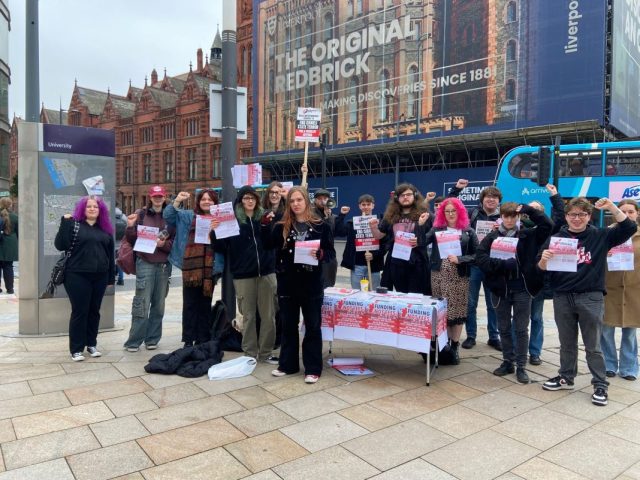
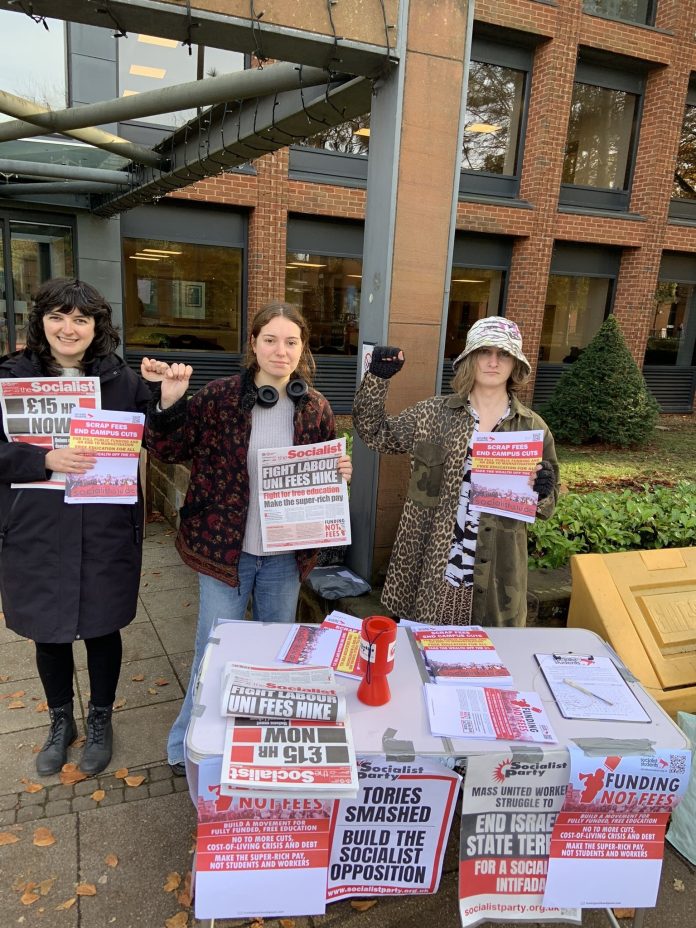
This is why we have taken to the streets raising the demands of our ‘Funding not Fees’ campaign, and received a positive response. Few students disagree with an end to tuition fees, grants not loans, cancelling debt or fair pay to all, and many will be prepared to rally against the university bosses when more attacks come in the future.












 Socialist Students