Corbyn sabotaged by the Blairites – build a mass student movement to resist further Tory attacks on education!

  • Blairites have to go! Kick them out of the Labour Party and refound Labour as a party of workers and young people with a socialist programme!
  • For a council of war on campus, bringing together students, workers, trade unions and others on campus to resist the next round of Tory attacks!
  • Defend on campus democracy! For democratised students’ unions and a refounded, fighting NUS!
  • Join Socialist Students!
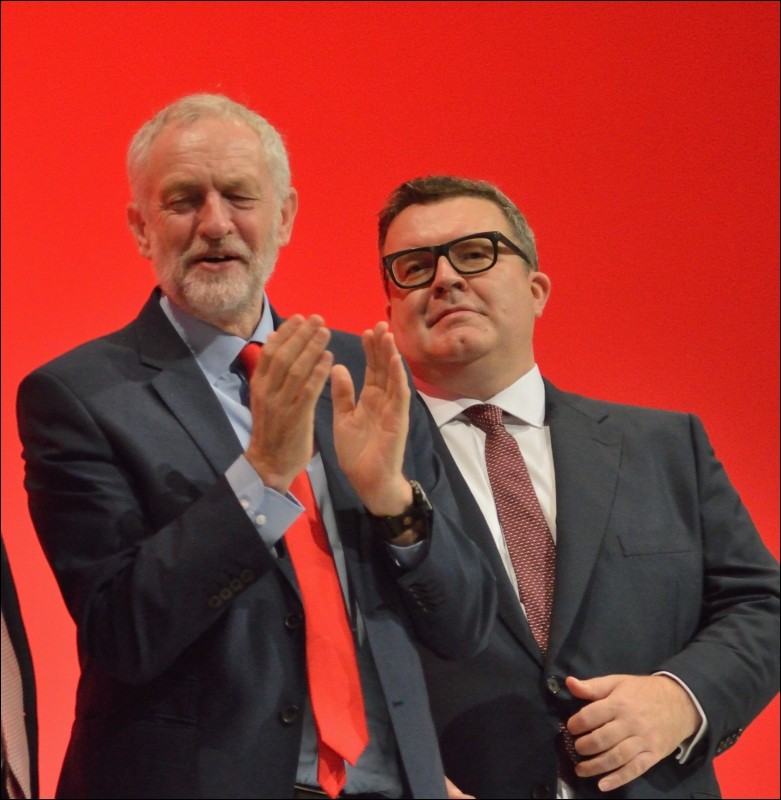
Jeremy Corbyn and Tom Watson, photo Rwendland/CC 

Students and young people will be disappointed with the news that the Tories managed to win a majority. Already the right wing media and the right of the Labour Party, the Blairites, both who moved heaven and earth to attack Corbyn over the last four years, are piling on to try and claim that Corbyn’s anti-austerity programme which lost the election. They’ve been waiting for four years to jump at the opportunity to hammer that Corbyn’s programme is ‘unpopular’.

But that couldn’t be further from the truth. While the right wing media and capitalist press have attacked Corbyn for delivering ‘Labour’s worst result since 1935’, the reality is that Corbyn won 10 million votes – higher numbers wise and percentage wise than Labour’s vote in 2005. Policies such as free education, the abolition of youth rates, the scrapping of zero hours contracts, the mass construction of council housing, and the renationalisation of rail, mail, water and the energy companies remain enormously popular policies.

No peace for the Tories
Despite winning a majority, there will be no easy ride for Boris Johnson’s government. The divisions in the Tory Party over how the best handle Brexit in the interests of big business will not disappear, but will deepen.

And the anger at years of Tory cuts and austerity will also not disappear. Johnson was forced to promise measures to improve funding to the NHS, education and so on, in order to win this election. Workers who, in their words, ‘lent’ the Tories a vote to get Brexit finished, will not forget those promises.

But he also vowed to introduce further legislation to curb the ability of workers to take legal strike action – and indication not only of the massive attacks which are to come the way of working class and young people, but also of the Tories anticipation’ for mighty struggles of workers and young people will launch against the coming Tory attacks.

Compromise with the Blairites to blame
Corbyn and shadow chancellor John McDonnell do share some of the blame however. Chiefly, they have to accept the responsibility for not using the last four years to mobilise a campaign in the Labour Party to kick out right wing Blairites saboteurs out of the party and replacing them with socialist fighters!

Take for example Corbyn’s mistaken position on Brexit which cost him dearly in seats in the North and the Midlands. His position of remaining ‘neutral’ in a second referendum was understood by many workers to be an attempt to undo the democratic result of the 2016 referendum, and was a complete concession to the right wing of the Labour Party, who if they had it their way would have forced Corbyn to adopt an out and out remain position.

Brexit was not the only mistake. Corbyn made other vital concessions to the pro-capitalist wing of Labour. Corbyn’s programme was missing from the vast majority of local Labour Party campaign material. The mass rallies of the 2017 election campaign, which made that election feel at times like a movement, were missing this time round.

But above all else, Labour councillors who control hundreds of councils up and down the country, have for years voted for vicious and life changing cuts to local jobs and services. ‘Labour’ for millions of working class people wasn’t just the legacy of Tony Blair, which included the Iraq War, the privatisation of parts of the NHS, and the continuation of Thatcher’s anti-union laws, but it concretely meant job losses, homelessness and poverty for local working class communities.

Socialist Students called for Labour councillors to take a stand against cuts delivered from the Tories in Westminster – to use their enormous spending reserves to pass no cuts budgets, and to build mass local campaigns to demand the funding stolen by the Tories back to local communities.

Had Corbyn and McDonnell issued the order to Labour councils to adopt such an approach after the release of their manifesto, and demanded that Labour councils began immediately with turning Corbyn’s anti-austerity promises into a reality, many would have seen that Corbyn was prepared to fight to improve their lives.

A new party needed
Corbyn and his supporters in the Labour Party now must hold firm to resist the attempted onslaught by the right of the Labour Party to discredit his enormously popular programme. Corbyn and McDonnell have correctly said that their anti-austerity programme wasn’t what lost them the election. But they now must go further and draw the conclusions necessary to fight to make that programme a reality.

This election result is proof that it is impossible to fight for the interests of working class, young people and students while attempting to represent the interests of big business at the same time. It is now urgent that a labour movement conference is called, of Corbyn’s supporters, trade unionists, and students and young people, to refound the Labour Party as a mass democratic workers’ party organised around a socialist programme.

What next for the fight on campus
The Tories will no doubt come for further attacks to education and students’ rights. Needed now is a council of war on the campuses – bringing together students, campus workers, UCU and UNISON members, and anyone who wants to fight against Tory attacks – to discuss how to resist the next round of Tory attacks, and to defend the rights of students and workers to organise and protest on campus. The new year will no doubt bring new struggles on campuses, with the UCU union already discussing a second round of industrial action in 2020.

The NUS leadership should begin organising now for a mass student demonstration in the new year, linked to mass student and workers meetings on campuses which plan and discuss the tactics of building for such a demonstration. These local meetings on campuses should be organised by Students’ Unions, linked to a programme for the refounding and democratisation of the NUS. Alongside measures for national student actions to defy the Tories, the trade union leaders need to mobilise in the workplaces to defend the NHS, public services, jobs, living standards, and the environment from further Tory attacks.

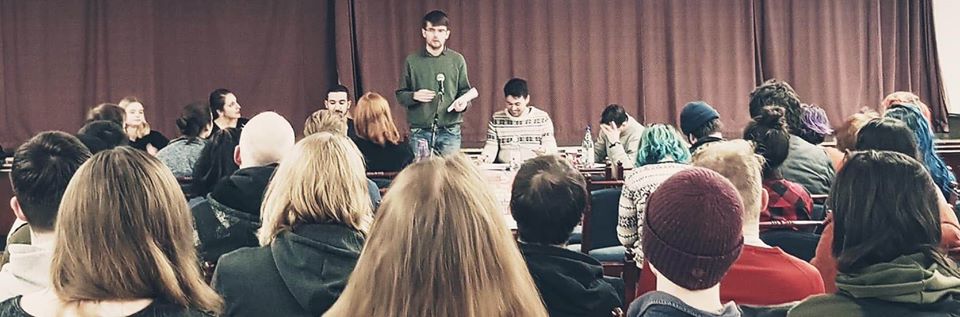
Socialist Students conference: Students and workers united in struggle

Ella Doyle, Birmingham University Socialist Students

Michael Morgan, Warwick Socialist Students, speaking in the election rally
Students from across England and Wales came together in Birmingham for the 2019 Socialist Students national conference on Saturday 30 November.

Berkay from London Socialist Students chaired the 60-strong rally on fighting for a Corbyn victory with socialist policies.

Michael, Warwick Socialist Students, spoke about the need to fight the attacks on free speech on campus. Some student unions have banned general election campaigning on campus. Some universities threatened to penalise students supporting the UCU strike.

Sundar, a student activist in Pakistan, phoned in about the fight for student unions, banned by the Pakistani government since 1984.

Connie, a school student from Birmingham who has been involved in the climate strikes, called for nationalisation of the polluting industries. Connie also explained the important role that Socialist Students can play in assisting in setting up student unions at schools.

Lucy, a strike committee chair from the University and College Union, highlighted the shared struggle of students and workers under a management system that runs universities as businesses. Many contributions from the floor revealed the positive impact that student involvement has had on these movements.

After lunch Bea Gardner, Socialist Students national chair, introduced a really useful discussion on building our societies on campuses, which dealt with organising good political meetings, a focus on activity on campus, linking up with struggles in the wider area, standing for positions, and involving new people.

Andrea, a student from Chile, gave an inspiring report of the mass upheaval in her home country.

Finally, the Socialist Students steering committee was elected. Theo, national organiser, explained its role and candidates were invited to come forward. The conference prepared us for the battles to come – in this election, on the day after, and in 2020.

Out campaigning for a a Corbyn government with socialist policies at Leeds University

Allen Haigh, Leeds Socialist Students

With the general election rapidly approaching, the Leeds University Socialist Students have been actively campaigning for a Corbyn led Labour government. Along with our regular Wednesday stalls, we decided to canvass at one of the larger student halls, Lupton residences, on Thursday, November 21st to assure that all students had registered to vote, and to have a conversation with them about the current political landscape. We also sought to help disambiguate any thoughts or perceptions students had about Corbyn’s campaign; and expressed our strong belief that an anti-austerity, anti-capitalist government with a socialist programme, one in line with the needs of workers and students alike, had the potential to radically change the workings of our society for the better.

We were pleased to find that generally students were already registered, and were personally invested in the outcome of this election. We spoke to some students who were already planning to vote for Labour based on the strength of their manifesto, as well as others who still felt ambivalent about their voting intentions but were intrigued or impressed by Corbyn’s pledges on free education, and investment in the NHS. We visited one block that was largely composed of student nurses, who were particularly sympathetic to Corbyn’s plans for the NHS due to their first-hand experience of inadequate funding and gross mismanagement. We exchanged thoughts on what we perceived to be the current shortcomings and what needed to be done in the future to protect the interests of staff and patients alike.

We also canvassed in the Hyde Park, an area with a large student population in Leeds, on Monday, 25th of November, and again were pleased to find that most students had registered and had educated themselves about some key policy differences. We stressed to Corbyn supporters that regardless of the outcome of the election, there would remain a continuous need to fight for socialist policies, whilst those who remained undecided pledged that they would remain vigilante of media bias, and do their research on what a Corbyn campaign would really stand for. Most of all it was good to see that almost every single individual saw Boris Johnson’s anti-establishment rhetoric for what it really is, a farce, and most seemed to recognise the need for real change in society; Leeds socialist students will certainly continue to fight for a fairer Britain.

Students back UCU strike at Leeds Uni

Molly Rampton, Leeds Socialist Students

Hundreds of University of Leeds lecturers, staff and students are rallying against pension cuts, unstable/zero-hour contracts, overwork and wage inequality. UCU members at 60 universities are striking for eight days over the coming fortnight after the university managements failed to respond to demands for fair treatment of all staff. Leeds Socialist Students Society are enthusiastic supporters of the movement, along with other student groups and individuals.

The UCU strike is a crucial last resort in the fight for fair working conditions at many universities across the country. Many lecturers and other staff live without the security of knowing that they will be employed until the next academic year or semester, while even those with long-term contracts have seen their pensions slashed. Many staff are paid hourly, which does not include time spent planning for and evaluating work outside of class hours. Wage gaps remain static, with people of colour and most women earning less than their white male counterparts.

The strike has been criticised for disrupting student’s education – a claim deliberately blind to the fact that this education cannot take place without quality teaching; which in turn cannot take place without quality of life for those teachers. Staff at Leeds must feel valued and secure within the institution in order to be able to impart their knowledge and expertise effectively.

The mistreatment of Leeds University employees is directly at odds with the enormous fees currently paid by students. The academic body deserves investment into educational, rather than market demands and we will stand for nothing less.

Bolton University fire – fight for affordable and safe student housing!

photo Paul Mattsson

This article originally appeared in the Socialist on 21 November 2019

Fire ripped through a six-storey student accommodation block, with what eyewitnesses described as terrifying speed, on the evening of Friday 15 November.

The fire started on the fourth floor of the Cube, a six-storey University of Bolton building. Within 90 seconds it had spread to the top level, and reached the roof 40 seconds, later leaping across floors spread by cladding. 211 students have been left in temporary accommodation.

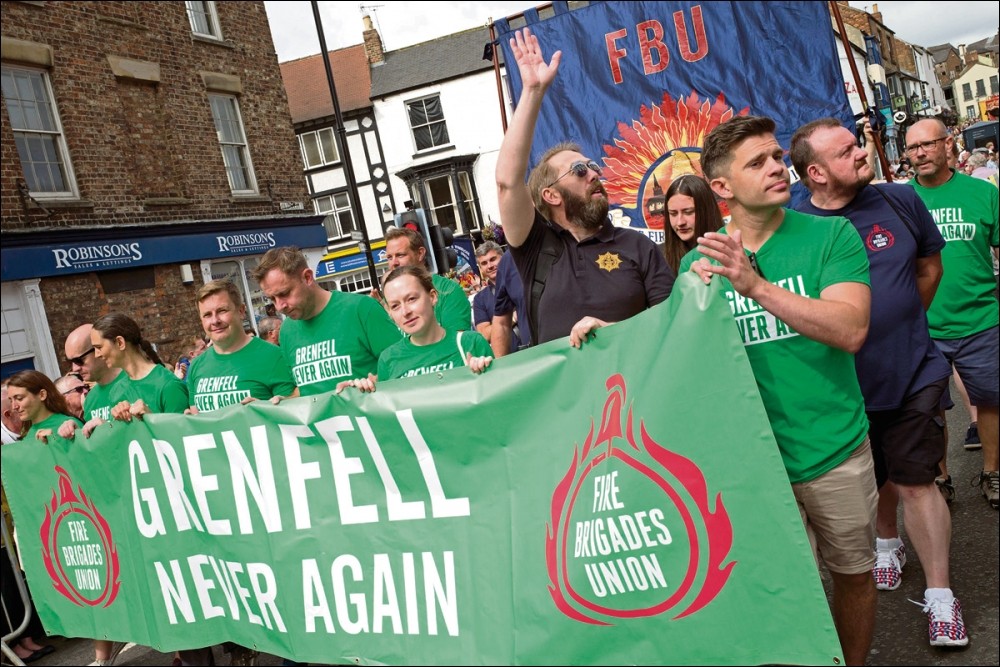
Two and a half years after the catastrophic fire at Grenfell Tower the government is still failing to act on fire safety.

Firefighters’ union (FBU) leader Matt Wrack rightly commented, “It’s deeply troubling to see fire spread rapidly up a building’s exterior again – a shocking indictment of the government’s shameful inaction after Grenfell.”

Unsafe cladding

It is reported that the cladding is not the same as the ACM (aluminium composite material) used at Grenfell – this points to the scale of the safety problem.

The government has failed to act on warnings about HPL (high pressure laminate) cladding, apparently used in Bolton.

Attention has focused on Grenfell-style cladding, but progress has been slow in social housing and worse in the private sector.

At the current rate of progress it would take until October 2033 for the buildings to be made safe.

Government targets are inadequate and are being missed. But this was another terrifying fire, like the recent Barking Reach fire, in a building under 18 metres high, and therefore outside the scope of the government ban on combustibles.

The position is made worse by cuts to the fire service. Boris Johnson made deep cuts when London mayor and the cuts continue.

Fire service cuts

Les Skarratts, FBU North West executive council member said, “Greater Manchester has lost more than 600 firefighters since 2010 alone and, alarmingly, Andy Burnham is trying to cut another six fire engines, including one in Bolton.

“We need to stop the senseless cuts to our fire and rescue service before we see another awful incident like this.”

Student unions and tenant groups should demand to see fire risk assessments. Ultimately, if they don’t get satisfactory answers they could organise to withhold rent – ‘no safety, no rent.’

Trade union safety reps in workplaces with buildings covered in cladding should ask employers about the type, the risks and what they have done and are doing to make it safe.

Labour shadow housing minister John Healey said the fire should be a “wake-up call” for cladding to be removed.

This is a chance for Labour to campaign on reversing fire service cuts and a programme of housing investment to make buildings safe. It should pledge to reimburse local councils that start the work immediately.

Socialist Students fights for;

  • For universities to provide decent, safe, and affordable housing for all students, and Students’ Unions to promote and campaign for this – end the driving of students into the arms of rip off landlords and letting agencies.
  • For immediate rent controls – councils can and should use their legal powers to implement an immediate programme of rent controls on all locally rented housing.
  • The banning of all agency and contract fees – don’t allow rip off landlords to profit from our misery.
  • For a mass programme of council house building – councils should use their resources to launch a mass programme of affordable council house construction.

University staff striking back

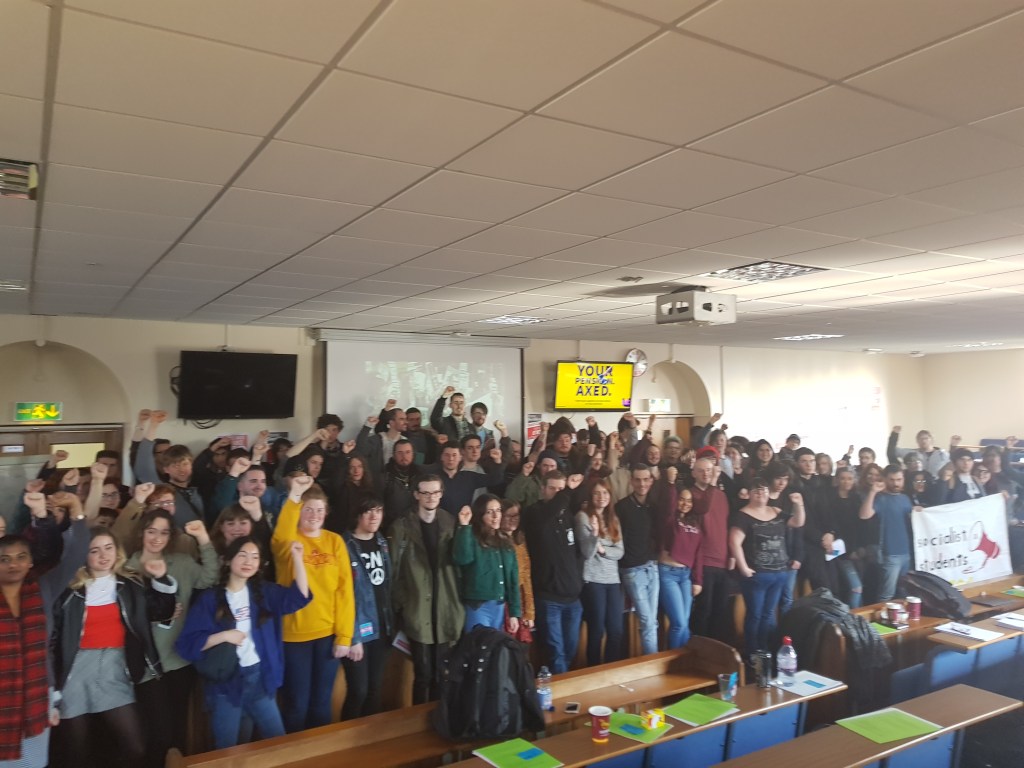
Socialist Students national conference sending solidarity to UCU strikers during the 2017 dispute

Lucy, Cardiff UCU and Socialist Students

In February and March last year, university staff across the UK in the University and College Union (UCU) trade union took 14 days of strike action against attacks on pensions – the proposed changes would have seen a typical lecturer an estimated almost £10,000 a year worse off when they retired.

Trade unions like UCU are a vital way for workers to organise to stand up against exploitation from their employers. Individual workers have very little power to make changes to their pay and working conditions, but when workers stand together they are a powerful force. Strike action can be a particularly important way for workers to force bosses to listen. It highlights that bosses are reliant on their workers: strike action hits bosses’ profits – they don’t make any money if workers don’t work. It’s not that different in education: universities can’t run without people working for them.

Strikes are the most powerful tool working class people have to confront the bosses. It’s no wonder then that in previous decade since they’ve been in power, the Tories have introduced new anti-union legislation designed to restrict workers’ ability to take strike action.

For example, for a strike to be legal under the newest Tory anti-union laws, 50% of members of the union have to participate in the vote (ballot) that decides whether strike action is taken. That means that is even if 100% of unions members who vote, vote for strike action, if only 49% of members took part in the vote, it isn’t legal. This 50% threshold isn’t required for other forms of voting (for example, turnout in the UK for the European Parliament election was less than 37%!). This makes organising for strike action difficult – but not impossible! Last year the average UCU ballot turnout was 58% with 88% voting for strike action.

This shows how angry people were about the attacks on their pensions.
The impressive 14 days of militant strike action that UCU members took last February and March –sometimes even in the snow – stopped employers from implementing the pension changes. It also led to the union gaining almost ten thousand new members! This shows that with a determined lead and fight from activists within the trade unions, the draconian Tory anti-union laws can be smashed, and our unions can grow.

Importance of student support
Student support was really important for striking university staff. Staff weren’t just angry about pensions. They were angry about the marketisation of education that’s led to stagnating wages that don’t match inflation, to increased casualisation which means more and more staff members are on fixed-term contracts or zero-hour like contracts that don’t guarantee a decent number of hours, and to massive workloads which mean staff are burnt out working days of unpaid overtime to keep up.

These are important issues for students too – staff working conditions are students’ learning conditions – learning conditions that are also becoming harder as tuition fees rise and pressure increases.

As tuition fees have risen and staff working conditions declined, it’s the top university bosses who have benefitted. The average university vice chancellor earns a ’basic‘ salary of over £250-thousand pounds! The Bath University the vice chancellor last year was on £468-thousand. By fighting together, staff and students are more likely to be able to change things. Last year students joined staff on pickets all over the UK. In some cities they organised solidarity meetings and even held occupations. Socialist Students played a key role in these activities and helped striking staff to keep on fighting.

More possible strike action
This September and October, university staff in UCU will again be voting on strike action – this time in two ballots. One vote will be about pensions – last year’s pensions strike forced our employers to set up a panel to investigate the situation, but now it looks like they’re going to ignore this and try to make staff pay more for our current pension. This shows that the bosses can’t be trusted, and that sustained struggle is needed.

The second vote is about pay-related issues. Staff voted on this earlier this year, but although almost 70% voted for strike action in England, Scotland and Wales we missed the 50% turnout threshold with a 41% turnout. The vote covers a range of issues including addressing gender and ethnicity pay gaps, reducing zero-hour and hourly-paid positions and reducing excessive and unsafe workloads.

It’s important that these ballots draw in all the different kinds of UCU members. Different members will be more affected by some issues than others. For example, a lecturer near retirement might be particularly worried about their pension, whereas a newer lecturer who is only guaranteed a small number of hours work a term might be more angry about zero-hour like contracts. Most staff members are stressed by their workload: it’s estimated that on average staff in higher and further education staff work more than two days unpaid each week. Like with all employers, unpaid overtime is a way for universities to save money by not hiring the extra staff they need.

It’s important that the union builds a fighting organisation to unite all of its members behind resisting these attacks to their pay and working conditions, and it’s important that students support this struggle.

Join the fight back!
It’s not just university staff who need to build fighting organisations – students and young workers do too. Young workers are often particularly exploited by employers – like some university staff they can get stuck in jobs that don’t guarantee them a minimum number of hours a week, can get left without sick-pay and holiday-pay or end up working unpaid overtime by being asked to come in before their shift starts or stay on late. They also get paid less – often for doing exactly the same job – because minimum wage is lower for younger people.

Bosses also make workers feel like they’re easily replaceable to make them put up with bad working conditions and treatment. Like in the university, workers are stronger if they join a trade union so that they can fight together for improvements.

It’s important that workers in different unions also support each other in their struggles. Local Trade Union Councils play an important role in linking up different unions to work and campaign together on issues affecting people at work and in the community. In lots of areas local Trade Councils supported the UCU strike last year – they organised for UCU members to visit other unions branches to discuss the dispute, leading to lots of donations to our local strike fund which helped some of the worse paid workers continue to strike. They also came and spoke at our rallies – encouraging us to continue the fight against attacks on working conditions that affect workers in all sectors.

But it isn’t just the UCU which is currently building for strike action to fight back against the bosses. Workers in the Communication Workers Union (CWU), the National Union of Rail, Maritime and Transport Workers (RMT) and civil servants in the Public and Commercial Services Union (PCS) are all campaigning within their unions for strike action in the near future.

Boris out – Corbyn in with socialist policies!
With chaos building in Parliament and the Tories on the brink of collapse, co-ordinated strike action organised by the leaders of the trade unions could be the final straw for Boris Johnson and the rest of the Tory government. Unions like the UCU should put out the call for a national demonstration organised by the trade unions demanding a general election to kick out the Tories and fight for a Corbyn led anti austerity government.

But our struggle won’t end there. If elected, Corbyn will come under enormous pressure from the capitalist class to back down on his anti-austerity manifesto. Corbyn will only be able to fully deliver on his promises if he breaks the power of the big banks and monopolies, starting by nationalising under democratic public ownership the big banks and companies.

If students were called out onto the streets by Corbyn alongside workers, mobilised in the fight for socialist policies like free education, cancellation of student debt, for living grants, an end to slum student housing and campus cuts, a movement to abolish capitalism and transform society could be built.

Socialist Students will be organising joint meetings with UCU members, open to all students and workers, to discuss how we can support university staff in building successfully for strike action and how to take on the Tories. This year, support university staff in their struggle against attacks on their pay and working conditions, and join Socialist Students to fight for a better education system that’s free and accessible for all.

Rees Mogg visit at Leeds University cancelled

Ever since Socialist Students heard that arch-aristocrat and Tory House of Commons leader, Jacob Rees-Mogg was due to speak at an event hosted by the Leeds University Conservatives, we initiated the call for protests against his visit and the Tories anti-working class, pro-big business austerity agenda.

Over the course of the last week, several other left groups joined the call for the protest, and we had a great response at the Leeds Beckett freshers fayre where we gave out leaflets promoting the protest. Many students’ response was shock that he would even think he’d get any sort of audience from ordinary people in Leeds, and were enthusiastic about joining the protest.

As the numbers on social media promoting the protest grew, the ongoing crisis in parliament deepened, as well as the rough reception Boris Johnson got in nearby Morley (currently a Tory held seat), then it appears Rees-Mogg has cancelled. Socialist Students will remain ready to organise a fresh protest if the event is rearranged, but in the meantime we will continue our campaigning for a general election and building our support for socialist ideas to challenge the capitalist system the Tories defend.

No to Boris, general election now!

Socialist Students groups have been campaigning at freshers fairs, signing up hundreds of students across the country over the last few weeks. We’ve been out discussing with students against the backdrop of utter crisis for the capitalist class. Since the below editorial for our magazine was written we have seen the supreme court find against Johnson and rule the prorogation of parliament null and void. Read below for what we think about the need for students and workers to fight for a General Election now and for Corbyn to fight on socialist policies to win!

This September, Prime Minister Boris Johnson is returning to Parliament along with other Tory MPs. Elected by less than 100,000 predominantly elderly and wealthy members of the Tory Party Boris’ ‘election’ marks another turn and ramping up of the Tory Party civil war.

Former Tory MP Nick Boles attempted to savage Johnson on his very first day as Prime Minister by telling the press that the party has been “fully taken over by the hard right”. This was in response to one of Johnson’s first moves as PM – to sack 18 cabinet ministers in the biggest cull in living memory, and pack it full of pro-Brexit supporters, including Jacob Rees Mogg, the head of the pro-Brexit European Research Group.

This is the state of the complete and utter disarray of the ruling Tory government, which with the fast approaching ‘Brexit Day’ of October 31, is teetering on the edge of collapse.

It’s an unstable situation for the capitalist class, unlike anything in British history. Inherent in the situation is the collapse of the Tory government, a new general election, and the possibility of the coming to power of a Corbyn led anti austerity government, elected on a programme that saw Corbyn nearly take power in 2017 on the back of the “youthquake”, the flocking of millions of students and young people to polling stations to vote for Corbyn’s manifesto.

To vote for free education; for a mass programme of council house building; for the renationalisation of mail, water and energy and the railways; for a ten pound an hour minimum wage and the abolition of youth rates. The hopes of millions of young people were raised at that election, and could be yet again at the next election.

Brexit
Corbyn has put himself forward, in the event of a no confidence vote tabled by himself against Johnson in Parliament passing, to lead the formation of a temporary ‘caretaker government’ to avert a no deal Brexit on October 31 by applying for an extension of Article 50 in order to call a general election.
The fact Corbyn has put himself forward to form such a government and press for a general election is a positive, and should be welcomed.

But Johnson has threatened that, if a no confidence vote passes, and if a new alternative government and Prime Minister fails to be agreed by Parliament, he will not call a general election until after October 31 in order to complete a Tory Brexit – with or without a deal.

Fight for a general election
Either would be bring no relief for students and young workers if left in the hands of the Tories. A Tory negotiated leave, or crashing out with no deal at all, will be used by the Tories – the party and government of the super-rich – to continue to make young and working class people pay for the economic crisis of capitalism.

What is needed now is an all-out campaign from every corner of the student and labour movement to fight for that general election.
For students, this should start with a massive national student demonstration called by the NUS, as well as Corbyn and McDonnell, during the Autumn term, demanding a general election with the demand for free education central to mobilising students. If the NUS refuses to call such a demonstration, student campaigners from campuses and colleges around the country who want to kick out the Tories should co-ordinate and organise a demonstration themselves without the NUS.

This would be a strong start and potentially spell the start of the end for Johnson’s government. But the entry of the trade unions onto the scene, firstly with a national trade union-led demonstration as a first step towards co-ordinated strike action if necessary – bringing the working class onto the streets alongside students struggling for free education and students’ rights – would tip the balance of power completely.

Programme
But crucial to mobilising such a movement is a programme capable of giving a clear and bold alternative to the pro-capitalist austerity policies of the last decade – a socialist programme.

Socialist policies would mean free university education and the cancellation of all student debt, as well as the introduction of living grants for all students. With the publication of the Tory Auger report, it’s clear that the Tories still have students in their sights and will try to yet again make us pay for the crisis caused by the rich (see pages 15 and 16 for more).

It would also mean an end to the marketisation of our universities and funding cuts to services on campuses, as well as a complete reversal of all academisation and cuts to schools and colleges.

In the world of work, it would mean a minimum wage of at least £10 an hour for a start – we say £15 should be the living wage in London, as well as the banning of all zero hours contracts.

It would mean ending and reversing all cuts to public services, including to the NHS, and the launching of a mass programme of council house construction and the introduction of rent controls in the private sector.

And crucially, it would mean the nationalisation – not just of the railways, mail and the energy companies as Corbyn has outlined, but also taking the banks and the other big companies into public ownership, under the democratic control of workers and young people, to fund all of these policies and plan the economy for the benefit of the vast majority of the population and to protect the environment from climate change.

Such a programme could unite workers and young people who fell on both sides of the EU referendum, in a united battle to topple the Tories and fight for jobs, homes and services for all. This is the only force capable of breaking the logjam in Parliament.

If a Corbyn led government was propelled to power by such a mass movement, Corbyn would have the basis to negotiate with the EU a socialist Brexit deal – a Brexit which would be in the interests of the overwhelming majority of society – millions of working class, young people and students, as well as the middle class.

This would mean a deal that would scrap all the anti-worker directives and legislation of the single market – including the posted workers’ directive, legislation prohibiting the renationalisation of industry, and laws restricting state aid – and to establish a new customs union in the interests of students and workers.

National unity government?
But every time the moment arrives when a Corbyn government seems to be on the cards, his enemies mobilise to stop him at all costs. This doesn’t only include the Tories, but also the Blairites, who could back the formation of a “national unity” government with Tories, Lib Dems and all manner of pro-capitalist, pro-austerity politicians.

That’s why Socialist Students says that it is crucial Corbyn calls for the removal of the pro-capitalist elements of the Parliamentary Labour Party, the Blairite MPs, and campaigns for their reselection and replacement with class fighters who will fight for the interests of workers, students and young people, not for the interests of big business. 

The rank hypocrisy of the pro-capitalist politicians will be an outrage to the overwhelming majority of students and young people. The fact that Jo Swinson – leader of the little bosses’ party, the Lib Dems, responsible for trebling university tuition fees alongside the Tories in 2010 – refuses to back even a temporary Corbyn government to prevent a no deal Brexit demonstrates what the pro-capitalist politicians truly fear.

Their biggest fear, and the only glue which holds the fractious Tory Party together, is the coming to power of a Corbyn led government. The anti-austerity policies he campaigned on in 2017 and continues to campaign on is only part of what frightens big business and their political representatives though.

It’s the raised hopes and expectations of millions – including students – which the capitalist establishment truly fears. The election of a Corbyn led government could unleash a whole new wave of mass struggle, pushing Corbyn further to the left than he intended to go.

Socialist Students says go further
But if Corbyn is to mobilise a movement both within the Labour Party to transform the party, and a movement in wider society to oust the Tories, he needs to go on the offensive with bold socialist policies.

Why not instruct all Labour councils now to stop passing on cuts delivered to them from the Tories in Westminster using their massive financial reserves and borrowing powers, and build local campaigns, mobilising students, workers and the community as a whole, to fight for the funding required to make good on all of his anti-austerity pledges.

With a guarantee from shadow chancellor John McDonnell that a future Labour government would underwrite any debt, linked to taking the banks and finance companies into democratic public ownership, such a fightback could be the beginning of the end of Boris Johnson and the rest of the rotten Tories, and point the way towards a socialist future.

Young workers protest in Dundee against greedy bosses

12:30pm Murraygate, Dundee, Tuesday 6th August 
Near Tesco’s 

The Young Socialists, Young Workers Rights campaign will be protesting and raising the need to join trade unions.

Maddie, Dundee fast food worker, and member of Unite Hospitality, “If you’re sick of your boss, join a trade union and get involved in our day of action. Retail bosses like Asda are hammering workers with attacks like Contract 6, where paid breaks and holidays are cut and workers are threatened with the sack if they don’t sign up. We support the fight of the GMB trade union against Contract 6. Recently we have sign Tesco workers organised in USDAW take strike action, CWU postal workers walk out against management bullying and Unite airport workers strike for decent pay and to defend pensions. The best way to defend your rights and conditions at work is to join and get active in a trade union. We fight for trade union rights for all workers on day one of employment”. 

Oisin, Glasgow bar worker, and member of Unite Hospitality, “Young Socialists Young Workers Rights campaign fights for a £10 an hour minimum wage and trade union struggle for a living wage. Recently at festivals like Glasgow TRNSMT we have seen young workers suffering tip theft and working without breaks. Exploitation of young workers is also rife at the Edinburgh Fringe and T in the park. Bar workers suffer bullying, uniform charges and exploitative shift patterns every day of the week. It’s time to stand up and fight back. As well as fighting for rights at work we want to change society and end capitalism. That means workers control in workplaces, socialism, taking over the top 150 major companies, banks and industries into public ownership”. 

Wayne, Dundee factory worker and member of the GMB, “We need to fight for the rights of all workers including apprentices who should be paid a living wage with the trade unions fighting for the Construction Training board to implement this. 

The SNP government talks about “fair work” but has let workers down including failing to protect skilled work at the Caley Railworks through nationalisation. 

Jeremy Corbyn has a lot of pro worker policies such as a £10 minimum wage, one of our tasks is to call on the TUC, the STUC and the Corbyn Labour leadership to launch a mass campaign of rallies advocating socialist policies, mass demonstrations and co-ordinated national strike action to bring down Johnson’s Tories and force a general election.” 

For more information, ring or text or text Maddie on +44 7596 456551

Theresa May admits tuition fees system is broken – organise to kick out the rest of the Tories!

Theo Sharieff, Socialist Students national organiser

Theresa May on Thursday admitted that herself and the Tories got it wrong on tuition fees and higher education funding.

The headline proposal contained in the long delayed Auger report is to give students from disadvantaged backgrounds a £3000 a year maintenance grant, admitting that the Tories in 2015 got it wrong. This will come as welcome news to students who have been forced to take out loans and accrue debt just for choosing to pursue studies in higher education. It’s a reflection of the massive pressure the Tories are under, terrified of the huge anger their policies of cuts and austerity measures has created.

Other suggestions in the report are completely woeful. Even the suggestion to cut fees by a small amount to £7,500 is cover for vicious attacks on students and low paid graduates in debt.

The plan suggests extending the period over which former students would repay their loans from 30 to 40 years. Moreover, the report suggests lowering the income threshold for loan repayments to begin, meaning that even lower paid young workers will be forced to give up their wages towards paying off loans and extortionate interest, simply for going to university.

Clearly these changes are intended so that the government has more time to claw back money from the currently huge and growing pile of national student debt.  The debt currently stands at £118 billion, and is predicted by the government to reach £450 billion by 2050 without inflation. Three-quarters of students will not pay back their loan in full by the time it is wiped, and the state will be footing the bill.

The Tories are aware that they are presiding over an economic time bomb. Desperately, they are attempting to remedy that by fighting to further shackle former students, as we age into retirement, with a lifetime of debt.

But even the proposal to reduce tuition fees is a poisoned chalice. When the Tory-Lib Dem coalition trebled tuition fees back in 2012, the government cut its funding to universities, meaning universities were forced to rely on student’s tuition fees for funding.

With the report suggesting a decrease of tuition fees to a still ludicrous £7500 a year, and no proposal for the government to plug the funding gap, universities would face a huge cut to funding – resulting in cuts to courses, redundancies, and closures.

Scandalously, bosses of the Russell Group came out in March to rally against reducing tuition fees for this reason, pretending that there would be no alternative. This however isn’t true.A mass struggle of students united with workers to end austerity could provide free, fully funded university education. Jeremy Corbyn raised in the 2017 general election abolishing tuition fees, but Socialist Students says he should go further – to not only scrap tuition fees entirely and to introduce living grants for all students, but also to cancel all the outstanding student debt.

With Theresa May gone, now is the time to launch that fightback. A campaign to fight for free education which mobilised students and workers in demonstrations and strike actions could spell the end of the Tory government which is tearing itself apart with yet another leadership contest – and fight for an anti-austerity Corbyn led government to power on a socialist programme.