Socialist Students Sheffield organised a demonstration against Trump and Netanyahu’s bombings and imperialist escalation in the Middle East. This is the first demo we’ve organised. From this, we got the contact details of several people interested in Socialist Students.
Our campaign started following our International Women’s Day discussion, which focused on the ‘Women, Life, Freedom’ movement in Iran, following the brutal murder of Mahsa Amini by the regime’s ‘morality police’ in 2022.
We promoted our event on social media, had a dedicated leafleting session, as well as attending another student-led demo on campus. We held the protest at the lunchtime rush outside our student union building.
This protest reached different students compared to our previous campaigning. We’re organising more events and campaigns to grow our presence on campus.
Students at York St John’s University protested against sexual harassment, after a number of recent incidents in the student union bar.
As indicated by a number of students who spoke, these incidents are but the tip of the iceberg. To loud chants of “shame”, students spoke of even worse incidents of sexual harassment and rape on campus, where they have felt let down by the university and its provision of student support.
As several speakers said: “We’re paying almost £10,000 a year to be subjected to this”.
Socialist Students member and York St John student Anna spoke to the protest, raising a number of measures that could improve campus safety, including improved lighting, increasing funding to student support, and more.
And key to implementing that would be ending the marketisation of universities. That means they are starved of funding, as well as ensuring that such measures are under the democratic control of elected representatives of students and campus trade unions.
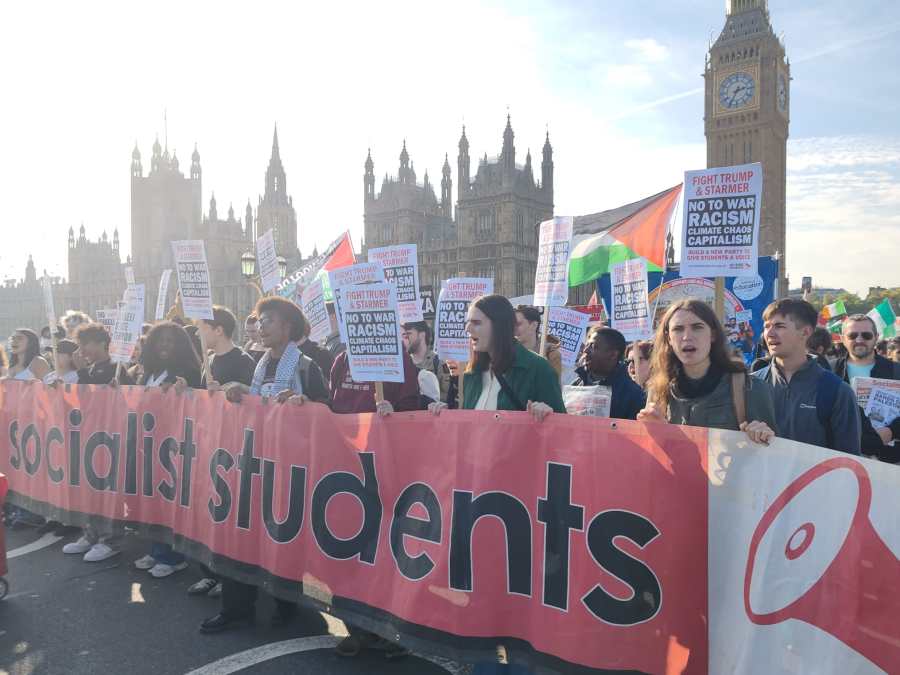
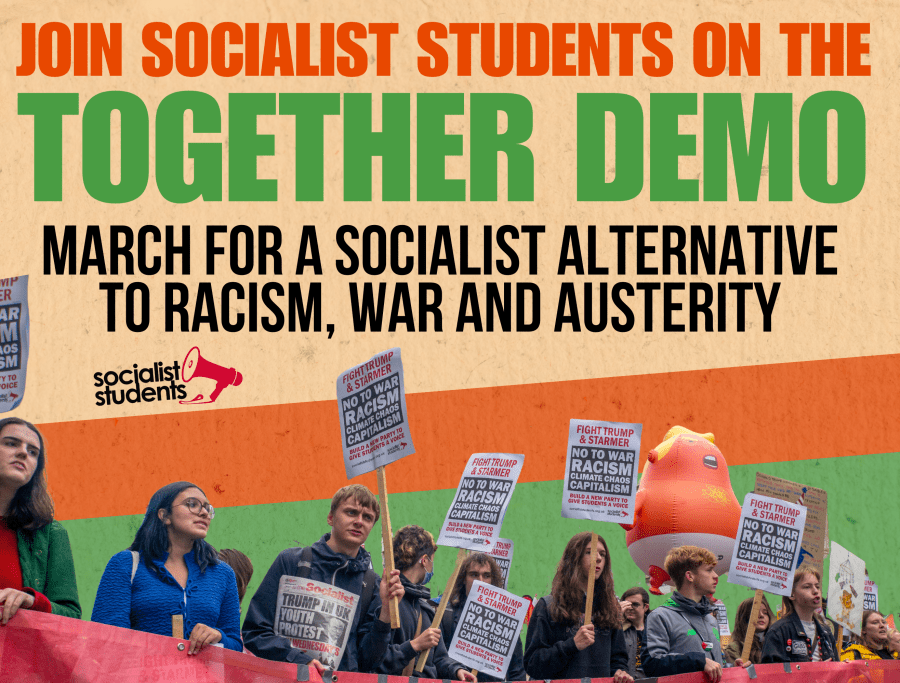
March for a socialist alternative to racism, war and austerity
Meet from 11.30am on Park Lane/Upper Grosvenor Street Corner for speeches
The need to combat racism and the far-right is urgent. Nigel Farage’s racist right-populist Reform UK is currently leading in most polls. In the Summer, 100,000 people turned out to far-right activist Tommy Robinson’s ‘Unite the Kingdom’ demonstration in London.
In response, Together – a new anti-far right alliance – has called a national demonstration in London for Saturday 28th March. Socialist Students is calling on students to join our contingent on the demonstration, to help us raise the need for a socialist alternative to capitalism as a central part in the fight against racism.
Capitalism means racism, war and austerity
Capitalism is an inherently unequal system that puts the profits of the billionaires above the needs of the billions of people around the world. To maintain this unequal set-up, the capitalist ruling class has always relied on racism to enable its brutal exploitation. Racism was used to justify the trafficking of ten million people by the slave trade, and later to justify colonial rule by British imperialism and other capitalist powers across the world.
Today, capitalist politicians continue to stoke racist ideas in an attempt to divide working-class people and weaken our collective ability to fight back. And they have plenty of reasons for wanting to sow racism and all forms of division, at a time when their system can only deliver more war, climate chaos, and falling living standards. The ongoing US-Israeli war on Iran, and the chaos that has already wrought on the world economy, underlines how capitalism today can only bring instability for our futures.
Build a socialist alternative
The Labour government has no alternative. They are firmly on the side of the billionaire bosses and have overseen yet more austerity and cost-of-living crisis. By so blatantly attacking the living standards of working-class people, Labour creates the space for Reform UK to falsely pose as an ‘anti-establishment’ alternative ‘standing up for the little people’. If we want to stop Nigel Farage becoming the next prime minister, then we have to build a political alternative to the pro-capitalist, austerity policies of not just Reform but Labour and all the establishment parties. We need to build a mass movement of workers and young people for the resources we need for a decent life. We have to demand: ‘Migrants aren’t to blame – take the wealth off the super-rich. For jobs, homes and services for all, not racist division!’. That kind of movement could bring working-class people from all backgrounds together in a united fightback that cuts across racism and identifies the real enemy: capitalism.
As the American civil rights activist Malcolm X said: “You can’t have capitalism without racism”. And if racism is embedded in the current system, then we need a new system: a socialist system which would eliminate the root cause of racism by taking economic and political control out of the hands of the small minority at the top who profit from inequality and division.
If you want the Together march to be a step towards building the mass anti-racist and socialist movement that is needed, join the Socialist Students contingent on March 28th and join your local Socialist Students society on campus.
A march can be an important start – but to end racism, we need to build a sustained movement that can challenge the capitalist system that profits from and reproduces reactionary ideas day-in, day-out.
Do you want to be part of the socialist, anti-racist challenge in this May’s elections?
The Trade Unionist and Socialist Coalition (TUSC), which Socialist Students is part of, is appealing for the widest-possible anti-austerity stand in the upcoming May elections. That would be a powerful way of putting forward a socialist political alternative to Reform, Labour, and all the establishment parties.
For that message to have an impact on the national political debate, there needs to be the widest possible presence for a socialist alternative, including in the media coverage of the elections. To break through the media blackout, we must hit the Ofcom threshold for “fair media coverage”. This requires standing at least 840 candidates under a party registered with the Electoral Commission. Could you be one of them? Click here for more info
Socialists say scrap fees, cancel all student debt, take the wealth off the super-rich
Adam Harmsworth, Coventry Socialist organizer
The student debt crisis is back in the news after MPs launched an inquiry into Labour’s decision to freeze the repayment threshold for over 5 million graduates on Plan 2 loans.
Plan 2 loans were created by the Tory-Lib Dem coalition government in 2012. Under the Plan 2 terms, graduates earning over a certain salary threshold pay back 9% of their income above that amount, chasing a debt that increases by at least RPI inflation. In November, chancellor Reeves fixed the threshold at £29,385 until 2030.
Labour is trying to shove more graduates stuck on low incomes into making repayments on loans that are impossible to pay off.
The ‘concern’ from sections of the establishment couldn’t be less genuine. Sir Nick Clegg, who co-led the Con-Dem government that trebled tuition fees after he pledged to oppose them, has called the system a “mess”. His solution is just to reverse some decisions made after he lost the election in 2015, but keep graduates stuck in horrendous debt.
In the Financial Times, Cambridge University’s new chancellor Lord Chris Smith (Tony Blair’s first culture secretary in 1997) criticised the high interest rates and the low repayment thresholds. But rather than consider if the tuition fees his government introduced were an abysmal idea, he instead argues that too many young people are going to university! So much for Blair’s “education, education, education”.
The National Union of Students (NUS) meanwhile has launched a petition merely calling for “fairer terms” on student debt. So far 12,676 students have signed. The NUS should be mobilising tens of thousands of students to fight for free, fully funded education.
University education is in crisis. Fees have risen while maintenance grants have been scrapped, yet universities are making cuts and still not balancing the books. 68% of students now work while studying, and food banks are popping up in uni buildings to support impoverished students.
The government can find money for war and backing US imperialism in a heartbeat, but is relying more on students, graduates, and university workers to keep higher education afloat.
Socialist Students are championing the fight for free education, and taking money off the super-rich to fund our universities – for funding not fees. Join the socialists fighting for a decent future for higher education!
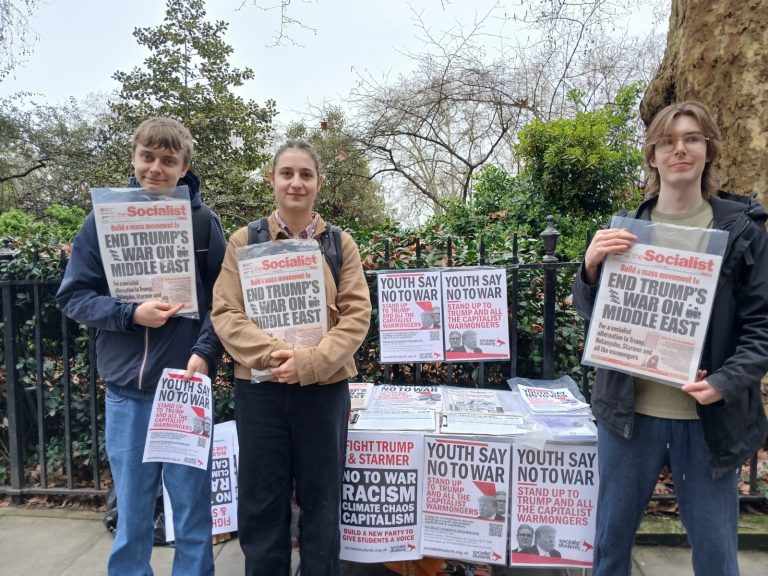
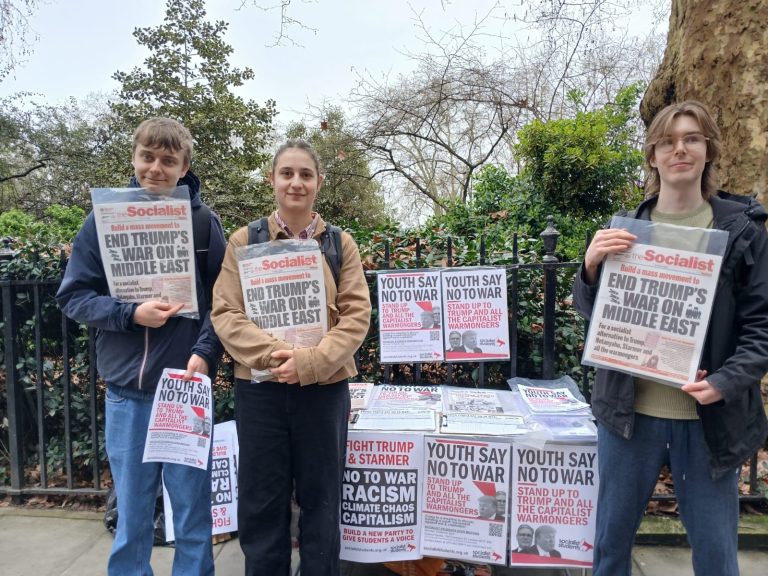
Socialist Students organised a campaign stall opposing Donald Trump’s war in the Middle East at KCL uni in central London. Lots of people queued up to take leaflets, hungry for ideas on how to stop this devastating conflict.
There were lots of conversations on why this war is taking place. A lot asked questions: “Why is there more war around the world? How do we fight back against it?”
We pointed out that capitalism is in crisis, the links between universities and weapon manufacturers, and the need for fully publicly funded free education.
Getting organised
We said how young people can organise on campus to protest against war, for full funding, and to demand universities open their financial books to workers and students. We raised other issues we face – tuition fees, high laundry fees, and the need to fight for a socialist alternative.
This got more young people interested in our ideas, and had people looking and asking for leaflets, our petition, and our Socialist paper.
At our London Socialist Students meeting opposing the war in the Middle East, there was enthusiasm to go out and find young people angry at the war, and to build a fightback on the campuses.
Young people are angry at this war, and all the chaos of climate change, attacks on our living standards, and the capitalist chaos that blights our future. So let’s find these students, and build a socialist alternative against war and capitalist chaos.
Dean Young, Liverpool Socialist Students organizer
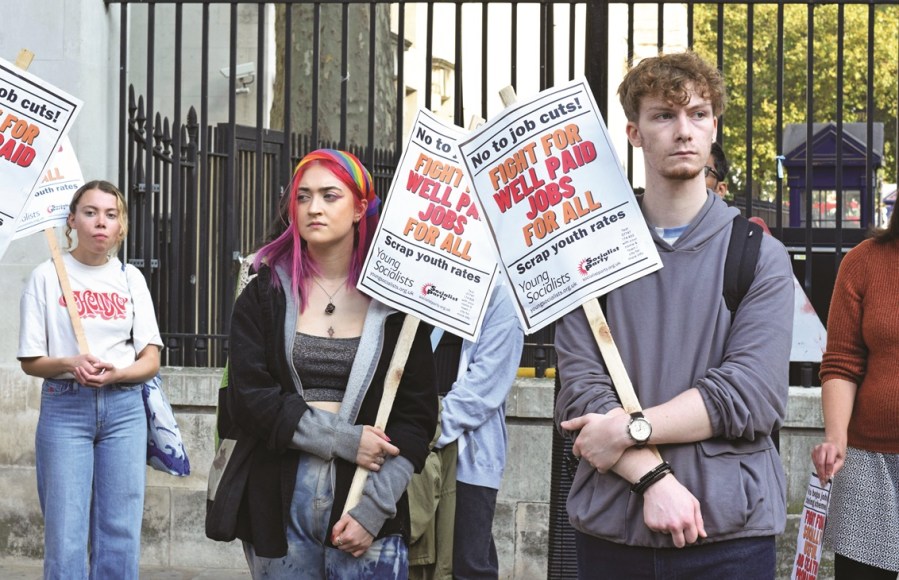
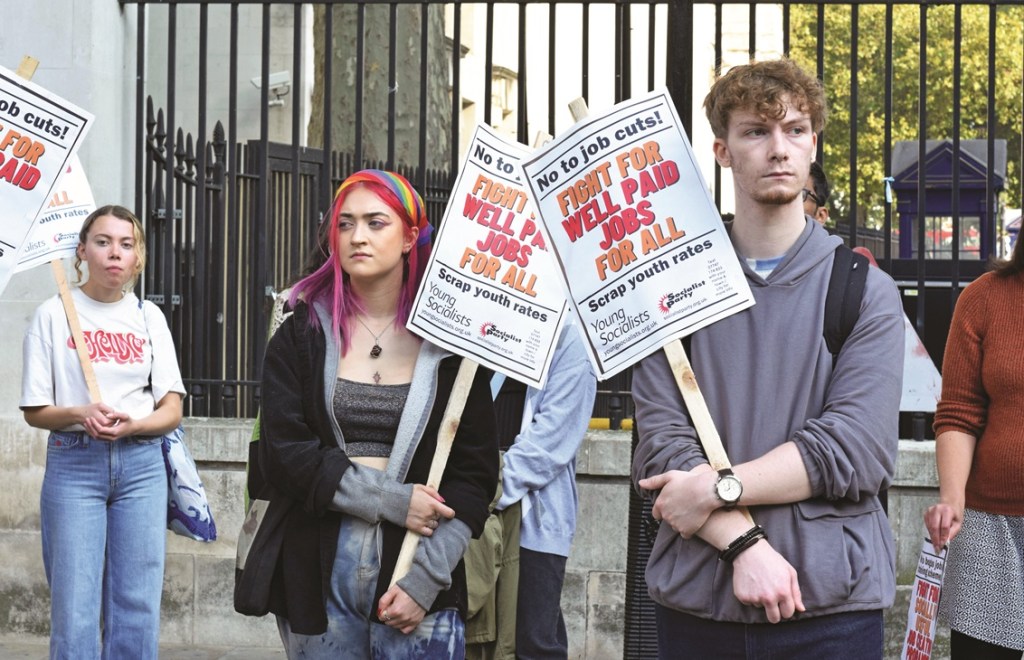
Many young people expected Starmer’s New Labour government would be a change from the Tories but not even two years in, our situations are much worse despite Labour’s election pledges. Youth unemployment has gone up to 16.1% in February, the highest rate in five years. And another U-turn appears to be on the horizon. Under pressure from big business, the government is considering shelving the proposal to equalise the minimum wage for those over 18.
I recall being 19 and working in Burger King for just £6.83 an hour, then around £3 less than my co-workers who happened to be four years older than me. They were hardly living the life of Riley themselves, but it is not fair to have workers doing the same job be paid at different basic rates. It should be an equal day’s pay for an equal day’s work.
Bad excuses
The excuse from the mouthpieces of megacorporations, such as Luke Johnson the former chairman of Pizza Express, that it is simply too expensive to pay workers, is a farce. Pizza Express, for example, had a revenue of £442 million in 2025. The problem isn’t that people on minimum wage are being paid too much, it is that corporations and billionaire boards are seeking short-term profits at the expense of millions of working-class young people. And the government subsidises these employers paying low wages through Universal Credit payments; more people who receive benefits work than not.
What is needed is well-paid jobs that are sustainable. We need a £15 per hour minimum wage immediately for all workers, including those under 18, as a step towards a real living wage. We need trade union struggle that fights in the interests of young workers, including for the wages we need.
It is only ‘impossible’ to deliver a £12.71 minimum wage for all because the capitalist system operates on the basis of short-term profits for a few over a plan which serves the needs of the majority of us. And to those who say they cannot afford this, we say open the books and show us where the profit is going. And if small businesses genuinely cannot pay the wages we need to live on then they should be subsidised, taking the wealth away from the big bosses.
There is a socialist alternative to the capitalist race to the bottom. By nationalising under democratic working-class control the commanding heights of the economy – big business and the banks – we could allocate jobs to all who need them and properly train up employees. Capitalism doesn’t wish to invest in young people; increasingly young people do not wish to invest their support in capitalism either!
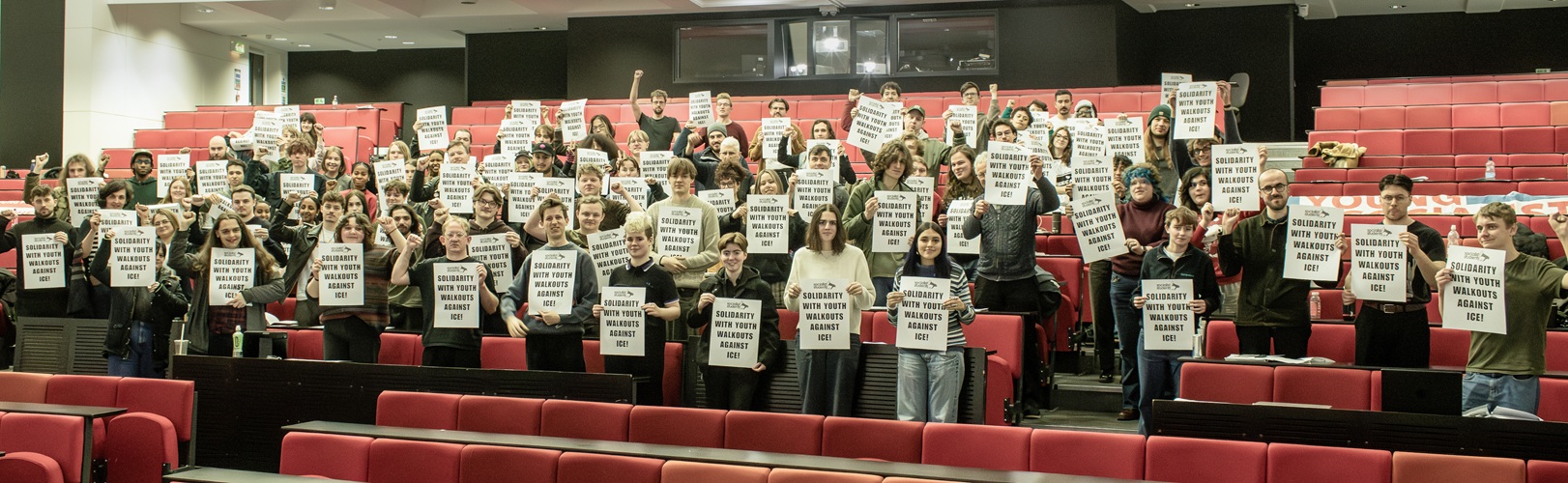
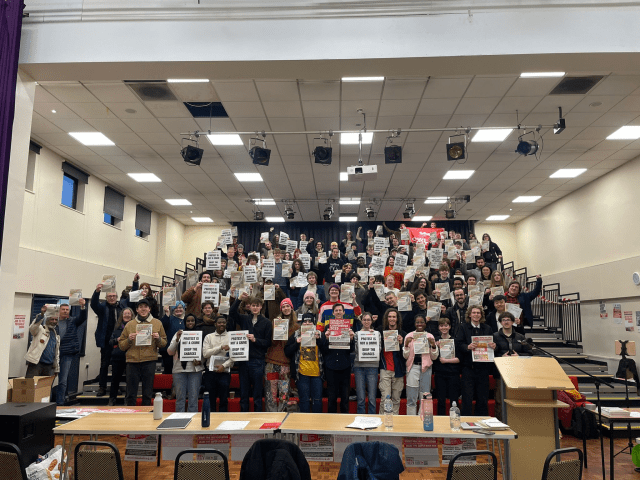
“We truly are in unprecedented times” – these were the opening words of the 2026 Socialist Students conference in Manchester. On Saturday 14 February, over 80 student activists from across England and Wales battled train cancellations and a cost-of-studying crisis to come and debate what can be done to combat crisis-ridden capitalism on and off campus.
Kicking off the opening session on ‘The struggle for socialism in a world on fire’, Robbie Davidson from Manchester Socialist Students pointed out that young people can see more clearly than ever that this is a system with no answers. The purpose of the discussion wasn’t just to moan about the ills of capitalism today, but to have a stocktake of what is wrong with the world so we can understand how to change it.
That’s why he described the brutal repression being meted out by Trump and his anti-immigration ICE goons in Minneapolis, and the stoking of global tensions with military interventions in each of Venezuela, Nigeria and Iran in recent months.
This is not coming from a position of strength, but because Trump is unable to answer declining living standards and becoming ever more unpopular among workers and youth in America. There’s been walkouts of students and workers in Minneapolis against ICE killings, and occupations, as well as some of the biggest protests in US history around the No Kings movement.
And crucially, socialism is back on the agenda in the US. Newly elected Zohran Mamdani declares himself a socialist, a point of attraction rather than a turn-off for the million-plus who voted for him, and the thousands who came out to campaign for him.
Walking out against Trump
The effect of “bigot in chief” Trump on radicalising young people isn’t just a factor in the US, but also here in Britain. Last September when he came to Britain, Socialist Students organised walkouts of school and college students against the red carpet being rolled out for him by Starmer and the royal family. Despite attempts by headteachers to threaten disciplinary action, lock school gates and snatch leaflets from our hands, Socialist Students met college and school students taking political action for their first time and helped them get organised.
Not that there’s a lack of reasons to be angry much closer to home. Those turning 18 today will have lived their entire life in the wake of the 2008 banking crisis. Many of British capitalism’s problems stem from this era. In the two decades since, Tory, Lib Dem and Labour governments have attempted to break even by making the working class pay.
Low pay and high rents accelerated in the austerity era, schools became underfunded to the extent that teachers have been paying out of their own pocket for supplies for years. Dean Young from Liverpool described the dire situation facing young people leaving education. The unemployment rate among 16 to 24-year-olds is now 15.9%, with over half a million looking for work and unable to get it, while 800,000 claim Universal Credit. Linked to this is the disappearance of graduate and entry-level job roles.
And as James Taylor from Birmingham described, those able to find full-time employment on marginally more than the minimum wage will be faced with crippling loan repayments of 9% of their income over the £28,470 threshold for repayments, set to be frozen for the remainder of this government. Crippling interest of inflation +1% and additional repayments of 14% for those with postgraduate qualifications means that even those entering previously well-paid professions are finding their income squeezed by student debt. No wonder in recent years there have been well-supported strikes by resident doctors, teachers and even barristers!
These are just a few of many examples of trade unions coming back on to the scene. Conference delegates gave plenty of examples of how Socialist Students groups have worked with unions, including those in higher education struggling against job cuts, low pay and bad working conditions.
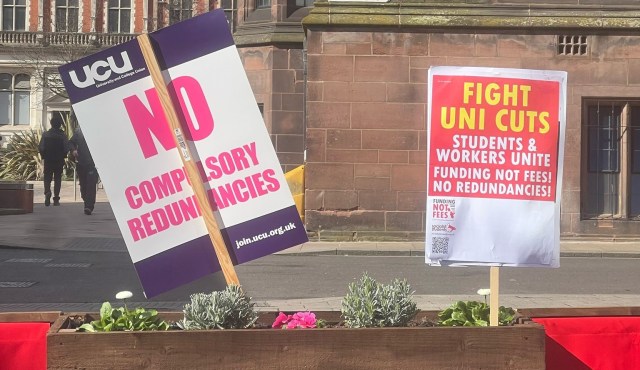
Tilde Resare from University of Sheffield described the ongoing strikes against redundances. Management have been hard to negotiate with, demanding strikers work in their own time to make up for work missed during strikes or face losing 100% of their pay (including for non-strike days). Striking University and College Union members effectively faced a 18-day-long lockout.
One staff member was penalised for not running a tutorial to prepare for an exam that had already happened. Sheffield Socialist Students have been able to help explain the reasons for the strike to students by leafleting alongside striking workers.
Ben from Birmingham called on delegates to look for where workers are fighting back in their local areas, such as the Birmingham bin workers fighting pay cuts and deskilling, or Oxfordshire firefighters campaigning to maintain a safe level of cover.
These examples of collective action by workers aren’t just deserving of support in their own right, but can give confidence and inspiration to students in how to organise to win their own struggles.
The University of Essex is threating closure of its Southend campus – hundreds of local students, especially from working-class backgrounds and facing barriers to study are being told they don’t have a place at university.
15,000 threatened job cuts
Nationally there have been 15,000 threatened job cuts in higher education since the start of 2025, with the government not ruling out closure of some unis. The occupation of campus buildings and mass assemblies on the level that took place against the trebling of tuition fees in 2010 could spark a national movement. This would put pressure on the Labour government to step in with emergency funding and replace the current inadequate funding model for higher education that relies on UK students being saddled with debt, international students rinsed for every penny, and universities making deals with arms companies and other unethical investments.
In Manchester, where the university is the largest landlord in the city, Socialist Students have played a leading role in the relaunched ‘Fight The Rent Hike’ campaign. This is in response to one of two relatively affordable options for university halls being replaced with one costing £100 a week more, with the rents raised after prospective students had already applied to live there.
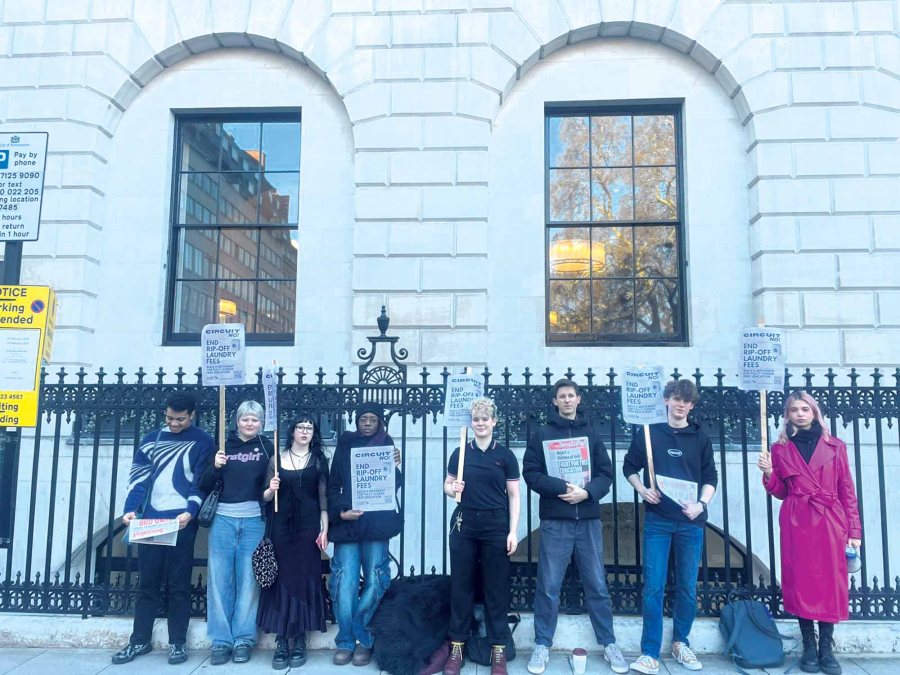
With student finance held at below-inflation levels for years, the cost-of-studying crisis has reached such a level that a few quid extra a week in laundry costs represents a big hit for students. Socialist Students at University of Arts London (UAL) launched the Circuit No! campaign against washing machine provider Circuit Go charging over £5 a load for laundry.
To add insult to injury, costs for the same washing machines provided by this company, who have 90% of the UK market stitched up, vary massively between campuses, even within the same city.
As Kat from UAL put it: “Students across the country are being ripped off. It’s time for students to take a stand”.
Morgan Tritton from University of Hertfordshire described the epidemic of violence against women on campus: “We’re not putting up and shutting up”. Socialist Students societies have recently campaigned to improve sexual harassment reporting policies at Herts, won gender neutral changing rooms at Queen Mary University, and reinstated the night bus at University of Liverpool.
Socialist Students national organiser Adam Powell-Davies described how, although we are not at the moment in the middle of a national wave of student struggle, there is a questioning of the system in the minds of young people.
Socialist Students has been making progress, with a record number of students signing up to get involved this academic year. That’s because we don’t just talk about revolution, or fight for every possible gain on campus, but link the two to the need for socialist transformation of society.
To set ourselves up for this new era of opportunities to build support for socialist ideas on campuses, the conference debated and voted to adopt a new constitution for Socialist Students. This re-establishes the democratic structures of Socialist Students, with each society having the right to send motions to conference establishing the political and campaigning direction of the organisation, send a representative to the national steering committee that assesses the work of Socialist Students and takes decisions between conferences, and to vote on the officers responsible for the day-to-day running of the organisation.
This includes the existing 40 societies and campus groups active across England and Wales. But the conference also agreed that other student groups with a socialist orientation should be able to affiliate to Socialist Students and participate in its structures.
We expect everyone involved in Socialist Students to agree to aims of fighting for socialism, while encouraging maximum debate on how it can best be achieved. This will mean testing out ideas in the real struggle and then reassessing based on the fullest possible democratic debate within the structures of Socialist Students.
Your Party and the Greens
Already, representatives of Aston Left Society and Kings College London and University College London Your Party supporters were present at the conference.
With the huge surge in support for and membership of the Green Party among young people since the election of Zack Polanski as leader, this could include Green Party societies. As Tom Porter-Brown from Leicester put it, we have to show the way to Green Party members who want to fight austerity and capitalism.
It’s likely that after the May local elections, the Greens will have over 1,000 councillors, including in areas with large student populations, and a greater platform than ever to fight austerity. This will put them to the test as to whether they take an active role in campaigning for more funding for services, or a backseat one, or worse still join council administrations in wielding the axe as they have in Bristol and Sheffield.
Against the arguments that nothing can be done under the current model for funding local councils, we should be prepared to argue that the organised mass of young people and workers can knock back commissioners and council cuts, and that Green councils use reserves and borrowing to put a stop to the cuts.
Say to Greens, let’s come together and prove that the answer to our problems lies in the coffers of the fat cats. After all, no party governing under the constraints of the capitalist markets will be able to fundamentally change things for working-class and young people.
This includes Reform UK. Many spoke on the worry students and young people feel at the prospect of a Reform government, and the growth of the far right beyond that. At the same time, the conference recognised that they have been able to grow due to the failure of the establishment parties and that the working class does not yet have its own mass political voice.
As Ali from Yorkshire pointed out in the closing rally, Reform societies have been set up on some uni campuses but at the moment find a limited echo. When Farage’s social media manager was invited to speak at York University, hundreds came out to protest.
After all, what do Reform have to offer students? They have no answers to the higher education funding crisis, for example, or any of the crises students face. So what better way to cut across support for Reform and the far right than to offer a real alternative? A socialist world free from want and oppression.
Multiple speakers pointed to the two thirds of young people in Britain who, in opinion polls, have said they’d like to live in a socialist economic system. The task now will be to translate the constitution and motions voted on from words on a bit of paper into action, so Socialist Students can be a real factor in the battles emerging on campus.
As Becca Bayman from Liverpool commented in the closing rally, it’s an increasingly difficult time for students, but increasingly important to build a fightback. After this year’s conference, Socialist Students is well placed to lead this.
Text from a Socialist Students leaflet produced for International Women’s Day 2026
International Women’s Day – March 8th – once again takes place in a world of chaos. Wars, economic instability, and attacks on basic rights have become the norm. The Epstein files reveal the sexism and rottenness of the capitalist class.
There is a lot to protest about! Many of the legal and social rights women have won are under threat and exacerbated by capitalist turmoil. Even basics like health care and housing have become a struggle. Sexist and misogynistic ideas are being amplified by powerful figures, not least President Trump.
A major issue for women students is the outrageous levels of sexual harassment and abuse we face. 97% of young women in Britain have experienced sexual harassment. That confirms what we all know from our experiences on campus, on nights out and at work. University and college bosses are more concerned about cost and their reputation than student safety.
Around the world young women are part of the mass movements challenging the sexism, poverty, repression and exploitation of the capitalist system. We’ve had enough, and we need change.
Raising awareness of the issue is not enough. We need action.
That starts with getting organised – and discussing what we want to fight for. Immediate measures that would dramatically improve women’s safety on campus include: free 24/7 shuttle transport; decent lighting; and the expansion of student support services.
Venues can do much more, including distributing free drink covers. All venue staff should have training to identify red flags and how to intervene, with sufficient staffing levels to ensure they can. Instead of unaccountable uni bosses, we need student and trade union democratic oversight of reporting and complaints procedures so we can have confidence in them.
Socialist Students is campaigning for all of these demands. Winning safe learning and social spaces will mean fighting for funding. Socialist Students fights for full public funding of education and an end to the rotten market model of running education.
Fight for socialism
Prejudices, gender stereotyping, and sexist behaviour should be challenged; that starts with democratic and accountable student committees which should be in control of how training is carried out.
But education alone is not enough. Sexist ideas do not stem from individuals; they are products of the capitalist system we live in.
Systemic problems require systemic solutions. To eliminate gender violence, we need to challenge the root cause of sexist ideas by taking economic and political control out of the hands of the small minority who profit from inequality and oppression.
We need a mass movement with workers and youth at its heart to win the funding and resources we need and fight for a socialist alternative to capitalism.
The University of South Wales (USW) is going to Socialist Students conference for 2026. For the last year, we have been fighting for the opportunity to bring our Socialist Students society back into existence.
We had to fight to re-register. USW administrators weren’t happy with our campaigning on campus against the war on Gaza, exposing the university’s connections with companies providing software for military drones used by the Israeli army.
Students are enthusiastic about learning of and discussing socialist ideas. Each student brings new ideas and experience – a small-scale version of the energy you can find at the annual conference.
Cardiff Socialist Students has hired a minibus to travel to Manchester this Saturday 14 February to take part in the conference. The seats are full!
Socialist Students conference is an opportunity to get to know like-minded students. It truly gives you a sense of our movement’s scale and energy.
That was my biggest takeaway from last year. It reminded me that we are in a real movement, and that everyone wants a change in our conditions.
Circuit Laundry is known for overcharging university students living in halls, and for providing poor service to students.
These are students who already face a cost-of-living crisis and struggle to make ends meet. At one University of Arts in London (UAL) accommodation, students are charged £4.10 per wash and £2.60 to use the dryer. You don’t even get detergent included for that!
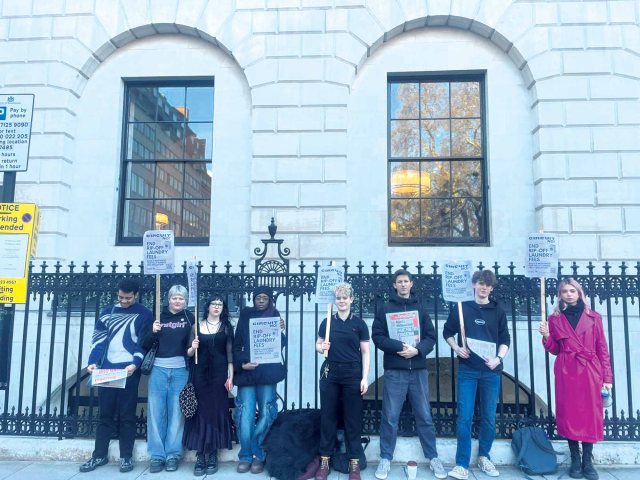
London Socialist Students organised a lobby outside the headquarters of Cinven – the private equity firm that owns Circuit Laundry. It has contracts with over 90% of universities in Britain.
We heard speeches from Socialist Students organisers and we chanted. Students demanded an end to rip-off charges, and an immediate reduction of laundry fees to £1 per wash.
A lot of passers-by expressed their support. One security staff said he supports the protest, as it would affect his children when they go to university.
Students also used the lobby to launch a national petition too, which links the need to oppose laundry fees to the need to fight for fully funded free education.
The petition calls for kicking out private profiteers from universities, bringing these privatised services back in-house. Socialist Students is now stepping up the campaign.








 Socialist Students