End the student housing crisis!

Charley Lincoln, Northampton Socialist Party and Socialist Students

Student rents have risen more than inflation. Student loans have not. There is a massive gap. The average monthly rent for a student in 2024 is £689.43, 16.5% higher than the year before. In London the average is a whopping £1,032 a month. A student getting the maximum maintenance loan and living away from parents outside of London can borrow £10,227 a year, £852 a month.

No wonder 69% of students now work alongside their studies, according to the National Union of Students. The negative impact is not limited to academic achievement but also health and social outcomes. 78% of students surveyed say they are suffering ‘significant stress’ over money.

Most students with more wealthy parents willing and able to pay don’t face the same stress. Increasingly, access to higher education is becoming the privilege of a wealthy few, deepening economic inequality as working-class and poorer young people are forced to forego education and take low-paid jobs with little chance of long-term progression.

Socialist Students fights for free, fully funded education for all. Rather than being saddled with a lifetime of debt, student loans should be replaced by living grants that rise with the cost of living.

Students are a ‘captive market’ for landlords – be it the university itself, private halls or private renting. All know the level of student maintenance loans, and all hike rents to maximise income. Student housing has become even more competitive than the housing market in general.

University halls

Around one in five students live in university-owned halls of residence. Increasingly, access to this is limited to first-years, postgraduates and international students. These three groups typically bring in the most cash and unis are motivated to get students enrolled (and paying fees) with as few hurdles as possible.

Halls typically have very limited provisions for students who have families, or for disabled students. Often when attempts are made to accommodate disabled students, it is not as thought-through. There are problems such as push-door buttons on one side only, or even behind non-accessible internal doors in the way of the accessible one, or needing an able-bodied person to place a ramp down.

Licensing for halls is viewed in the same way as for residential homes. Each room is treated as an individual dwelling, instead of looking at the whole building. Therefore halls do not have to meet the same fire safety standards as other high-rise residential buildings. In England, more than one residential hall has been found to use the same flammable cladding as Grenfell.

  • End rip-off rents – give students and university workers democratic control over rent levels, maintenance and repairs
  • Invest to provide high-quality, safe, and accessible accommodation, including to meet the specific needs of disabled students, and those with families

Private halls

Building private student halls is big business. The largest provider, Unite Housing, is listed on the FTSE 100 biggest companies on the London Stock Exchange. Unlike traditional housing, when halls of residence are sold, they are sold as a whole building, not as individual flats. Since 2013, the ‘block’ selling of student halls has increased.

That marked the start of a student accommodation investment boom, and led national and international investors to build new property portfolios. As investors sought to consolidate scale and drive down operational costs, England has seen levels of investment steadily at around £3.2 billion a year. The selling of IQ student accommodation company to Blackstone in 2020 was for £4.7 billion, which is the highest seen in England so far.

Investment isn’t planned to meet the needs of students. Instead, private hall owners invest in what they think will be profitable.

It’s also worth mentioning that this building type is difficult to repurpose when it needs to be sold (normally due to oversupply). The standardised nature of typical purpose-built halls, along with small room size, makes changes to residential use difficult.

Some cities have attempted to use the rise of co-living integration in the workplace, living environment, and social space as a product for students and young professionals. Still, reports of negative experiences living in this set-up are rampant. People have felt unsafe and forgotten.

Socialist Party member Marcelin shared her experience of a co-living accommodation: “The entrance to the building did not lock even when pushed closed; it was on the street with heavy footfall. Random non-residents would let themselves in, and there have been issues that led to police turning up. The property was meant to be pet-free, but one neighbour had six dogs that would be allowed to roam unsupervised in the hallways.” When both issues were raised, she was told nothing could be done. Previously, she had lived in halls and a shared house, but was priced out.

Student accommodation does not have to comply with affordable housing requirements. At the same time, any housed student can count towards meeting a local authority’s housing targets. In other words, each rented bedroom can be counted as a single home, misrepresenting reality. This means councils can claim they are tackling homelessness while not actually taking action, and instead exploiting students.

  • Stringent council licensing of student housing providers, with the direct democratic involvement of students
  • For democratic rent controls, quality and safety standards in-line with university-owned halls

Private-rented accommodation

Second-years and beyond are largely left to fend for themselves securing housing on the private market in competition with groups of other students. Landlords and agents exploit the shortage of housing (and using fearmongering about scarcity too) to charge maximum rents and get contracts signed months in advance. To maximise income, bedrooms are crammed into homes designed for a single family.

Similar to the boom of landlords looking to profit through Airbnb in tourist hotspots, in student areas landlords buy up family homes to convert into student accommodation, further reducing the supply of available housing for families, this drives up the cost of rent for everyone.

Housing contracts for students are not fit for purpose. They often do not provide year-round accommodation, assuming you have a family that can support you during the holidays. They are also not flexible enough to account for the realities of student life. If a student has to drop out, they will no longer have the student loan to pay rent, putting themselves and often their housemates at risk due to them being locked into their contract.

Invasive landlords often take advantage of the inexperience of student tenants, often turning up un-announced for inspections, maintenance and property viewings for the next tenants. This creates a lack of privacy as well as emphasising how replaceable tenants are.

The requirement for guarantors and security deposits, often on a yearly basis, assumes again that the student has a family that is able to provide this support, excluding poorer students from a working-class background from this kind of housing, as well as excluding those with complicated home lives. Students often lose hundreds of pounds every year to landlords manufacturing reasons to take security deposits.

  • Compulsory licensing for all landlords, including subject to quality and safety inspection from local council authorities and student representatives, and to end security deposit theft
  • Democratic rent controls for all rental properties, student or otherwise
  • Access to secure tenancies, including flexibility that accounts for student term dates and other issues. Include Student Finance England as guarantor for students excluded or forced to leave courses early
  • A programme of mass council house building to meet the needs of all

Damp, mould and rip-off rents

Frankie Sell, Southampton Socialist Students

From the extortionate rates charged by both university and private student halls to omnipresent mould and botched renovations, it feels as if the crisis of student housing is inescapable.

Student halls in particular can cause tremendous headaches as many students’ first experience of living away from home. For instance, in my first year I lived in the cheapest ensuite room stocked with just a single bed and desk. This now costs £6,646.92 for a 41-week contract (an increase of about £500 since 2022). When you consider that the maximum student loan is just £9,672.00 per year, this leaves students with just £250 per month after rent.

This is clearly unsustainable. Like many students, I opted for cheaper student housing with a private landlord going into my second year; however this came with its own problems. The only bathroom and shower I had access to was a converted storage closet under the stairs, it was barely large enough to stand in and had constant issues with damp and mould that were never dealt with. The ceiling in the living room would occasionally start pouring water. The landlords attempted (unsuccessfully) to fix this problem but eventually gave up trying towards the end of the tenancy.

Then, the following year, there were large cracks in the walls (an external consultant informed me these were likely caused by structural damage) which took over three months to repair. There is also heavy staining in the carpets and walls, which have still been largely ignored four months into the tenancy.

Unsurprisingly to any students reading this, these examples are common in the industry of student housing, and are by no means the worst that I have heard in my time as a student.

Why should students be paying more than 50% of their income on rents? Rents should be capped, and maintenance standards regulated, including with maximum time frames for repairs.

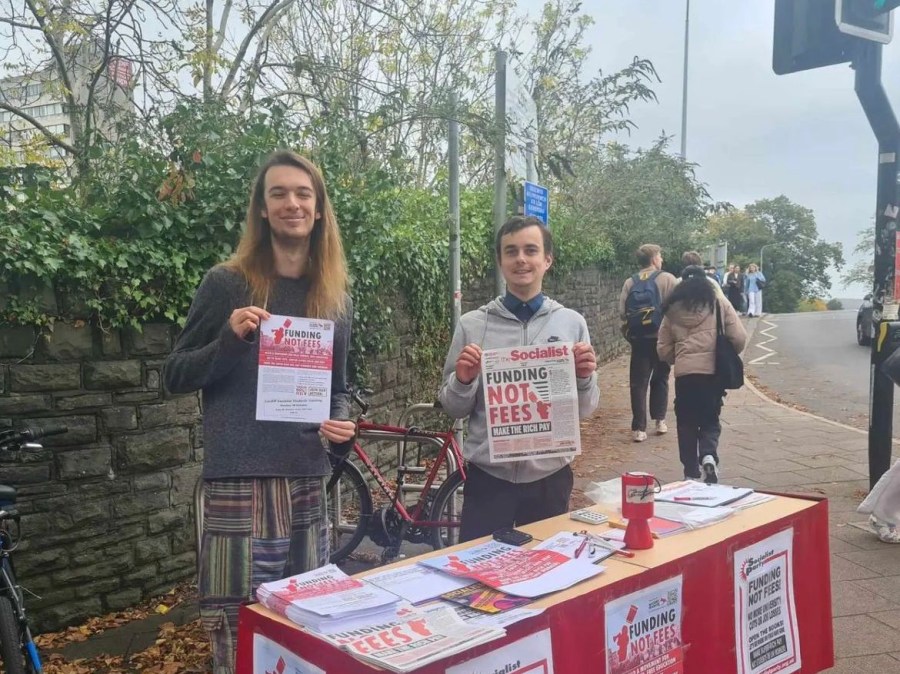
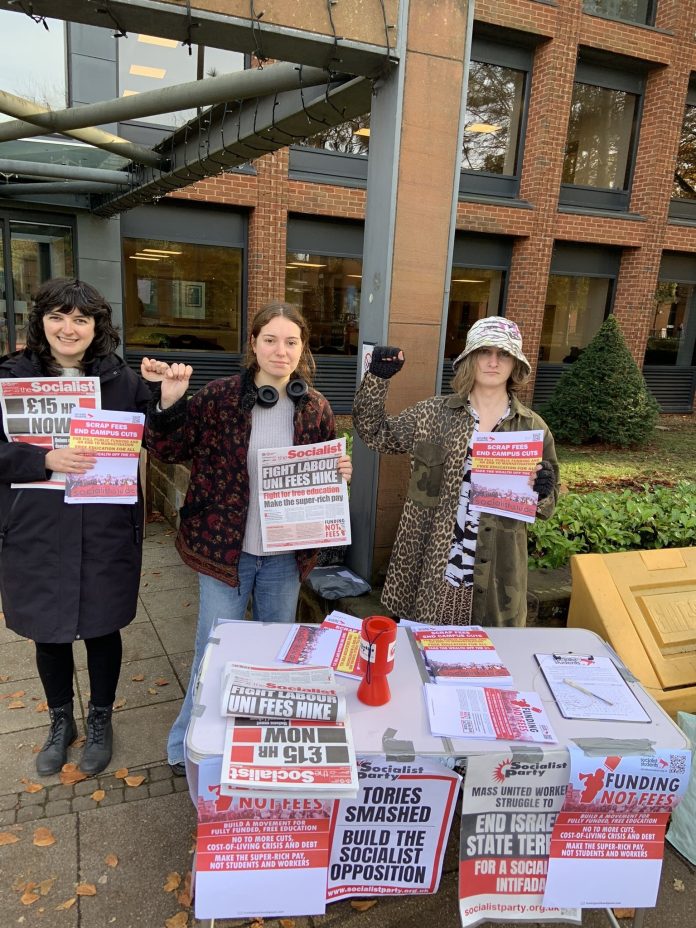
Funding not fees

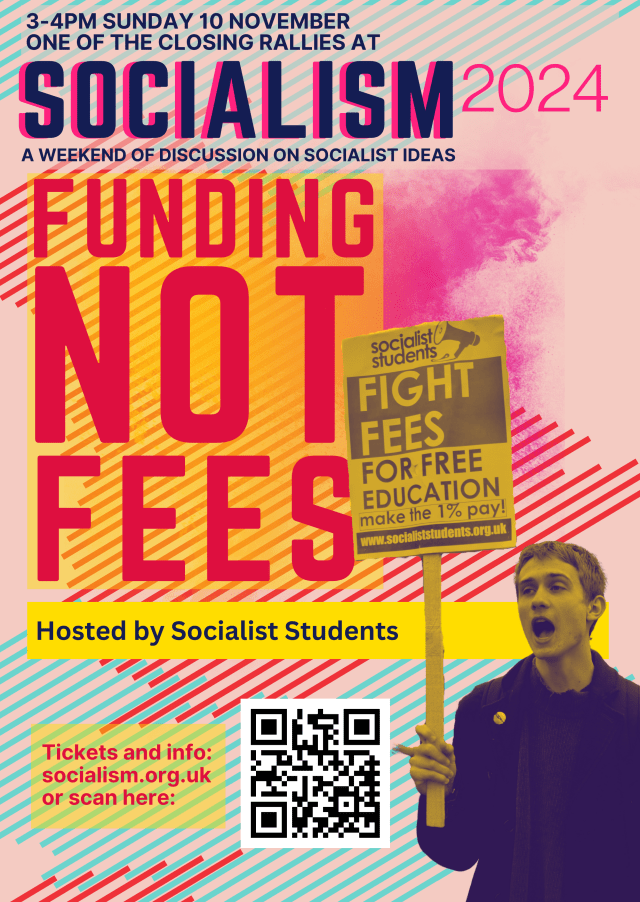
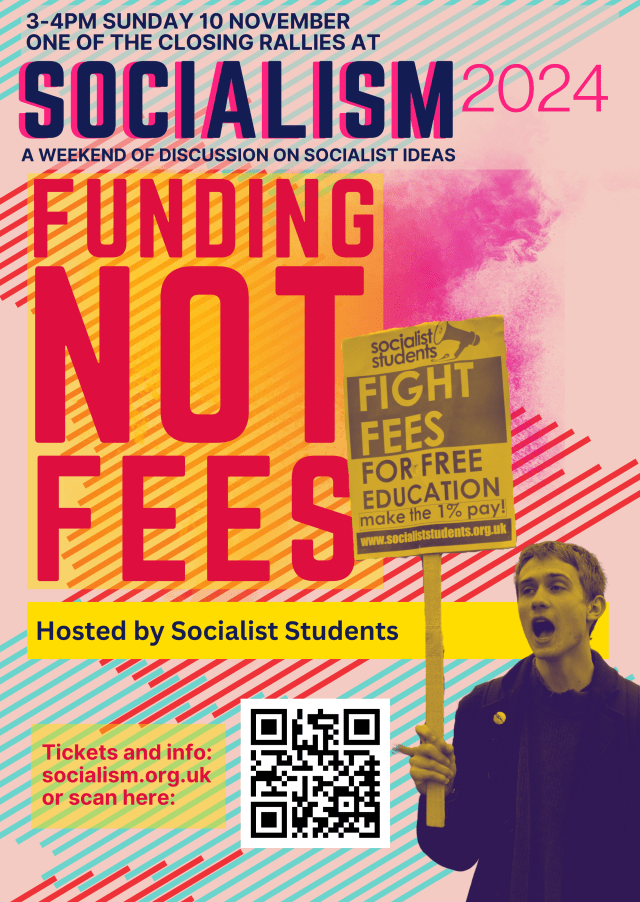
The Funding Not Fees campaign demands that big business foots the bill for education, not students and workers. We call for fully publicly funded higher education, paid for by taking the wealth off the super-rich, as the means to:

· Scrap tuition fees

· Introduce living grants, not loans

· Stop all cuts and closures on campus

Funding Not Fees

Funding not fees

Make the rich pay

Isis Smyth, Liverpool Socialist Students

Students are angry. Socialist Students members in Liverpool have spoken to thousands of new and returning university students since the start of the academic year. All we have ever known is Tory cutbacks and attacks. Now any hope that things might be different under Labour is being transformed into anger at Keir Starmer and his government, including over the possibility of a rise in tuition fees.

With Jeremy Corbyn as Labour leader for the 2017 and 2019 general elections, Labour’s policy was for free education. Starmer said it best at the recent Labour conference in Liverpool – the Labour Party has “changed”. It is no longer a party for working-class and young people. Continuation of war in the Middle East, two-child benefit caps and pensioners’ winter fuel payment attacks; life under Labour feels a lot like life under the disgraced Tories.

The cost of a university education is already staggering. Fees alone are £9,250 a year for most students, add to that loans to pay for rent, food and the basic necessities. Every year the threat of a debt mountain deters working-class young people from achieving a higher education qualification. And the Budget on 30 October could include raising fees further.

Already, universities like the University of Liverpool have upped food prices on campus and removed their food pantries, which gave students hit hard by the cost-of-living crisis access to free food if they could not afford to do weekly food shops.

This academic year, 40% of English universities are facing a deficit in their budget. And, as usual, the fat-cat vice chancellors and the government want us to foot the bill.

But at the same time, the rich keep getting richer. As horrific as it is, the capitalist system prioritises profit over young peoples’ futures.

University education should be free, fully funded and accessible to all. Maintenance grants should be universal and enough to be able to afford a decent quality of life. Life under Starmer’s Labour is making it clearer than ever that we need a party to fight for the many, not the few – a new mass workers’ party that fights for socialist change.

Socialist Students says

  • No to further fee increases – get organised on campus to fight for free education! Cancel student debt, replace student loans with living grants tied to the rate of inflation. Make the super-rich pay!
  • No cuts and no closures! Build democratic student organisations to link up with campus trade unions and the wider working class to fight for the funding our universities need
  • Kick big business off campus! End marketisation of our education. Open up university finances to democratic oversight and control, including by elected students’ representatives and campus trade unions, with the power to terminate all contracts and research tied to war, occupation, profiteering and exploitation, while guaranteeing jobs and funding
  • Students need a political voice. Build a new mass workers’ party that will stand up for students and workers and fights for socialist policies
  • Fight for socialist change. For democratic public ownership of the banks, monopolies and major industry to provide us with a future

Funding Not Fees campaign

Socialist Students is helping to initiate a new national campaign, Funding Not Fees, with the support of other campus organisations, to bring together students and workers in a movement for fully funded, free education – not more fees and cuts.

The Funding Not Fees campaign demands that big business foots the bill for education, not students and workers. It calls for fully publicly funded higher education, paid for by taking the wealth off the super-rich, as the means to:

  • Scrap tuition fees and cancel student debt
  • Stop all cuts and closures on campus
  • End low pay and insecure employment
  • Introduce living grants, not loans

No fee rises, no uni cuts

Make the super-rich pay for free education

Robbie Davidson, Manchester Socialist Students

After fifteen years of Tory austerity attacking our jobs, homes and services, Keir Starmer and Rachel Reeves have made clear to the bosses their government won’t be a radical departure. And, hearing about difficult decisions to be made on things including education funding, students are preparing for the worst.

Already, the university cost of living is at an all-time high. And the money we need to live on – once maintenance grants now transformed into loans – has not risen with inflation.

And its not just students. Lecturers and university staff are being exploited ever more – with low pay and longer hours. They have organised in their unions against poor pay and conditions during the strike wave and against redundancies now.

Students at this point in time, however, do not have the same level of organisation to match our growing frustration. For most of us, the students union is nothing more than a cafe and bar. Socialist Students members in freshers’ weeks across the country have raised the need to fill that void with democratic fighting student organisations.

Free education should be a right for all, and this can only be achieved by taking it back into our hands. We’ve been told to tighten our belts by the six-figure salary bosses at the core of the marketised system. But its time the super-rich bosses and corporations are made to pay

The University and College Union (UCU) has called for an education levy on big business to pay for an end to tuition fees. We believe students and workers should have a democratic say over how university funding is spent and our universities are run. At our public meetings and stalls we found that our programme for free education chimes with students.

When they tripled tuition fees in 2010, the ensuing outrage lacked the organisation to sustain a proper movement against them. We will be prepared this time! Join Socialist Students today to get involved in the fightback.

Socialist Students says:

  • No to further fee increases – get organised on campus to fight for free education! Cancel student debt, replace student loans with living grants tied to the rate of inflation. Make the super-rich pay!
  • No cuts and no closures! Build democratic student organisations to link up with campus trade unions and the wider working class to fight for the funding our universities need
  • Kick big business off campus! End marketisation of our education. Open up university finances to democratic oversight and control including by elected students’ representatives and campus trade unions, with the power to terminate all contracts and research tied to war, profiteering and exploitation, while guaranteeing jobs and funding
  • Students need a political voice – build a new mass workers’ party that will stand up for students and workers and fight for socialism
  • Fight for socialist change – for democratic public ownership of the banks, monopolies and major industry to provide us with a future

Scrap fees, end campus cuts!


For full public funding and an end to marketisation

Free education for all!

Students are once again in the firing line! A statement released by Universities UK (UUK) at the start of the Autumn term has called on the government to increase tuition fees in line with inflation – again passing the cost of the ongoing crisis of the capitalist system onto the shoulders of students and young people. UUK has said that each student now costs a university between £12,000 to £13,000 to educate.

One in five universities is in deficit. The government and so-called experts say the problem is fees being frozen and not keeping up with inflation. So they want us to pay more – and face cuts and closures on campus. But in reality, our universities have gone underfunded for years.

Since the introduction of tuition fees, and their trebling by the Tories and Lib Dems in 2010, government funding for universities has been continuously slashed. Students and campus unions have had to fight vicious cut-backs by management – cuts to entire courses, jobs, and attacks on staff terms and conditions.

Meanwhile the student cost-of-living crisis rages on. The rents we pay on average are more expensive than the average available loan – so how are we supposed to be able to live, especially considering inflation has pushed up the prices of food, travel, educational resources and other cost of living essentials?

 But it doesn’t have to be like this. Socialist Students is fighting to build a mass movement to win the funding that our universities and students need – to reverse the cuts which have taken place on our campuses, replace inadequate loans with genuine living grants for students tied to the cost of living, and to scrap the broken tuition fee funding model altogether. Education should be free, fully publicly funded, with grants re-introduced.

When Jeremy Corbyn was Labour leader, the party’s manifesto estimated that scrapping fees and re-introducing grants would cost about £12bn. Starmer’s Labour government has made it absolutely clear that it does not intend to cough up the funding our universities need. That’s because, just like the Tories, Labour now represents the interests of the rich and powerful in society.

Why should education be run like a commercial business? Britain is the sixth wealthiest nation on the planet. The FTSE 100 biggest corporations have been paying around £85bn annually in dividends to their shareholders. The University and College Union (UCU) has called for a £17 billion “education levy” on “profiteering businesses”.

That’s a good start – but why leave so much wealth and power in the hands of big business, which puts profit before need? If the enormous wealth in society was democratically owned and controlled by the working-class majority, we could plan society to meet all our needs. That includes education – how it’s funded and how it’s run should be determined by education workers and students and the wider working class, not fat-cat vice-chancellors.

The recent strike wave showed how governments can be forced to pay more than they intended – and those lessons need to be built on. Mass organised action is needed to build the fight for free education. Building a student movement starts with getting organised on campus with democratic decision-making, linking up with campus trade unions and local college students.

But students also need a mass political voice to give expression to our campaigns and movements, as do working class and young people more generally. If the Tories and Labour both speak for the interests of the super-rich, then we need a new mass political voice to speak for what we’re fighting for – including against attacks on our education, against war internationally, and for a socialist world.

As part of our movement, at the upcoming ‘painful’ (in Starmer’s words) budget on October 30, Jeremy Corbyn and the four other independent MPs, as well as the suspended seven Labour MPs, could use their voice in Parliament to propose full public funding of education for all.

We need tuition fees scrapped, student debt cancelled, loans replaced by living grants for students, all funded by taking the wealth off the super-rich. Some of this has been won before – many of the current MPs had a free education. An organised mass movement can win again. But to make such rights permanent means fighting to end the profit-before-all-else capitalist system. Socialist Students fights for free education, as part of the fight for a socialist world without poverty, war and exploitation.


No to further fee increases – get organised on campus to fight for free education! Cancel student debt, replace student loans with living grants tied to the rate of inflation. Make the super-rich pay!

No cuts and No closures! Build democratic student organisations to link up with campus trade unions and wider working class to fight the funding our universities need.

Kick big business off campus! End marketisation of our education. Open up university finances to democratic oversight and control including by elected students’ representatives and campus trade unions, with the power to terminate all contracts and research tied to war and occupation and profiteering and exploitation while guaranteering jobs and funding.

Students need a political voice. Build a new mass workers party that will stand up for students and workers that fights for socialist policies.

Fight for socialist change – For democratic public ownership of the banks, monopolies and major industry to provide us with a future.


How students can build a movement to stop the slaughter in Gaza

We have witnessed a year of brutal slaughter of Palestinians in Gaza, and increasingly in the West Bank too.

It has exposed to the world how capitalist politicians do not value human life, despite what they say about wanting an end to the conflict. Many people here in the UK have felt anger at the situation in Gaza, and taken to the streets to protest.

Many students have also taken things into their own hands, protesting against their university bosses, calling for divestment from arms companies and companies that prop up Israeli state terror.

School and college students have organised walkouts and protests in solidarity with the Palestinians. Towards the end of last term, student encampments were organised up and down the country, exposing universities’ links to arms companies and banks. Socialist Students members were involved with many of these.

We fight for the 7-million-strong trade union movement to be central. It is the threat of workers getting organised and fighting back that terrifies the capitalist world leaders, including in the Middle East.

It is a mass movement of workers and poor people, democratically organised and fighting for socialist change, in Palestine and across the region, that can point the way forward to an end to war and national oppression.

We call for an end to the marketisation of higher education and an end of the tuition-fee funding model. Universities are becoming ever more reliant on money from big business, including from arms companies such as BAE Systems and Lockheed Martin, due to cuts in funding from government. University education should be free for all, and fully publicly funded by making the super-rich pay.

The huge determined protests against the slaughter in Gaza have defied attempts by politicians and police to intimidate them. That defiance led to the hated Suella Braverman being sacked as home secretary.

Pro-Palestinian campaigners standing in the general election had a huge effect in a whole number of constituencies. Jeremy Corbyn was reelected, in addition to another four anti-war independent MPs.

That must be built on to deliver the new workers’ party needed to give a voice to the anti-war, socialist opposition to Starmer. Student protests this term can have a big effect too – and Socialist Students is determined to make them as effective as possible.

If you want to be part of the fightback, get involved!


What Ideas should students get organised around?

Universities should open their books to a democratic inquiry by elected students’ representatives and the
campus trade unions, with the power to terminate all contracts and research tied to war and occupation,
while guaranteeing jobs and funding.

END MARKETISATION!

The government must fully fund education to disincentivise universities from gambling our fees on dodgy companies and ‘vanity projects’. Scrap tuition fees, cancel student debt, and reintroduce living grants for all students.

WE NEED A POLITICAL VOICE!

Winning a free, democratic, and genuinely ethical education system means fighting to take wealth and power off the capitalist elites. Starmer’s Labour government won’t even begin to fight for this. We need a mass workers’ party, with a socialist programme to end the capitalist system that breeds war and oppression.

MAXIMISE OUR STRENGTH!

Our movement would be strengthened if more students and workers joined. Socialist Students is calling for students to join us with:

• Mass meetings open to all who want to discuss how we can build a movement against war, oppression and capitalism
• Stalls and leafleting sessions, where we can talk to other students about any upcoming protests and action, and encourage them to join
• A rally with speakers invited from local trade union branches, and students from other universities, colleges and schools nearby
• A lobby of our local MP or councillors alongside other students, workers and trade unionists, to demand they explain their position on the Israeli state’s onslaught in Gaza


See more of our campaigning:


Build a movement to smash racism!


Tens of thousands of students and workers came out onto the streets to confront attempts by the far right to mobilise racist riots. This magnificent show of solidarity shows the potential to build a movement that can smash racism – and the decades of cuts and rising poverty.

Desperate to divert growing anger at their system, capitalist politicians of all varieties and backgrounds have used racist scapegoating of immigrants to try and divert the blame for the crisis of their system. But, as Malcolm X said: “you can’t have capitalism without racism.”

Reform’s Nigel Farage is one particularly odious politician who consistently spouts divisive racist and anti-Muslim rhetoric. He is the highest earning MP, netting a million pounds a year in addition to his MP’s salary, all the while peddling the fraud that he is an anti-establishment ‘man of the people’.

But to focus entirely on him and his party lets the rest of the capitalist politicians off the hook. The Tories spent the last years in government talking incessantly about migrants on small boats and taking part in the expensive political theatre of Rwanda deportation flight plans in the hope of diverting blame and anger for falling living standards away from themselves.

The cost-of-living crisis, high tuition fees and student debt, low wages, high rents, the collapse of public services. These are the results of funding cuts and privatisation carried out by both Tory and Labour capitalist politicians serving the interests of big business.

But the Tories’ crushing general election defeat showed the huge anger at the attacks on living standards of the working class. It followed the huge strike wave and mass protests against the war on Gaza which have brought students and workers together in a common struggle.

Starmer has said there is ‘little difference’ between him and the Tories on immigration, and continues to support the Israeli onslaught on Gaza. The new Labour government is committed to a continuation of privatisation and cutbacks to public services, making the working class pay for the crisis rather than taking the money off the super-rich.

Those who defend capitalism want to divide the working class including by using racism. That weakens our ability to unite and fight against them and the rotten profit system they defend.

This latest surge of racist violence serves as a warning as to what can develop under a Labour government which is continuing with the Tories’ austerity policies – already cutting pensioners’ winter fuel payments and promising billions of pounds of further cuts, including to the education sector and universities. The election of five Reform MPs is a warning too.

The only way to successfully cut across far-right ideas getting a platform is for the workers’ movement to build mass struggle to fight for a socialist programme that unites workers against the bosses – for jobs, homes and public services for all.

If the 6.5 million-strong trade union movement was to lead a struggle for those things – bringing together workers and young people from all backgrounds – it would give an expression to the huge anger and discontent that exists under the surface in society.

The task of defending our communities from racist attacks, strengthening the level of organisation of students and the working class, and developing a workers’ political voice in the form of a new workers’ party– all go hand in hand.


The effect of a political voice that stands for the interests of workers and young people not the fat cats was glimpsed in the 2017 general election. It is estimated that one million UKIP voters switched to supporting Jeremy Corbyn’s programme of cutting tuition fees, council homes, security at work, and more funding for the NHS and other vital services.

Socialist Students campaigns for students to get organised on campus to fight for all of this. We want to build a united movement of workers and students to overthrow this rotten system of capitalism for good.

We fight for the socialist transformation of society, based on bringing the commanding heights of the economy and the banks into democratic public ownership. Under the democratic control and management of the working-class majority, society’s wealth and resources could be planned to meet all of our needs. That is a necessary component of the fight to end racism and all forms of oppression and inequality for good.

If you want to fight back against racism, war and inequality, then join Socialist Students and get organised!


No to racism and the far-right! Build a united student and workers’ movement for good jobs, homes and public services – including free education for all!

Fight to build a political voice for the working class – a socialist alternative to Labour and all the capitalist parties. You can’t have capitalism without racism!

Fight for a socialist world free from exploitation and oppression!


Join the socialist opposition to Starmer and capitalism!

A lot has happened since last term.

The Tories have finally been booted out after 14 years of attacks on young people and the working class.

But Labour has wasted no time showing it has nothing to offer the millions of people in Britain who are desperate for something better.

A new Labour government did nothing to prevent racist riots stoking fear and division this summer.

While MPs holidayed on their £90k salaries, the job of routing far-right violence fell to thousands of anti-racist protestors in cities and towns across the UK.

But this government will only foster more racist scapegoating and division. None of the pro-capitalist parties – including the Labour government – have anything positive to offer, because they all stand for a capitalist system that puts the profits of a super-rich few before everything else.

They all want to divide us – with racism, sexism, LGBTQ+phobia and anything else they can find – to weaken our ability to unite and fight against them and the rotten profit system they defend.

But none of that can stop fierce opposition growing under this Labour government.

Hundreds and thousands of young people have protested against the Israeli state’s genocidal war on Gaza in the past year, with students launching our own protest encampments in universities up and down the country. That fight is going to continue this term.

Starmer has already promised that “things will get worse” on his watch. His government is reporting a £22 billion ‘black hole’ in its finances, and it wants us to foot the bill through cuts to our services, like schools and the NHS. So there will have to be opposition to these attacks too.

Workers will have to strike for decent living conditions under Labour, just like they did on a massive scale in the final years of the Tory government. Labour has already been forced to give pay rises to NHS workers and teachers – they were scared that if they didn’t, then those workers would strike against them! It all goes to show that when we fight, we can win – and that students can strengthen our potential to fight back by linking up with the workers’ movement.

Ultimately, we need to channel all these different struggles – against racism, and war and occupation; for decent pay, and good-quality services and homes for all; for a safe and sustainable climate – into one massive movement that fights to end capitalism and build a socialist world free from exploitation and oppression.

A world in which society’s wealth and resources would be democratically owned and planned by the working class to meet the needs of all, instead of to make profits for the few.

That’s what Socialist Students is fighting for from day one of the new term. If you want to build the socialist opposition to Starmer and capitalism, join us!


Starmer and his ministers are considering raising tuition fees to plug the gaping hole in higher education funding – a far cry from 2019 when former leader Jeremy Corbyn was promising to abolish them!

If Starmer goes ahead with increasing tuition fees, or any other attack on universities, then there will need to be mass student meetings held on every campus to discuss and democratically agree a concrete plan of action to organise and defend our futures.

Socialist Students would help to organise such meetings and build protests wherever we can. We also campaign as part of the Trade Unionist and Socialist Coalition (TUSC) for steps to be taken towards building a new mass workers’ party that gives a socialist alternative to Starmer’s Labour and all the pro-capitalist parties – including standing for free education.

Read our full article on the university funding crisis below:

Uni funding crisis: Prepare for struggles ahead

Adam Powell-Davies, Socialist Students national organiser

The risk of universities going bankrupt made it onto Keir Starmer’s pre-election ‘shitlist’ of major immediate challenges facing a Labour government.

Will Starmer’s Labour government raise tuition fees? Will it be the first to let a university go bankrupt on its watch?

Following the election of the new Labour government in particular, university vice-chancellors and higher education thinktanks have wasted no time speculating on what a university bankruptcy could mean – and setting out their views on what an adequate government response would look like.

Clearly a university going under would have catastrophic consequences. In many towns and cities, universities are one of the biggest employers, often second only to the NHS. Many thousands of jobs would be lost. Potentially tens of thousands of students would be without a course. There are fears that if one university went, it would trigger a domino effect throughout the sector.

That’s why Labour would be likely to intervene – for example, by providing emergency funding, with strings attached. In 1987, Thatcher’s Tory government found £20 million to save the then University College Cardiff, but only while mandating its takeover by the neighbouring University of Wales institute of Technology to create Cardiff University.

At the same time, state intervention to save a university would raise the sights of workers and young people to demand similar intervention; for pay rises, public service funding and more.

Labour would much rather take short-term measures to prevent the chaos of a university bankruptcy being posed in the first place.

A recently published review by the Office for Students (OfS) – the university regulator – concluded that financial challenges are “rapidly crystalising” with budget deficits, redundancies and course closures. Failure to manage these risks will “undoubtedly lead to a market exit, potentially in the near term, of one or more large providers”.

The government has accepted the recommendations of the review, putting out a statement that “the role of the Office for Students will be refocused to prioritise the financial stability of the higher education sector”. Crucially, however, the government is yet to respond to the recommendation to “clarify its position on market exit”. The University and College Union immediately put out a statement calling for new funding for the OfS to be able to directly intervene to support struggling universities. Key for students and workers is not just more funding, but control of how the money is spent.

How did unis get to this point?

In 2017, the Tories were forced to freeze tuition fees in England at £9,250 a year – a concession made under pressure of Jeremy Corbyn’s call for free education.

The real value of tuition fees has fallen dramatically due to inflation, to the point that universities now lose roughly £4,000 on average for every UK undergraduate.

This funding shortfall has driven a trend towards universities relying on international students, in effect using these students’ much higher tuition fees to subsidise the cost of teaching UK students.

However, international student applications are reportedly down by around one-third on last year. This recruitment crisis is a major reason why 40% of universities are predicted to run deficit budgets this coming year. The real value of higher education funding is at its lowest point since fees were trebled in 2012.

What will Labour do?

With Starmer abandoning his pledge for free education last year, Labour could complete the U-turn by increasing tuition fees. New education secretary Bridget Phillipson has more than once refused to rule this out when asked. New Labour linchpin Peter Mandelson went as far as calling for an “immediate uptick in fees” at a reception in Westminster this July.

Unfreezing the tuition fee cap would mean fees rising every year with inflation. That was how it was supposed to be, before Corbynism became a meddling factor in the plans of capitalist politicians.

Another option is to undo the visa restrictions brought in this year by the Tories, which prevent international students from bringing family members to the UK.

Labour’s approach may well be a combination of these things. But whatever they decide, clearly it will not involve any substantial increase in direct public funding for higher education, let alone free education. Phillipson has previously boasted about her plans for universities that could be implemented “without adding a penny to government borrowing or general taxation”.

And Labour will also want to cut back on the indirect public funding given to universities in the form of student loans. Despite the Tories’ attempts to overhaul the loan repayment system, most student loans continue to go unpaid and become government debt. The current figure for outstanding student debt is about £250 billion, equivalent to over 10% of GDP.

Appearing on Sky News last week, the new Labour skills minister Jacqui Smith declared that “it’s first of all in the hands of universities to take the action necessary in order to be as efficient as possible”. This is Labour’s warning to universities: “Even if our government does something on university funding, you will still have to make cuts if you want that money to go far enough”.

Fight Labour attacks

Overall, it looks like Labour will squeeze students for extra funds, which they hope will be enough to stave off bankruptcies in the short term, but not enough to remove the incentive on universities to make ‘difficult decisions’ over the longer term.

Any attempt to make students pay higher tuition fees would be met with widespread anger, not just among current university students but also school and college students planning to attend university.

Given that over half of under-30s in Britain now go to university, an attack on university students would be widely seen as an attack on young people’s futures in general.

There is already huge discontent among millions of young people, who see little to nothing positive about society as it is currently organised. They see themselves growing up in a world that allows uncontrolled war, poverty, climate degradation – all overseen by a tiny elite at the top, who get richer and richer while everyone else gets poorer.

In this context, the announcement of even a small fees increase could spark explosions on campus and among young people in general. Students would have to respond by calling mass meetings in every university, as well as colleges and schools, to collectively debate and discuss how to build a movement to fight Labour attacks on education, on young people and the working class as whole.

When Tony Blair introduced tuition fees in 1998, it sparked a big student movement. When the Tory-Lib Dem government trebled fees in 2010, it was the same again.

In 2024, the marketised fees model of higher education is in limbo. Labour want to keep it on life support while making students and the working class pay; socialists have to fight for a real alternative – a free and fully funded education system, run democratically by students, university staff and the local community for all to enjoy, as part of a socialist society organised to meet people’s needs, not profit.


Socialist Students says:

  • Fight for fully funded free education – scrap and refund tuition fees, cancel student debt, replace student loans with living grants tied to the rate of inflation. Make the super-rich pay!
  • Take universities under the democratic control of elected bodies of campus trade unions, students and communities
  • Build democratic student organisations to link up with the campus trade unions and fight for what our universities need
  • Build a new mass party that will stand up for students and workers
  • Fight for socialist change – for democratic public ownership of the banks, monopolies and major industry to provide us with a future

Socialist Students post-election statement

The Tories have been smashed. Reduced to their lowest vote in a century, they have been punished for 14 years of attacks on the working class, the young and the vulnerable.

There are plenty of reasons for students to be pleased that the Tories are gone. Their broken higher education funding model has left universities at risk of bankruptcy. Average student debt has soared to £50,000, and a collapse in maintenance support has driven a historic student cost-of-living crisis. Facing the fury of students, the Tories have encouraged university managements to clamp down on our right to protest.

But the new Labour government has no intention of improving our situation. Starmer has made clear that his government will stick to the Tories’ fiscal rules. He will use his landslide Labour majority to carry out more attacks on workers and young people. Already the Labour manifesto has promised nothing more than “existing funding” (i.e. Tory austerity budgets) for post-18 jobs and training, and it commits to maintaining wage disparity between 16 to 17-year-olds and the rest of the workforce. It is also silent on fixing the university funding crisis.

No wonder there was no enthusiasm for Labour in this election. According to a poll released just days before polling, half of people planning to vote Labour were only doing so to get the Tories out. The Labour popular vote in this election was lower than in 2017 and 2019, when Jeremy Corbyn was Labour leader, with an anti-austerity programme that inspired hundreds of thousands of young people.

As Socialist Students said at our conference in March:

Although there will inevitably be hope amongst some that a Labour government would mean an improvement to the day-to-day lives of workers and young people, any political party wedded to the capitalist system would be compelled sooner or later to carry out attacks on workers and young people. The stormy economic backdrop to the incoming Starmer-led government, acting within the economic constraints of capitalism, will push it rapidly into confrontation with students, young people, and the working class.

The next Labour government is set to come up against struggles on an even bigger scale than what developed [during the strike wave]. This will not only mean strikes, but struggle among students and young people.

The student fightback against Starmer’s Labour has already begun; it has been a big feature of the student encampments, and of the Gaza anti-war movement in general.

Now let’s take the movement further. We need a mass movement of all students who want to fight for a decent future, and for a free and democratic education system. That means getting organised on campus, linking up with the workers’ movement, and taking steps towards a new mass party that unites workers and young people in the struggle to:

  • Take on a Starmer government
  • Kick out all the capitalist politicians
  • Fight for socialism

Socialist Students has been preparing for the fightback that will continue under a Starmer government. Join us!


Join Socialist Students

← Back

Thank you for your response. ✨

Meet the socialist college student standing in the General Election

Adam protesting against the slaughter in Gaza

Adam Gillman is standing in the General Election in Reading Central for the Trade Unionist and Socialist Coalition (TUSC). At 18, he is one of the youngest candidates standing in the country. Adam has been active in the local trade union movement for a number of years, visiting picket lines and organising demonstrations.

Adam is a member of Socialist Students, a national organisation fighting for free education and a decent future for young people. He campaigned in his college for students to have the right to discuss socialist ideas.

Adam will be part of an anti-war, socialist challenge to the main parties alongside 39 other TUSC candidates nationally. He will be campaigning for concrete policies to improve young people’s lives, including:

  • Scrapping tuition fees and cancelling all student debt
  • Mass trade union struggle for a £15-an-hour minimum wage with no exceptions for age and inflation-proof pay rises for all
  • A mass programme of environmentally-friendly council house building, democratically set rent controls, and an end to no-fault evictions
  • The right to vote and stand in elections at 16

Adam says: “I’m standing to give a voice to young people who are horrified at the war in Gaza and suffering from the cost-of-living crisis. The main parties don’t work for us, so we need working-class, socialist MPs that will.”

If elected, Adam would only take the average wage of a skilled worker in Reading.

Those interested in getting involved can contact the campaign at 07403 057140.

The campaign has organised a pre-election rally where Adam will be speaking:
Tuesday 2nd July, 7:30pm
Reading International Solidarity Centre (RISC), London Street, Reading, RG1 4PS


Socialist Students says:

  • End the student housing crisis
    Introduce rent controls in all student accommodation. For socialist MPs who take on dodgy private landlords.
  • End the student cost-of-living crisis
    Replace maintenance loans with maintenance grants which cover all living costs. Scrap tuition fees, cancel all student debt – make the super-rich pay.
  • Stop war and occupation! End the siege of Gaza
    Workers and young people internationally: unite and fight the capitalist warmongers!
  • Combat climate change
    Carry out a massive switch to green energy NOW! Take the energy companies under democratic public ownership, to be run by workers and not the bosses.
  • Fight for socialism
    For the banks, monopolies and major industries to be owned and run by the working class to meet people’s needs, not the profits of the super-rich.