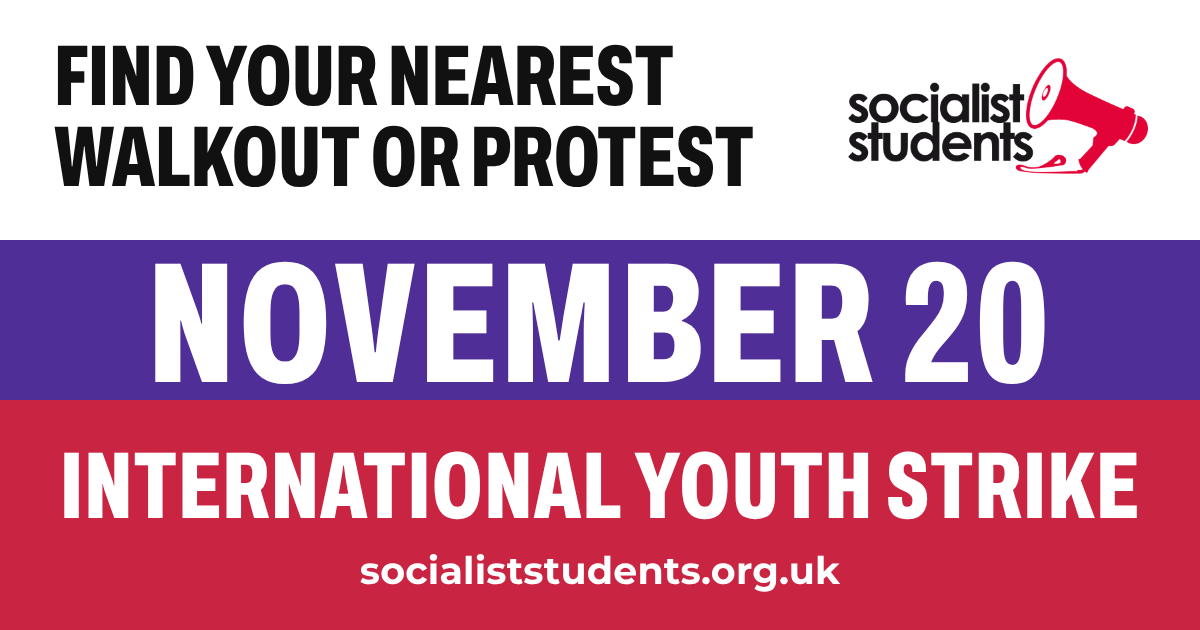

Worried about walking out, or about what teachers, parents or the media might say? Here are some points to help you answer the critics and feel confident. If you need more specific advice, email socialistudents@gmail.com or text 07515921699.
What do I say if a teacher, parent or the media criticises the walkout?
Last year’s walkouts against Trump’s state visit, and the work building 20 November so far, have shown us that many teachers and parents support what we are doing. The government is finding billions for war and militarisation while young people face education cuts, the cost of living, a deepening climate crisis and a growing far right. Plenty of people are glad to see young people organising to fight back. The national executive of the National Education Union (NEU), the largest education union in Europe, voted unanimously to back the International Youth Strike. In its motion, “Support the International Youth Strike: ‘Fight for our future, not their wars’”, the executive resolved to “express support for the right of young people to peacefully organise, protest and make their voices heard, including those taking part in the N20 day of action”, and to “oppose disciplinary action against students participating in peaceful protest activity, including detentions or other sanctions, and to support campaigns defending students’ rights where required”. The union will also tell members about the strike through NEU communications channels, including how they can “safely and responsibly support participating students’ rights in line with safeguarding requirements and legal obligations”, and will advise members who wish to volunteer as stewards at local student demonstrations.
The National Union of Students (NUS), which represents over 7 million students, is taking part in the strike. The University and College Union (UCU) and UNISON, which organises support staff in universities, have called a national day of action over the crisis in higher education on the same day, and want to see rallies, protests and events in every university. “Every university in the UK protesting on the same day,” the two unions said.
In France, young people protesting has resulted in the Macron government announcing several billion euros in extra funding for education, including lower class sizes and more teachers. In Spain, an early election has been called due to nationwide housing protests, while in Serbia the ‘student list’ has won the election with a programme for free education, affordable housing and healthcare after two years of protesting. These show what young people can do when they get organised!
Some people will still worry about students missing a day of education. As socialists, we absolutely support, and fight for, the right of every young person to a high-quality education for every day they are a student. That is not what is on offer after years of cuts and underfunding. That is why we are walking out on 20 November, alongside young people in more than a dozen countries. It is a day when young people can feel their potential power and get organised for a future of decent jobs, homes, free education and peace, instead of war, cuts and division.
Points you can make:
- Underfunding does far more damage to education than one day out. Use a local example wherever possible: a course or department being cut, a subject with no specialist teacher, oversized classes, a building falling apart. Labour has cut university teaching grants (Socialist Students, 15 July). The same government is raising defence spending to nearly £80bn a year by 2029. Walking out is about getting organised to win the funding education needs. Fewer than one in six students aged 17 and over who resat GCSE maths this summer got a grade 4 or above (FE Week, 20 August 2026).
- If you are old enough to vote, you are old enough to protest. The government has announced it will lower the voting age to 16 for UK elections, and in Wales 16 and 17 year olds already vote in Senedd and council elections. It makes no sense to say young people are mature enough to help choose a government but not to protest peacefully about what that government does.
- 20 November is World Children’s Day, the anniversary of the UN Convention on the Rights of the Child, which the UK ratified in 1991. Article 12 gives young people the right to express their views on matters that affect them. Article 15 recognises their right to freedom of association and peaceful assembly. UNICEF UK’s Rights Respecting Schools Award is built on the Convention, so if a hostile school holds it, point that out. We will be marking the day by using those rights.
- This is not a day off, it is an international movement. Young people in France, Germany, the Spanish state, Italy and beyond are striking on the same day. French youth organisations say 800,000 joined their 20 October day of action, and by organisers’ counts each German school strike has brought out over 50,000. 20 November is also the last scheduled day of the COP31 climate summit.
How we respond depends on who we are talking to. A parent or teacher may have genuine concerns about a student’s education. With them we should patiently put our arguments and, where we can, convince them to actively back the walkout. A parent can tell the school they support their child’s decision, and a teacher can take our model motion to their union. Management threatening sanctions is a different matter, covered below, and no student should be left to argue with them alone. With the media, stick to our message: why we are walking out, that it is peaceful, that it is international and that young people have the right to protest. If a journalist contacts you, you can refer them to a Socialist Students spokesperson at socialistudents@gmail.com.
When teachers, parents or lecturers are worried about safety
Teachers, parents and lecturers who are worried about students’ safety are welcome to join the students protesting on the day, and you can invite them. Parents and teachers joined the walkout protests against Trump that Socialist Students organised last year. An adult who comes along can see for themselves how the protest is run, adds to the safety of the group, and shows management and the press that the walkout has support beyond the students.
Take the concern seriously, because it usually comes from people who care about the students. Explain how the day will run: students walk out at an agreed time, go to a fixed meeting point and stay as a group, with stewards keeping everyone together. It is a peaceful protest. Parents can come along with their child’s group, and teachers and lecturers can come with their union branch, ideally as stewards (see below). Trade union branches can be invited to speak at rallies on the day, alongside students who can explain why they’re taking action.
When students are worried about getting in trouble
It’s normal to be nervous. Schools and colleges can record an unauthorised absence and apply their behaviour policy, for example with a detention. But numbers are the best protection. It is much harder to punish fifty students than one, and harder again when parents, staff unions and local councillors are publicly backing the right to protest.
If you decide not to walk out, you can still help build it, bring others, and come to the follow-up meeting and the 5 December Socialist Students conference. Or a lunchtime protest can serve as an alternative.
However, a threat made to one student should be answered by many. If you are threatened with a sanction like a detention, get it in writing, or write down straight away who said what and when. Ask which part of the published behaviour policy the sanction is based on. Tell us by emailing socialistudents@gmail.com or texting 07515921699, so we can respond collectively through parents, the staff union branch, councillors and, if needed, publicity. If you can start to organise a student union, that is the best means you have of defending students against sanctions.
Use the trade union movement
Our model motion is an important tool for protecting students. Every supporter of the walkouts in a trade union should put it to their branch, and to the trades council, before 20 November. There are not many union branch meetings before then, so find the dates now. A passed motion shows management that the labour movement backs the students’ right to protest. It gives union reps the authority to raise any victimisation, and it can be quoted in letters to councillors and the press.
Where a school, college or university is being hostile, the priority is getting the motion discussed inside that institution. That means finding a sympathetic teacher or lecturer to take it to the union there: the NEU or NASUWT group in a school, or the UCU and Unison branches at a college or university. Mention that the NEU national executive has voted to support the strike, and UCU and UNISON are calling a day of action at every university on 20th November. Then ask the branch to raise the students’ right to protest with management. At colleges and universities, you can also take it to the students’ union or student council. The National Union of Students is supporting the strike. Once staff are discussing the motion, it is no longer students on their own against management.
Push for trade union stewarding on the day. Wherever a branch passes the motion, follow up straight away with a concrete request: stewards at the walkout, in union hi-vis and with the branch banner. Stewards make it much harder for anyone to single students out, and they show students that the workers’ movement is on their side. Agree names, phone numbers, a meeting point and a short briefing before the day.
Write to local councillors
Where staff are hostile, write to the ward councillors, and to the council’s lead member for children and education, asking them to publicly support students’ right to protest. Councillors cannot overrule a head teacher or principal, but a public statement of support from them still matters to management. A councillor who backs the students can be quoted, with their permission, to the school and the press. A refusal also shows students who stands where. If a student is afraid of being singled out, the letter can come from the Socialist Students group or a parent instead.
Dear Councillor [name],
On Friday 20 November, students at [institution] plan to join the International Youth Strike. It is a peaceful walkout and protest about war, education cuts, the cost of living and climate change, joined by young people in more than a dozen countries. [Staff/management] at [institution] have [threatened students with …].
20 November is World Children’s Day, the anniversary of the UN Convention on the Rights of the Child. The UK has ratified the Convention, which recognises young people’s right to express their views and to peaceful assembly. [The NEU/UCU branch at … has passed a motion supporting this right.]
I am asking you to publicly support the right of students at [institution] to protest peacefully without being punished for it, and to raise this with [the school/trust/college]. I would be grateful for your reply by [date].
Yours sincerely,
[name, for the Socialist Students group, or as a parent]
Need more specific advice? Email socialistudents@gmail.com or text 07515921699 and we will help.