Adam Powell-Davies, Socialist Students national organiser
Socialist Students has stepped up our campaigning for a free, fully funded, and democratic education system.
We’ve protested against Labour’s rise in tuition fees on 25 university campuses. When sixth form teachers and university workers have been on strike, we’ve been on the picket lines.
Now we’re bringing our solidarity to education workers rallying against cuts at the ‘protect education now’ national demonstration, organised by the University and College Union (UCU) in London on 10 May.
The government is fuelling the crisis in education. Labour government ministers parrot their pro-austerity watchword of ‘efficiencies’ – cuts. That’s because the alternative – publicly funding education – is opposed by the big corporations and super-rich individuals that this government serves.
The best way to ‘protect education now’ is to build a mass movement for a real alternative to what this Labour government is offering – for free, fully funded education, paid for by taking the wealth off big business and the super-rich.
Socialist Students has launched the Funding Not Fees campaign to raise the kind of demands a movement could fight for now. Socialist Student members on the UCU national demo will be talking to trade unionists about the campaign, to ask if they would like a representative from Funding Not Fees to speak at their upcoming union branch meeting.
We also think that our movement needs a voice in parliament. That’s why Funding Not Fees campaigners are contacting MPs over the next month. We’ll be requesting that MPs meet with us, and pledge to raise a pro-free education amendment in opposition to any further attacks on staff and students in the upcoming Labour government spending review on 11 June.
Tom Porter-Brown, Socialist Students activist at Birmingham City University
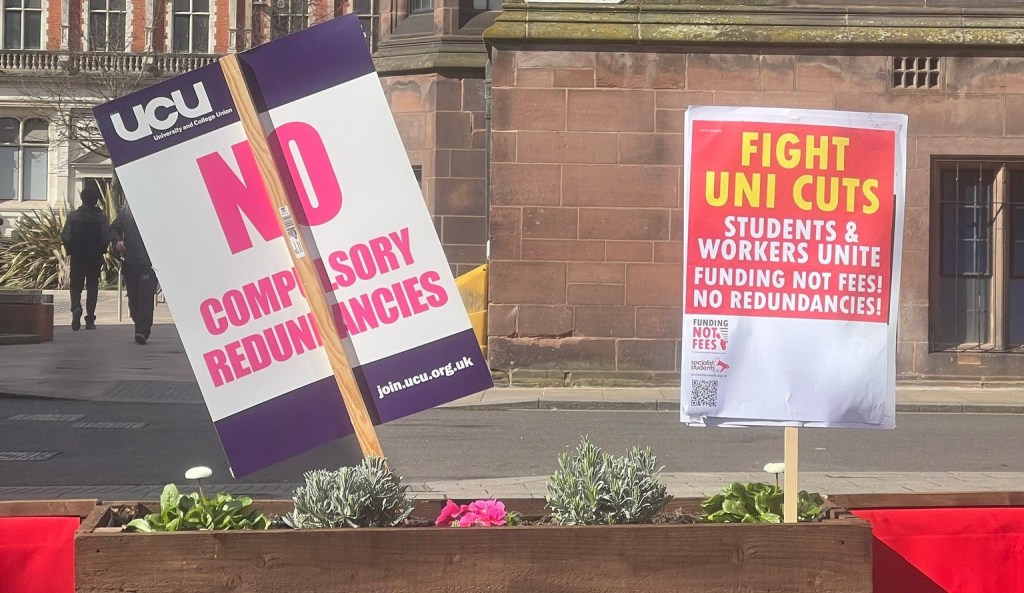
The University and College Union (UCU) branch at Birmingham City University (BCU) has begun strike action in reaction to the attacks by the vice chancellor (VC). A planned ‘restructure’ includes 36 academic staff redundancies.
The VC claims that his changes are to benefit students, but how is it in students’ interests when staff suffer job cuts, students are crammed into lecture rooms, and courses are at risk of closure?
It’s no coincidence that the VC chose to announce his plans at the end of February, because the time it took for the union to jump through all the hoops of the Tory anti-trade union laws means the strike has begun during exam season. Members think this is a deliberate move to try to cut across students supporting staff. He’s even gone as far as sending a mass email to students, telling us that “only 9% of staff have voted to go on strike and it should have a minimal impact on lectures”.
He’s got that figure by counting all BCU staff, including, for example, caterers and cleaners, but has neglected to mention that not every staff member is part of UCU! Although the VC’s bending of the truth could come back to haunt him when students don’t get their grades back in time, and no doubt he’ll contradict himself and blame it on the striking lecturers.
UCU had a good first picket, staying for hours until the rally at lunchtime. At least 50 staff, students and supporters, including Socialist Students members, turned up.
Union members need student support, which several of them expressed, discussing with each other the best way to communicate the issue to their students. Socialist Students members are campaigning to help build that support.
Socialist Students members discussed anti-austerity and anti-war ideas with strikers. If Keir Starmer and his Labour government can afford massive military budgets, they can afford to plug the funding deficit in universities. We talked about how the unions need a political voice, a new workers’ party, to fight for that to happen, and that universities need staff and students in control of the funding and resources to run it for the sake of education instead of profit.
What future do young people have today? The wealth of the richest 1% soars. But all we get are countless wars and climate destruction. The cost of everything is getting higher and higher – from phone bills and food prices to transport fares.
Rent is unaffordable. Wages are too low. Education is under attack. And under Labour, things are only getting worse. In this cruel capitalist world, it’s no wonder so many young people struggle with their mental health. Some students don’t receive mental health support, due to underfunding – services for all young people are inadequate.
This Labour government has shown it is no different to the conservatives. Even before they were in power, Labour backed the Israeli state’s assault on Gaza. Since forming a government, they’ve raised tuition fees for the first time in nearly a decade, refused to end age-based pay discrimination, and announced plans to restrict disability benefits – including raising the age for young people to access Personal Independence Payment from 16 to 18.
Whether it’s enabling war and poverty overseas or attacking the futures of young people in Britain, Starmer’s Labour Party is always on the side of the super-rich elites and their capitalist system. Starmer has rolled out the red carpet for Trump to visit the UK, both of which defend the same capitalist system.
This capitalist system, prioritises short – term profit over the majority of people’s needs at every turn, from education and housing to healthcare, jobs, and the environment, as well as stoking racist and homophobic division.
There is an alternative
The resources exist to provide everyone with a decent standard of living. The top 100 UK companies hand over £80 billion a year to shareholders – money that could instead be used to fund high-quality housing, free education, public transport, and well-paid jobs.
If we took all the major corporations and banks into public ownership, run democratically by working-class people to meet people’s needs and not for profit, then everyone could have a decent well-paid job, a high-quality home, free public transport, and access to free education and healthcare. It would be a socialist society based on collaboration and solidarity between people, laying the basis for ending all war, oppression and where human need and environmental sustainability come first.
We can fight back!
We’ve seen the power of working-class collective action. When workers across the country took strike action in recent years, they forced both bosses and the Conservative government to make concessions on pay, conditions, and funding for our services.
If the trade unions can fight and win under the Conservatives, then they can do the same under Labour. Every young worker should join a trade union, get active and fight for a socialist leadership which could be fighting for a £15-an-hour minimum wage for all – with no exceptions based on age.
Students also have the power to fight back and link up with workers doing the same. Socialist Students members in colleges and schools have recently organised walkouts and campaigns against the war in Gaza, and also fought for the right to meet and discuss socialist ideas. We have seen huge movements initiated by students take place in Serbia, Bangladesh and elsewhere at the forefront of challenging capitalist governments power.
In 2021 students at Pimlico Sixth Form College in London went on strike to protest the racist uniform rules, and against the removing of Black History month from the curriculum. When we fight, we can win change.
But we need political representation for our movements. Labour won’t represent us. Neither will the Tories, Reform, or the other pro-capitalist parties. They represent the interests of capitalism whilst expecting young people to quietly accept a system that fails us.
We say: enough. It’s time to build a new political force – a mass working-class party with socialist policies that gives a voice to our struggles and a vision for a socialist future.
We say:
For fully funded, free education – introduce living grants for all students, scrap tuition fees and cancel student debt, and stop cuts to courses
Divestment from arms and big business – no place for profiteers from war and exploitation in our education
Mass trade union struggle for a £15-an hour minimum wage now! Ban unequal youth pay rates and scrap zero-hour contracts
End the housing crisis! For a mass building programme of high-quality, affordable council housing
Take the wealth off the super-rich! For the banks, monopolies and major industries to be owned and run by the working class to meet everyone’s needs, not the profits of a few
Build the socialist opposition to Labour, the Conservatives, Reform and all the establishment parties! Build a new mass workers’ party with socialist policies to give working class and young people a political voice!
Our education system has been decimated by years of cuts – first under the Tories, now under Labour. Class sizes have grown. Teachers are overworked. Mental health support is practically non-existent. Buildings are falling apart. And now, Labour is planning to raise tuition fees even further – while diverting funding toward STEM subjects and away from vocational and humanities courses.
Socialist Students is organising lobbies of our local MPs, to see where they stand on education funding – and what they plan to do to represent us against this Labour government. Will they join our movement for free, fully funded education – to demand that big business foots the bill for education, not students and workers? Or will they stay silent as this government destroys our lives and futures?
The Welsh Labour government announced recently that it would be following the Labour government in Westminster by raising university tuition fees. From September 2025, Welsh students in Wales will be charged £9,535 a year, an increase of £285. Fees had already been raised by £250 this September.
The changes bring the university sector in Wales in line with the English system, though key differences still remain.
The university system and its finances have been in the hands of the Welsh Government since the creation of the Senedd (Welsh Parliament) in 1998. The Senedd can set the tuition fee cap for Welsh universities and set out funding and loans that students can get to help with finance.
In England, students receive a tuition fee loan to pay off tuition fees, and a maintenance loan to help with living expenses while at university. The amount a student gets depends on how much their family earns. In Wales, maintenance loans and grants work differently. All students get the same amount, but family earnings determine how much is a grant versus a loan. In addition, maintenance loans in Wales are higher than in England. English students living outside of London get up to £9,978 a year. Welsh students who live outside of London are entitled to £11,720.
Better deal?
Generally, the Welsh government has offered a marginally better deal for students. This would not have been the case were it not for students and organisers fighting to put pressure on the Welsh government.
Now these concessions are coming under threat.
The Welsh government is looking for ways to solve the lack of higher education funding, and trying to solve its own money problems. The solution it is choosing is to charge students more money while allowing universities to cut courses and staff members.
This is why the Funding Not Fees campaign and Socialist Students are so important, to fight back against the cuts that students in Wales have hard fought.
We demand the Welsh government immediately reverse the planned fees increase, and campaign alongside students in England for free, fully funded education with liveable maintenance grants, funded by the super-rich.
We are required to take on tens of thousands of pounds of debt to receive a university education, an education that politicians like Keir Starmer and Rachel Reeves never had to pay for
After paying ridiculous amounts, we enter into university and are faced with budget cuts and course closures.
Like many other young people, until this July, a Conservative government was all I had ever known and all I could remember.
This July, despite my best efforts, I deep down had a little bit of hope that maybe things could get better. But let me be clear, my hopes, and hopes of all students across this country, were shattered. Not three months into power, this government broke their election promises and raised tuition fees.
We don’t just stand against this latest rise in tuition fees, we call for all tuition fees for both university and college students to be scrapped, and for student debt to be cancelled immediately.
We call for the reintroduction of living grants not maintenance loans, and for them to rise properly with inflation each year.
We also stand in solidarity with university workers to end low pay, job insecurity, and bad working conditions.
At the end of the day, what we call for and what students need is for universities to be properly and democratically funded, paid for by taking it from the super-rich, not by raising the bill for students.
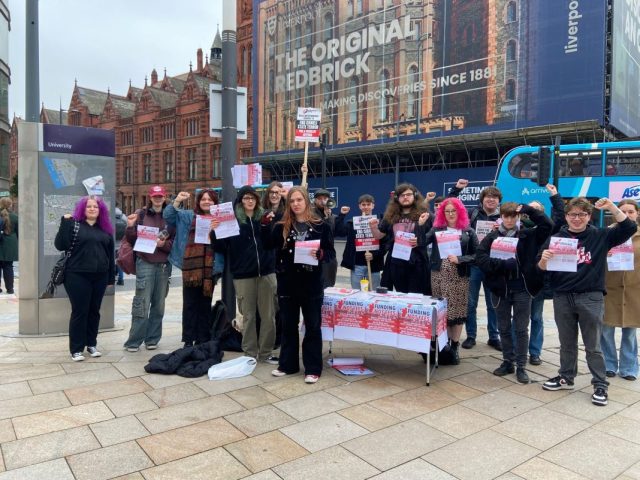
Funding Not Fees campaigners in Liverpool on the October 30th day of action
The Labour government has today announced that university tuition fees will rise in line with RPI inflation from September 2025.
In anticipation of a tuition fee hike this term, the ‘Funding Not Fees’ campaign organised protests at over 20 university campuses across the UK on Wednesday 30 October, the same day that Labour announced its first Budget.
The ‘Funding Not Fees’ campaign was launched, with the support of Socialist Students and other campus organisations, to demand that big business foots the bill for education, not students and workers. The campaign calls for fully publicly funded higher education, paid for by taking the wealth off the super-rich, as the means to:
Scrap tuition fees and cancel student debt
Replace maintenance loans with living grants for all students
End low pay, job cuts and the casualisation of higher education workers
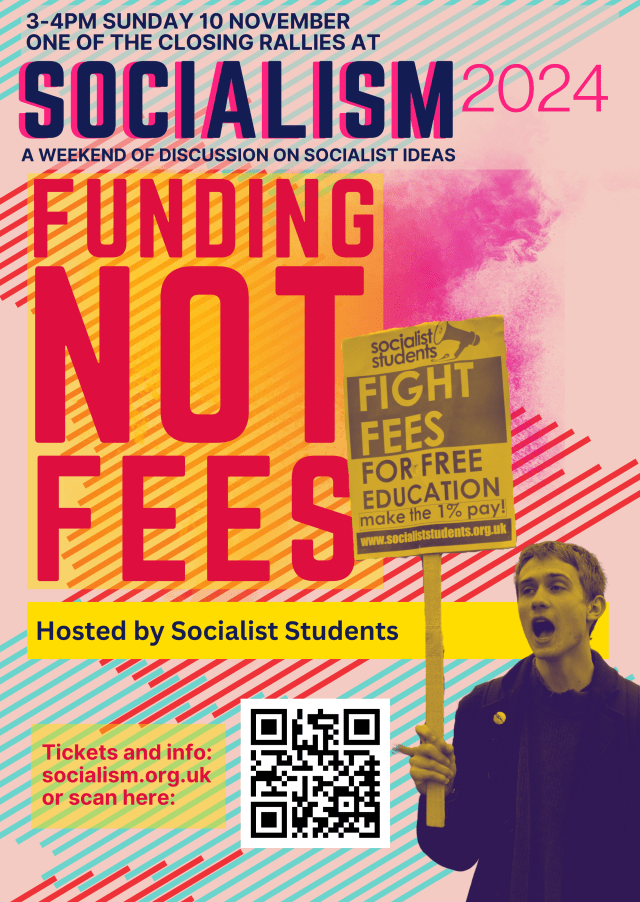
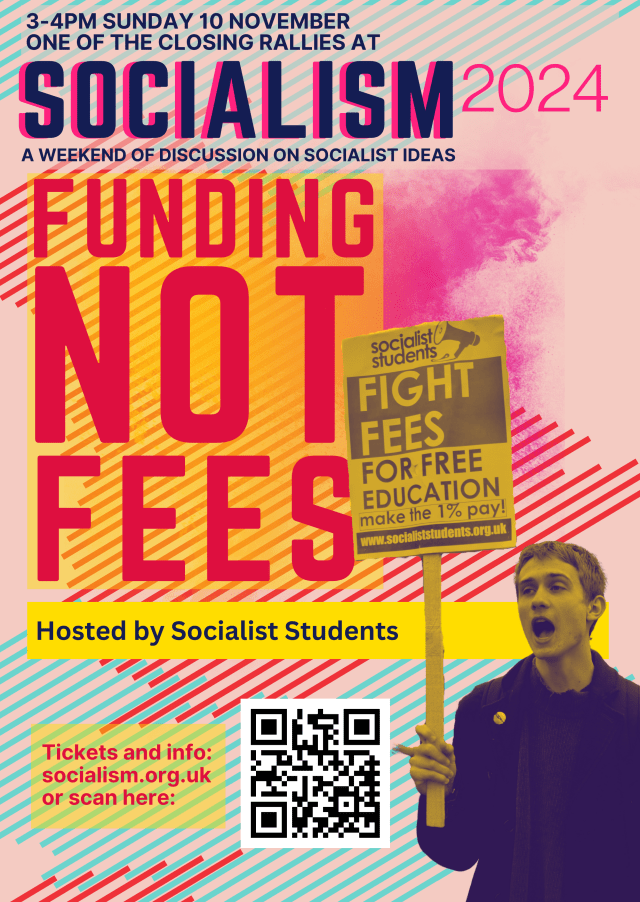
Student activists from around the UK will be discussing the next steps for the free education movement at the Funding Not Fees rally, taking place as part of the Socialism 2024 weekend at the Institute of Education in London on Sunday 10th November, 3-4pm.
Adam Powell-Davies, Socialist Students national organiser, said:
“In the space of five years, the Labour Party has gone from pledging the scrapping of tuition fees, to now increasing them. Today’s announcement only confirms that when Starmer talks about his Labour Party governing as ‘changed Labour’, he means a complete abandonment of the anti-austerity policies of Labour under Jeremy Corbyn.”
“Education secretary Bridget Phillipson has meanwhile indicated that an inflation-linked fee rise would only be the first step towards a wider overhaul of the university funding system, signalling the potential for even bigger attacks to come on students under this government.”
“Today’s fee rise announcement confirms that Starmer’s Labour wants students to pay even more for education, instead of big business and the super-rich, whose interests this government dutifully serves.”
“Students have to organise now to stop any rise in tuition fees. We refuse to pay an even higher price for the crisis in higher education, which a Labour government helped to set in motion by introducing tuition fees in the first place”.
“Socialist Students has helped to initiate the Funding Not Fees campaign this term as a step to building a united student and workers’ movement for fully funded, free education with living grants for all, paid for by taking the wealth and resources off the super-rich.”
“We will be reaching out to other student organisations and trade union branches in the coming weeks to build for ‘Funding Not Fees’ lobbies of MPs up and down the country, to demand they call for the full public funding students and university workers need – not more cuts, cost-of-living crisis, and fees.”
Charley Lincoln, Northampton Socialist Party and Socialist Students
Student rents have risen more than inflation. Student loans have not. There is a massive gap. The average monthly rent for a student in 2024 is £689.43, 16.5% higher than the year before. In London the average is a whopping £1,032 a month. A student getting the maximum maintenance loan and living away from parents outside of London can borrow £10,227 a year, £852 a month.
No wonder 69% of students now work alongside their studies, according to the National Union of Students. The negative impact is not limited to academic achievement but also health and social outcomes. 78% of students surveyed say they are suffering ‘significant stress’ over money.
Most students with more wealthy parents willing and able to pay don’t face the same stress. Increasingly, access to higher education is becoming the privilege of a wealthy few, deepening economic inequality as working-class and poorer young people are forced to forego education and take low-paid jobs with little chance of long-term progression.
Socialist Students fights for free, fully funded education for all. Rather than being saddled with a lifetime of debt, student loans should be replaced by living grants that rise with the cost of living.
Students are a ‘captive market’ for landlords – be it the university itself, private halls or private renting. All know the level of student maintenance loans, and all hike rents to maximise income. Student housing has become even more competitive than the housing market in general.
University halls
Around one in five students live in university-owned halls of residence. Increasingly, access to this is limited to first-years, postgraduates and international students. These three groups typically bring in the most cash and unis are motivated to get students enrolled (and paying fees) with as few hurdles as possible.
Halls typically have very limited provisions for students who have families, or for disabled students. Often when attempts are made to accommodate disabled students, it is not as thought-through. There are problems such as push-door buttons on one side only, or even behind non-accessible internal doors in the way of the accessible one, or needing an able-bodied person to place a ramp down.
Licensing for halls is viewed in the same way as for residential homes. Each room is treated as an individual dwelling, instead of looking at the whole building. Therefore halls do not have to meet the same fire safety standards as other high-rise residential buildings. In England, more than one residential hall has been found to use the same flammable cladding as Grenfell.
End rip-off rents – give students and university workers democratic control over rent levels, maintenance and repairs
Invest to provide high-quality, safe, and accessible accommodation, including to meet the specific needs of disabled students, and those with families
Private halls
Building private student halls is big business. The largest provider, Unite Housing, is listed on the FTSE 100 biggest companies on the London Stock Exchange. Unlike traditional housing, when halls of residence are sold, they are sold as a whole building, not as individual flats. Since 2013, the ‘block’ selling of student halls has increased.
That marked the start of a student accommodation investment boom, and led national and international investors to build new property portfolios. As investors sought to consolidate scale and drive down operational costs, England has seen levels of investment steadily at around £3.2 billion a year. The selling of IQ student accommodation company to Blackstone in 2020 was for £4.7 billion, which is the highest seen in England so far.
Investment isn’t planned to meet the needs of students. Instead, private hall owners invest in what they think will be profitable.
It’s also worth mentioning that this building type is difficult to repurpose when it needs to be sold (normally due to oversupply). The standardised nature of typical purpose-built halls, along with small room size, makes changes to residential use difficult.
Some cities have attempted to use the rise of co-living integration in the workplace, living environment, and social space as a product for students and young professionals. Still, reports of negative experiences living in this set-up are rampant. People have felt unsafe and forgotten.
Socialist Party member Marcelin shared her experience of a co-living accommodation: “The entrance to the building did not lock even when pushed closed; it was on the street with heavy footfall. Random non-residents would let themselves in, and there have been issues that led to police turning up. The property was meant to be pet-free, but one neighbour had six dogs that would be allowed to roam unsupervised in the hallways.” When both issues were raised, she was told nothing could be done. Previously, she had lived in halls and a shared house, but was priced out.
Student accommodation does not have to comply with affordable housing requirements. At the same time, any housed student can count towards meeting a local authority’s housing targets. In other words, each rented bedroom can be counted as a single home, misrepresenting reality. This means councils can claim they are tackling homelessness while not actually taking action, and instead exploiting students.
Stringent council licensing of student housing providers, with the direct democratic involvement of students
For democratic rent controls, quality and safety standards in-line with university-owned halls
Private-rented accommodation
Second-years and beyond are largely left to fend for themselves securing housing on the private market in competition with groups of other students. Landlords and agents exploit the shortage of housing (and using fearmongering about scarcity too) to charge maximum rents and get contracts signed months in advance. To maximise income, bedrooms are crammed into homes designed for a single family.
Similar to the boom of landlords looking to profit through Airbnb in tourist hotspots, in student areas landlords buy up family homes to convert into student accommodation, further reducing the supply of available housing for families, this drives up the cost of rent for everyone.
Housing contracts for students are not fit for purpose. They often do not provide year-round accommodation, assuming you have a family that can support you during the holidays. They are also not flexible enough to account for the realities of student life. If a student has to drop out, they will no longer have the student loan to pay rent, putting themselves and often their housemates at risk due to them being locked into their contract.
Invasive landlords often take advantage of the inexperience of student tenants, often turning up un-announced for inspections, maintenance and property viewings for the next tenants. This creates a lack of privacy as well as emphasising how replaceable tenants are.
The requirement for guarantors and security deposits, often on a yearly basis, assumes again that the student has a family that is able to provide this support, excluding poorer students from a working-class background from this kind of housing, as well as excluding those with complicated home lives. Students often lose hundreds of pounds every year to landlords manufacturing reasons to take security deposits.
Compulsory licensing for all landlords, including subject to quality and safety inspection from local council authorities and student representatives, and to end security deposit theft
Democratic rent controls for all rental properties, student or otherwise
Access to secure tenancies, including flexibility that accounts for student term dates and other issues. Include Student Finance England as guarantor for students excluded or forced to leave courses early
A programme of mass council house building to meet the needs of all
Damp, mould and rip-off rents
Frankie Sell, Southampton Socialist Students
From the extortionate rates charged by both university and private student halls to omnipresent mould and botched renovations, it feels as if the crisis of student housing is inescapable.
Student halls in particular can cause tremendous headaches as many students’ first experience of living away from home. For instance, in my first year I lived in the cheapest ensuite room stocked with just a single bed and desk. This now costs £6,646.92 for a 41-week contract (an increase of about £500 since 2022). When you consider that the maximum student loan is just £9,672.00 per year, this leaves students with just £250 per month after rent.
This is clearly unsustainable. Like many students, I opted for cheaper student housing with a private landlord going into my second year; however this came with its own problems. The only bathroom and shower I had access to was a converted storage closet under the stairs, it was barely large enough to stand in and had constant issues with damp and mould that were never dealt with. The ceiling in the living room would occasionally start pouring water. The landlords attempted (unsuccessfully) to fix this problem but eventually gave up trying towards the end of the tenancy.
Then, the following year, there were large cracks in the walls (an external consultant informed me these were likely caused by structural damage) which took over three months to repair. There is also heavy staining in the carpets and walls, which have still been largely ignored four months into the tenancy.
Unsurprisingly to any students reading this, these examples are common in the industry of student housing, and are by no means the worst that I have heard in my time as a student.
Why should students be paying more than 50% of their income on rents? Rents should be capped, and maintenance standards regulated, including with maximum time frames for repairs.
The Funding Not Fees campaign demands that big business foots the bill for education, not students and workers. We call for fully publicly funded higher education, paid for by taking the wealth off the super-rich, as the means to:
For full public funding and an end to marketisation
Free education for all!
Students are once again in the firing line! A statement released by Universities UK (UUK) at the start of the Autumn term has called on the government to increase tuition fees in line with inflation – again passing the cost of the ongoing crisis of the capitalist system onto the shoulders of students and young people. UUK has said that each student now costs a university between £12,000 to £13,000 to educate.
One in five universities is in deficit. The government and so-called experts say the problem is fees being frozen and not keeping up with inflation. So they want us to pay more – and face cuts and closures on campus. But in reality, our universities have gone underfunded for years.
Since the introduction of tuition fees, and their trebling by the Tories and Lib Dems in 2010, government funding for universities has been continuously slashed. Students and campus unions have had to fight vicious cut-backs by management – cuts to entire courses, jobs, and attacks on staff terms and conditions.
Meanwhile the student cost-of-living crisis rages on. The rents we pay on average are more expensive than the average available loan – so how are we supposed to be able to live, especially considering inflation has pushed up the prices of food, travel, educational resources and other cost of living essentials?
But it doesn’t have to be like this. Socialist Students is fighting to build a mass movement to win the funding that our universities and students need – to reverse the cuts which have taken place on our campuses, replace inadequate loans with genuine living grants for students tied to the cost of living, and to scrap the broken tuition fee funding model altogether. Education should be free, fully publicly funded, with grants re-introduced.
When Jeremy Corbyn was Labour leader, the party’s manifesto estimated that scrapping fees and re-introducing grants would cost about £12bn. Starmer’s Labour government has made it absolutely clear that it does not intend to cough up the funding our universities need. That’s because, just like the Tories, Labour now represents the interests of the rich and powerful in society.
Why should education be run like a commercial business? Britain is the sixth wealthiest nation on the planet. The FTSE 100 biggest corporations have been paying around £85bn annually in dividends to their shareholders. The University and College Union (UCU) has called for a £17 billion “education levy” on “profiteering businesses”.
That’s a good start – but why leave so much wealth and power in the hands of big business, which puts profit before need? If the enormous wealth in society was democratically owned and controlled by the working-class majority, we could plan society to meet all our needs. That includes education – how it’s funded and how it’s run should be determined by education workers and students and the wider working class, not fat-cat vice-chancellors.
The recent strike wave showed how governments can be forced to pay more than they intended – and those lessons need to be built on. Mass organised action is needed to build the fight for free education. Building a student movement starts with getting organised on campus with democratic decision-making, linking up with campus trade unions and local college students.
But students also need a mass political voice to give expression to our campaigns and movements, as do working class and young people more generally. If the Tories and Labour both speak for the interests of the super-rich, then we need a new mass political voice to speak for what we’re fighting for – including against attacks on our education, against war internationally, and for a socialist world.
As part of our movement, at the upcoming ‘painful’ (in Starmer’s words) budget on October 30, Jeremy Corbyn and the four other independent MPs, as well as the suspended seven Labour MPs, could use their voice in Parliament to propose full public funding of education for all.
No to further fee increases – get organised on campus to fight for free education! Cancel student debt, replace student loans with living grants tied to the rate of inflation. Make the super-rich pay!
No cuts and No closures! Build democratic student organisations to link up with campus trade unions and wider working class to fight the funding our universities need.
Kick big business off campus! End marketisation of our education. Open up university finances to democratic oversight and control including by elected students’ representatives and campus trade unions, with the power to terminate all contracts and research tied to war and occupation and profiteering and exploitation while guaranteering jobs and funding.
Students need a political voice. Build a new mass workers party that will stand up for students and workers that fights for socialist policies.
Fight for socialist change – For democratic public ownership of the banks, monopolies and major industry to provide us with a future.
We have witnessed a year of brutal slaughter of Palestinians in Gaza, and increasingly in the West Bank too.
It has exposed to the world how capitalist politicians do not value human life, despite what they say about wanting an end to the conflict. Many people here in the UK have felt anger at the situation in Gaza, and taken to the streets to protest.
Many students have also taken things into their own hands, protesting against their university bosses, calling for divestment from arms companies and companies that prop up Israeli state terror.
School and college students have organised walkouts and protests in solidarity with the Palestinians. Towards the end of last term, student encampments were organised up and down the country, exposing universities’ links to arms companies and banks. Socialist Students members were involved with many of these.
We fight for the 7-million-strong trade union movement to be central. It is the threat of workers getting organised and fighting back that terrifies the capitalist world leaders, including in the Middle East.
It is a mass movement of workers and poor people, democratically organised and fighting for socialist change, in Palestine and across the region, that can point the way forward to an end to war and national oppression.
We call for an end to the marketisation of higher education and an end of the tuition-fee funding model. Universities are becoming ever more reliant on money from big business, including from arms companies such as BAE Systems and Lockheed Martin, due to cuts in funding from government. University education should be free for all, and fully publicly funded by making the super-rich pay.
The huge determined protests against the slaughter in Gaza have defied attempts by politicians and police to intimidate them. That defiance led to the hated Suella Braverman being sacked as home secretary.
Pro-Palestinian campaigners standing in the general election had a huge effect in a whole number of constituencies. Jeremy Corbyn was reelected, in addition to another four anti-war independent MPs.
That must be built on to deliver the new workers’ party needed to give a voice to the anti-war, socialist opposition to Starmer. Student protests this term can have a big effect too – and Socialist Students is determined to make them as effective as possible.
If you want to be part of the fightback, get involved!
What Ideas should students get organised around?
DISCLOSE ALL FINANCES!
Universities should open their books to a democratic inquiry by elected students’ representatives and the campus trade unions, with the power to terminate all contracts and research tied to war and occupation, while guaranteeing jobs and funding.
END MARKETISATION!
The government must fully fund education to disincentivise universities from gambling our fees on dodgy companies and ‘vanity projects’. Scrap tuition fees, cancel student debt, and reintroduce living grants for all students.
WE NEED A POLITICAL VOICE!
Winning a free, democratic, and genuinely ethical education system means fighting to take wealth and power off the capitalist elites. Starmer’s Labour government won’t even begin to fight for this. We need a mass workers’ party, with a socialist programme to end the capitalist system that breeds war and oppression.
MAXIMISE OUR STRENGTH!
Our movement would be strengthened if more students and workers joined. Socialist Students is calling for students to join us with:
• Mass meetings open to all who want to discuss how we can build a movement against war, oppression and capitalism • Stalls and leafleting sessions, where we can talk to other students about any upcoming protests and action, and encourage them to join • A rally with speakers invited from local trade union branches, and students from other universities, colleges and schools nearby • A lobby of our local MP or councillors alongside other students, workers and trade unionists, to demand they explain their position on the Israeli state’s onslaught in Gaza
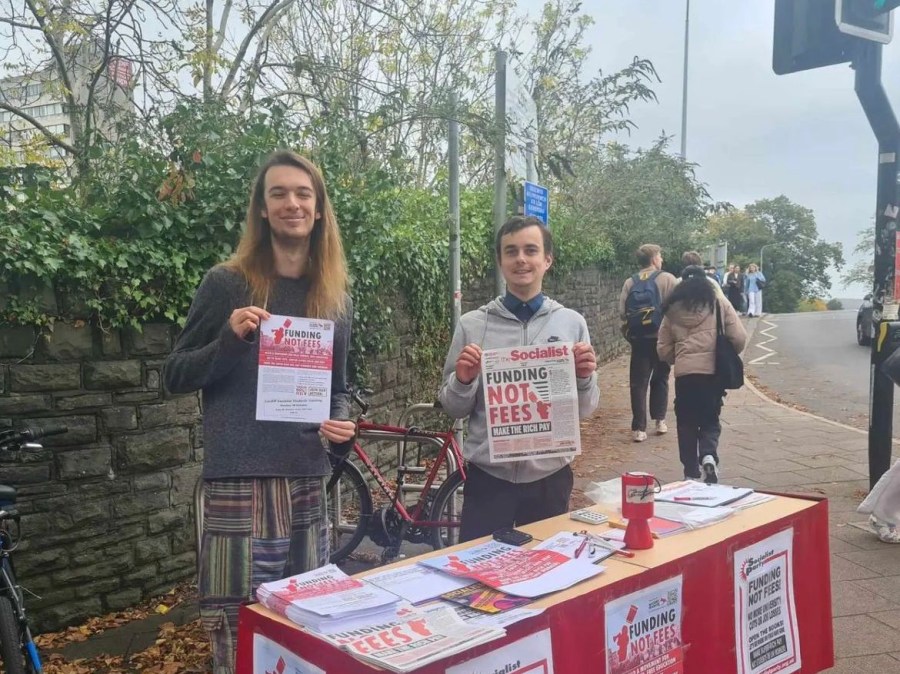
Socialist Students campaigning against the student cost-of-living crisis
Studying at university has become even more unaffordable for less well-off students, a recent report published by the Higher Education Policy Institute (HEPI) reveals.
The report calculates that the ‘Minimum Income Standard’ – the minimum income needed to study at university per year, including costs of living such as rent and groceries but excluding tuition fee costs – has risen to £18,632 for those studying outside of London, and £21,774 for those within London. Maintenance loans are able to cover less of these expenses year on year.
According to the National Union of Students, 69% of students are now employed alongside studying to afford their studies, up from 45% in 2022. Students have reported that balancing working, studying, and other commitments – alongside worrying about money – is having a negative impact on their academic achievement.
Access to higher education is further becoming the privilege of the wealthy few, deepening the economic inequality in the UK as working-class and poorer young people are forced to forego education and take low-paid jobs with little chance of long-term progression. Meanwhile, universities are being run like businesses: relying on inflated fees while simultaneously axing degree programmes, underpaying staff, and providing little support to students. Staff participating in the UCU strikes in 2022-23 spoke out on many of these deeply ingrained issues.
The long-term impact of the crisis in higher education is dire. Young people will have fewer opportunities, and industries dependent on qualified graduates will continue to face worker shortages.
The solution is obvious: stop treating education as big business and start treating it as an essential public service, free to use with grants, not debt, to enable people to study. It’s time for a democratically run and high-quality higher education system that is accessible to all and meets the needs of both students and staff.
Socialist Students says:
Fight for fully funded free education – scrap and refund tuition fees, cancel student debt, replace student loans with living grants tied to the rate of inflation. Make the super-rich pay!
Take universities under the democratic control of elected bodies of campus trade unions, students and communities
Build democratic student organisations to link up with the campus trade unions and fight for what our universities need
Build a new mass party that will stand up for students and workers
Fight for socialist change – for democratic public ownership of the banks, monopolies and major industry to provide us with a future


















 Socialist Students