
Adam Powell-Davies, Socialist Students National Chair
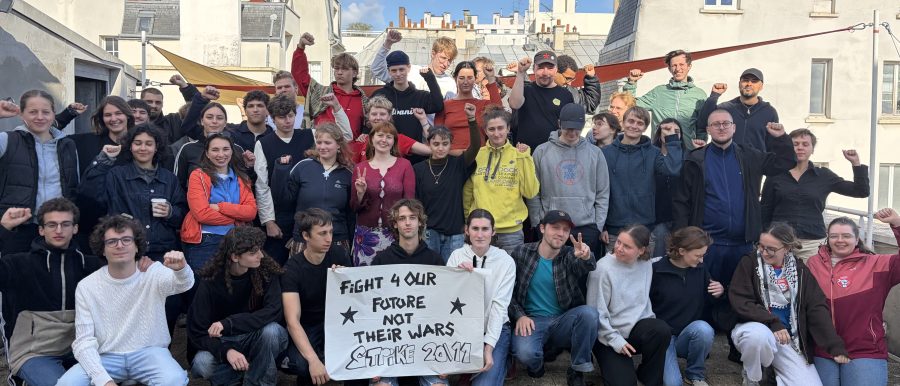
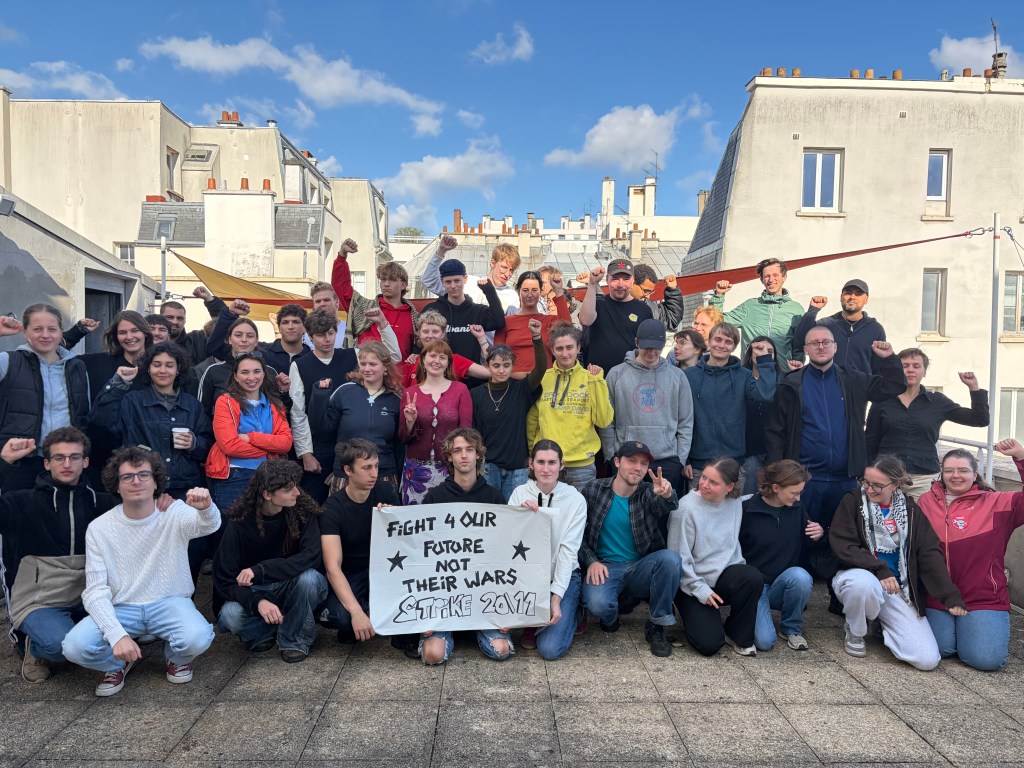
Amidst the mass youth movement in France, a Socialist Students delegation travelled to Paris on October 17-18 for an important meeting building towards the 20 November International Youth Strike. 27 organisations attended from eleven countries, to discuss next steps leading up to and after November 20.
This was the second in-person meeting of a Europe-wide network of youth, student and anti-war organisations that was initially formed at the start of this year to coordinate international action against war and militarism. The first meeting, held in Cologne on 14 June, launched the call for an International Youth Strike on November 20 (N20) under the slogan, ‘fight for our future, not their wars’. This was the slogan proposed by Socialist Students members, who argued that the struggle against war should be connected to the wider fight against the capitalist bosses and their profit-first system, which robs young people of a future in all ways – whether that’s through creating wars, fuelling climate change, or attacking our education and living standards.
‘Fight for our future’
Events since the Cologne meeting show why it was right to make the idea of ‘fighting for a future’ central to N20; it is a red thread running through all the movements that young people in Europe are now a key part of, which are spreading across the continent. That there were more than double the number of organisations in the Paris meeting than there were in Cologne is one indication that the idea is coming into its own. Reports to the meeting indicate that there will be at least tens if not hundreds of thousands of young people taking action on N20.
As one speaker from the Italian student organisation Rete della Conoscenza pointed out, a few months ago the youth fightback in Europe was being led by tens of thousands of German students fighting against the threat of conscription. Since then, they have been joined by hundreds of thousands more in many other countries. The political level of the meeting was raised by these ongoing events, in particular by the frontline reports from a number of organisations currently leading youth struggles in France, Spain, Italy and Germany.
The meeting also heard that an organisation in Albania had recently been in touch about joining N20, as had youth organisations in India, Indonesia, the Philippines and a number of other countries outside of Europe where there have also been massive youth-led movements. Delegates to the meeting joined the massive demonstration in Paris on the Saturday afternoon.
Given the shifting fronts of the youth fightback in Europe and internationally, with different specific issues being raised in different countries, there was an important debate over to what extent N20 should still be framed as an international day against war and militarism. The consensus was that ‘fight for our future, not their wars’ should continue to be used as the main overarching slogan across Europe, but with an understanding that different organisations can adapt this slogan to the specific issues that they feel can best mobilise young people in their own countries.
War and militarism
In response to some organisations who worried that this position meant diluting opposition to war and militarism, Socialist Students argued that an emphasis on ‘fighting for our future’ would in fact strengthen the fightback against war, as it would increase the potential for N20 to be picked up by young people as a means to take the fight to their own capitalist governments, who are the ones carrying out the drive to war and re-militarisation. A more narrow focus on war and militarism, without exposing how these issues are connected to the entire capitalist system which attacks ‘our future’, would make it less likely for N20 to play a role in increasing the level of international working-class organisation and consciousness needed to end war and the crisis-ridden capitalist system that produces it.
What happens after?
Another important feature of the discussion was around what should happen to the current informal network building the International Youth Strike after 20 November. The consensus was that, while N20 has the potential to be a major day of international youth action, it should only be a start to a process of re-building international youth and student organisation. It was therefore agreed that all organisations currently involved should continue working together beyond N20, while attempting to expand the network further by reaching out to other organisations in our own countries.
The meeting agreed to hold an in-person conference in Italy in February 2027, which will be an opportunity to reflect on the experience of N20, as well as planning the next steps for re-building a European and international youth movement against capitalism. Unlike the two previous in-person assemblies, which have been smaller and composed largely of representatives from the national leaderships of the organisations, the February conference is planned to be bigger and open to the wider activist layer within the participating organisations.
This movement is growing
Socialist Students members argued that the February conference should lead to an international socialist youth network, with some kind of basic founding statement clarifying why fighting against capitalism means fighting for a re-organisation of society based on need, not profit. But whether that is agreed or not, we emphasised that the main goal of the network should continue to be organising joint action between young people internationally, which could then be a starting point for allowing further discussion and debate between organisations on the way forward. As one concrete suggestion of future action, we raised the possibility of an international mobilisation to Britain on 27-28 November 2027, when the G20 grouping of capitalist powers is set to meet in Manchester.