
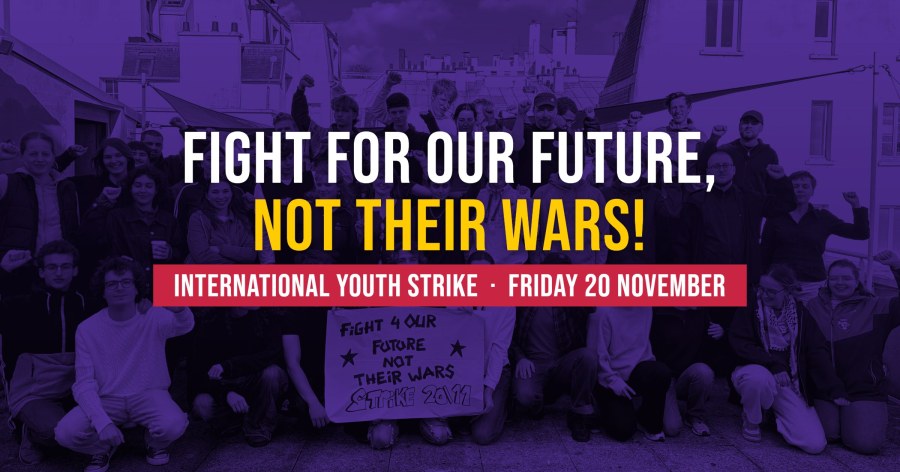
Seven in ten young voters voted against Trump’s Republicans, a record youth margin, as students in more than 50 UK towns and cities prepare to join a worldwide youth revolt by walking out on 20 November
Press release from Socialist Students
Socialist Students has hailed the youth revolt against Donald Trump in Tuesday’s US midterm elections, and says young people in Britain will add their voice on Friday 20 November, when students in more than 50 towns and cities walk out of schools, colleges and universities for the International Youth Strike under the slogan “fight for our future, not their wars”.
Democrats won control of both the House of Representatives and the Senate, according to projections by CBS News and other US networks on election night. Young voters rejected Trump’s party by a record margin: an estimated 71% of voters aged 18 to 29 backed a Democratic candidate for the House and 25% a Republican, according to initial figures from CIRCLE, the youth research centre at Tufts University, which called the 46-point gap “the highest we have ever seen in a national election”. In 2024, young voters were roughly split between Trump and Kamala Harris, according to the Associated Press.
According to CIRCLE, 63% of young men backed the Democrats, two years after 56% of them voted for Trump, and so did 75% of young women. Most voters under 30 said they were voting to express opposition to Trump, and about half said they were angry about the direction of the country, against about a third of voters aged 65 and over, according to the AP Voter Poll.
Around 50 million young Americans were eligible to vote, and by late October 3% more young people were registered than at the last midterms in 2022, CIRCLE found. More than 46 million early votes had been cast by 30 October, already a record for a midterm election, according to the University of Florida Election Lab.
The US vote is part of a wave of youth revolt around the world. In Brazil, President Lula won a fourth term on 25 October with more than 51% of the vote, beating Flávio Bolsonaro, son of the far-right former president Jair Bolsonaro. Three weeks earlier Lula had finished almost two points behind Bolsonaro in the first round, and the first Datafolha poll of the runoff put Bolsonaro ahead by 52% to 48%.
A mass movement led by young people turned the race around. Students started the fightback the day after the first round. Brazil’s national students’ union, the UNE, declared for Lula and called protests across the country: on 7 October thousands marched through Rio de Janeiro in a student-led protest with placards reading “No to the father, no to the son”, and the next day students protested in at least 13 states and in Brasília for free, quality public education, an end to the six-day working week and the defence of democracy. School students and their student councils helped call some of the protests. Hundreds of demonstrations followed, and the UNE organised brigades to take students out of the universities to bus stations, street markets and working-class neighbourhoods, to win over some of the 33 million people who had not voted in the first round. The UNE called it a “tsunami of hope”. By 15 October, Datafolha had Lula ahead among voters aged 16 to 24 by 50% to 43%, where Bolsonaro had led them a week earlier. The final Datafolha poll still had Bolsonaro narrowly ahead, but Lula won, and in his victory speech he thanked “the youth who took to the streets to defend democracy”.
In Serbia, the Student List, which grew out of the mass student protest movement, won an outright majority in the parliamentary election on 25 October with more than half the vote, and Aleksandar Vučić conceded defeat.
In France, school and university students, angered by an admissions system that left many without a university place, forced the government in late October to announce €4 billion in loans to renovate schools, €1 billion for university campuses, 15,000 extra higher education places, student grants that rise with inflation and a promise to replace the Parcoursup admissions system by 2028. Students say it is not enough and have vowed to keep protesting, with a national day of demonstrations set for 5 November.
Socialist Students national chair Adam Powell-Davies said: “Young Americans have delivered their verdict on Trump. Seven in ten young voters rejected his party, the biggest margin on record. This was a revolt against a government of billionaires that attacks migrants, wrecks the planet and pours money into war while young people struggle with rent, debt and the cost of living. But it was a vote against Trump, not a blank cheque for a Democratic establishment that failed to stop him last time. Young people in America need a party of their own.
“From Brazil to Serbia to France, young people are showing that when we organise, we can win. Serbian students have defeated Vučić at the ballot box, and French students have forced billions of euros for schools and universities out of their government. Here, Labour has cut university teaching grants two years running while planning to raise military spending to close to £80 billion a year by 2029. On 20 November, students across Britain will walk out to fight for our future, not their wars.”
The International Youth Strike was called by youth and student organisations from across Europe, and students in France, Germany, Spain, Italy and other countries will also take action on 20 November. In Britain, the National Education Union has backed the strike, the National Union of Students is taking part, and UCU and UNISON have called for protests in every university on the same day. Walkouts are planned at more than 100 schools, colleges and universities, and the main London protest is at 12pm in Parliament Square.

