
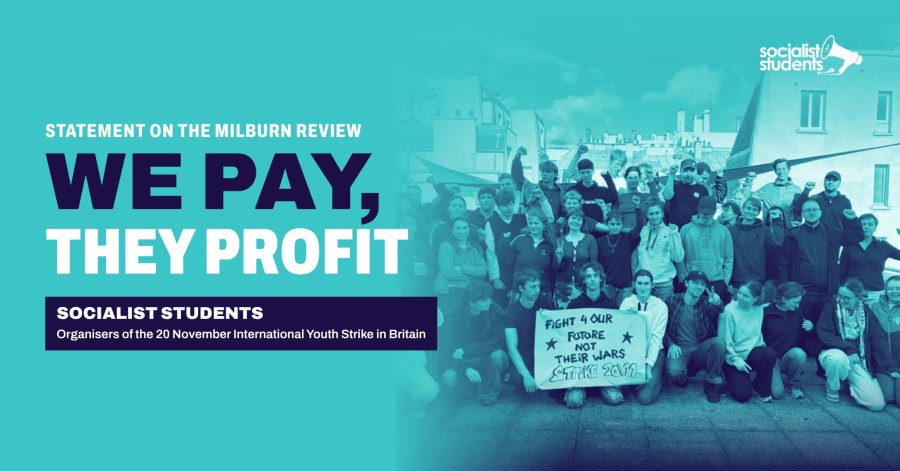
Share our statement on the Milburn review. Click an image to see it full size.
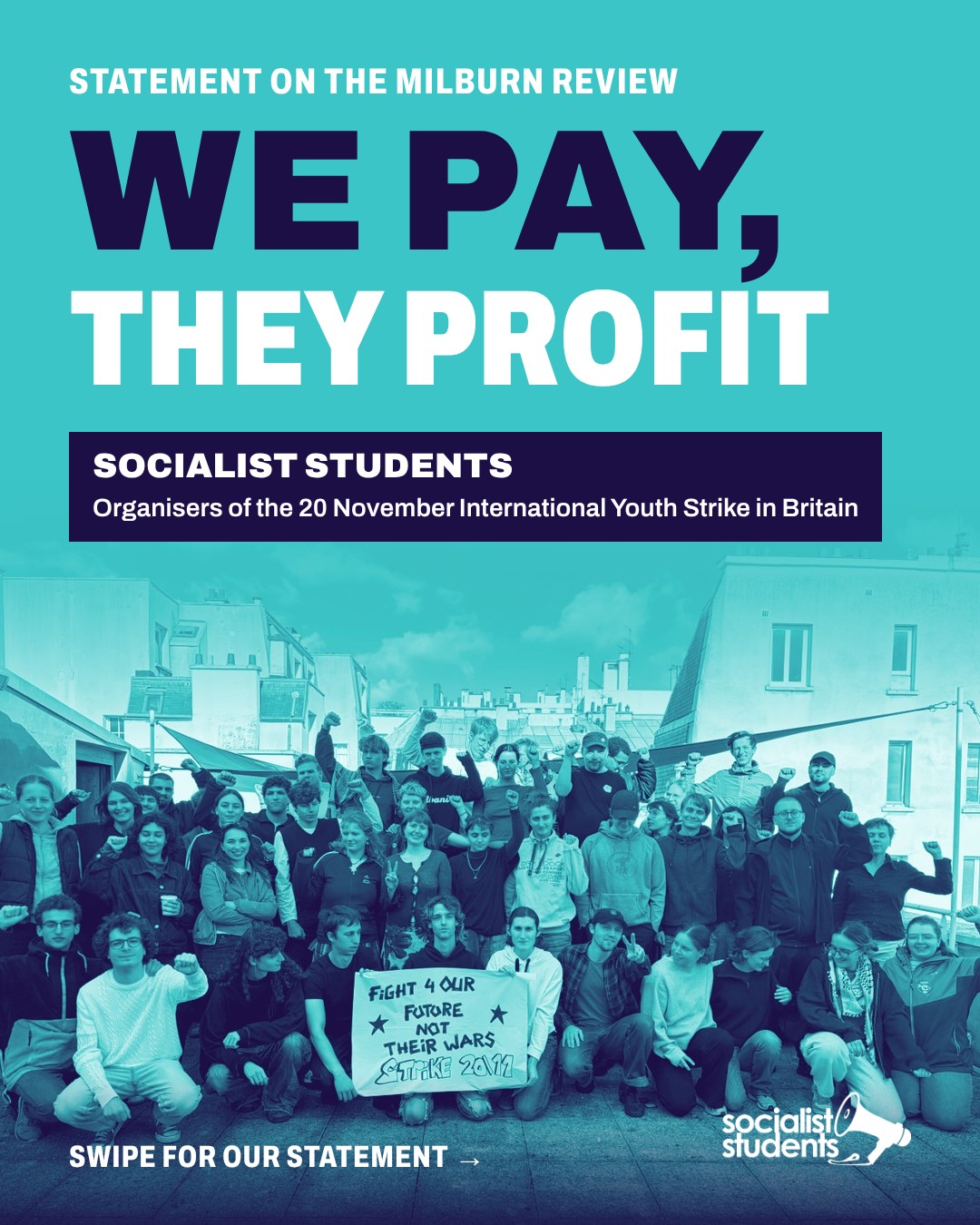
Disabled People Against Cuts joins the International Youth Strike after the Milburn review is published. Socialist Students calls to take the wealth off the super-rich to fund millions of jobs on trade union rates of pay; main London rally at 12pm in Parliament Square
Press release from Socialist Students
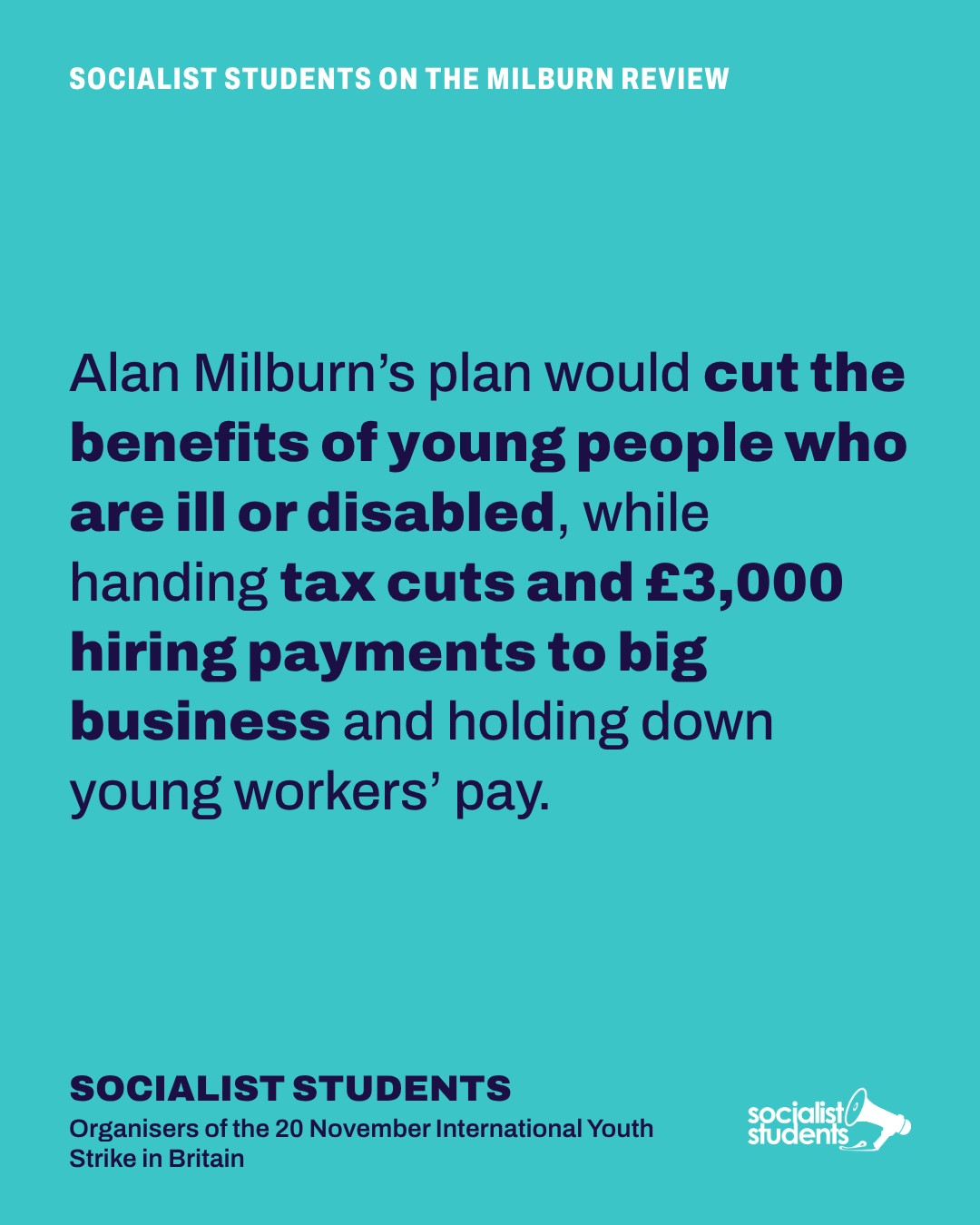
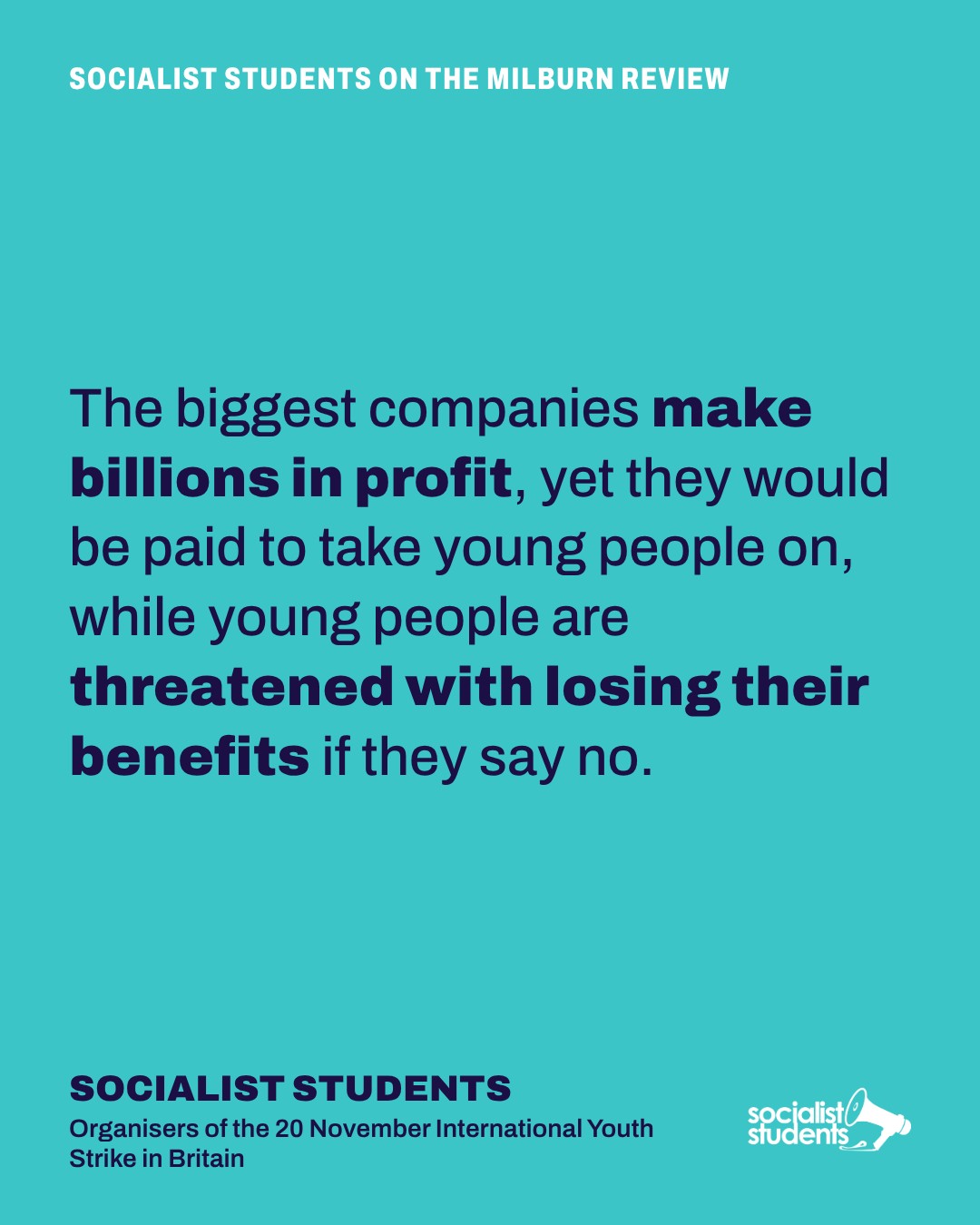
Socialist Students national chair Adam Powell-Davies said: “Alan Milburn’s plan would cut the benefits of young people who are ill or disabled, while handing tax cuts and £3,000 hiring payments to big business and holding down young workers’ pay. The biggest companies make billions in profit, yet they would be paid to take young people on, while young people are threatened with losing their benefits if they say no. That is not a new deal for our generation. It is the same old deal: we pay, they profit.
“They tell us there is no money for young people, while they plan to spend close to £80 billion a year on the military by 2029. There is no shortage of money. The richest 50 families hold more wealth than half the population. Take that wealth and use it to build council homes, renewable energy and decent public services, and we could create millions of jobs on trade union rates of pay. That is what we are walking out for on Friday: a fight for our future, not their wars.”
Students at 341 schools, colleges and universities across Britain (107 schools, 97 universities, 70 sixth forms and 67 colleges) are walking out on Friday 20 November as part of the International Youth Strike, under the slogan “fight for our future, not their wars”. Walkouts are taking place in 156 towns and cities, with 48 rallies and the main London protest at 12pm in Parliament Square. The walkouts come three days after the government published Alan Milburn’s review of young people and work, which would make young people pay for a crisis they did not cause.
Milburn’s final report, From a Welfare State to a Working State, was published by the Department for Work and Pensions on 17 November. It proposes replacing young people’s sickness and disability benefits with a single youth allowance that pays considerably less than some young people can claim now, and ending Personal Independence Payment for 18 to 24 year olds, with a narrower allowance only for those whose conditions are “well established, significant and ongoing”. Young people who do not take up what they are offered could lose benefits. The report relies on £3.6 billion a year of savings from welfare reform by 2036-37 to pay for its plans.
At the same time, Milburn calls for tax cuts for business. He proposes lowering employers’ National Insurance on workers aged 21 to 24, starting in retail and hospitality, a £3,000 payment to employers for each young person they take on after six months out of work or education, and work placements of up to 12 weeks. He also urges ministers to slow the rise in the youth rates of the minimum wage and to apply a “cautionary principle” to abolishing exploitative zero-hours contracts.
Disabled People Against Cuts (DPAC) has joined the strike, calling on disabled people to take part in the walkouts and rallies wherever they can. DPAC warns that the review would cut incapacity and disability benefits for young people and bring in more conditionality and sanctions, forcing young people into unsuitable work or training under the threat of poverty, and says it opposes attacks on young disabled people being used to pay for war.
Socialist Students points out that there is no shortage of money in Britain. According to the Equality Trust, Britain’s 157 billionaires now hold just under £670 billion, and the richest 50 families hold more wealth than the poorest 34 million people combined. Yet the government is planning to raise military spending to close to £80 billion a year by 2029. Socialist Students is calling to take the wealth off the super-rich to fund a mass programme of public works: building council homes, renewable energy and public services, and creating millions of jobs on trade union rates of pay.
The International Youth Strike was called by youth and student organisations from across Europe at a meeting in Cologne in June, where Socialist Students was present from Britain. In Britain, the National Education Union has backed the strike, the National Union of Students and Young Greens are taking part, and UCU, UNISON, UNITE and the GMB have called for protests in every university on the same day. In Northern Ireland, NIPSA, the largest trade union there, is backing the strike. In Scotland, the teachers’ union EIS is supporting UCU’s day of action. Students in France, Germany, Spain, Italy and other countries will also take action on Friday, and in Italy the CGIL, the country’s largest trade union confederation, has called a 24-hour general strike on the same day. In Portugal, the Frente Comum, which brings together more than 30 public sector unions, has called a 24-hour national strike of public sector workers on 20 November, ahead of the vote on the 2027 state budget.

