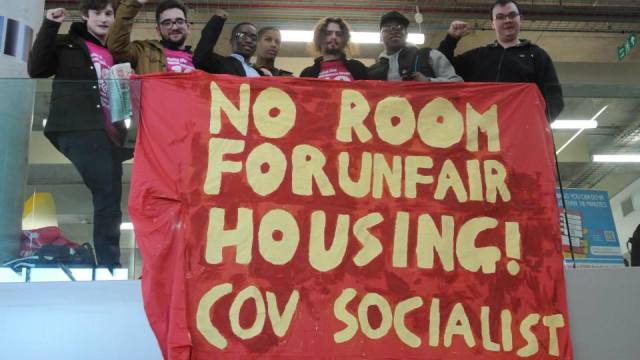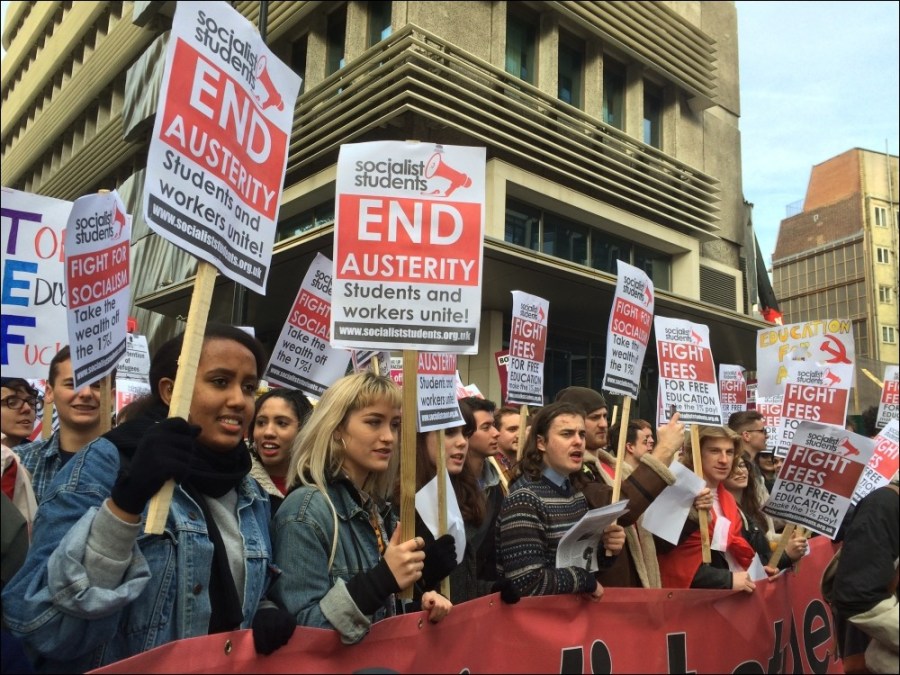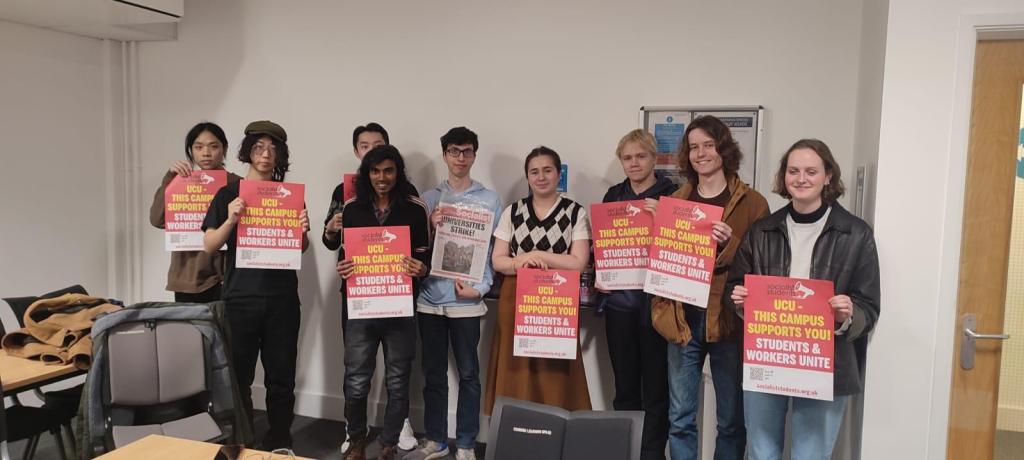
Staff were protesting throughout Cardiff University’s graduation week – 17 to 21 July. It’s part of the University and College Union’s (UCU) long-running dispute over pay, pensions, working conditions and workload.
Throughout the week, UCU members handed out sashes and badges for graduating students to wear. Students were running towards the UCU stall to collect anything they could, and chat with lecturers.
I was one of those students and, wearing a pink UCU sash, I protested against the university whilst walking the graduation stage. And I joined the UCU on their stall every day for the rest of the week.
UCU members are currently taking part in a ‘marking and assessment boycott’ – part of their larger strike action. This involves refusing to mark students’ coursework and exams. Many students now have missing marks and unconfirmed degrees.
Staff want to be celebrating their students’ success, and not taking this action. But workers have been forced into this action due to malicious actions by Cardiff University and university bosses nationwide.
Staff have been hit with pay deductions of between 50-100% – a huge impact during the cost-of-living crisis – despite all other work being completed.
University leaders have the power to end this strike. But they are refusing to negotiate.
Many students support striking staff in their battle with the bosses. We are on the same side.
University bosses do not care about us, or our degrees. They only care about squeezing as much money as possible from staff and students, and their position on the league table.
Staff working conditions are students’ learning conditions. We will not receive the quality of teaching we deserve if staff are overworked and underpaid. Anger must be directed at the university bosses who are undertaking this vile campaign against staff and students.
Any university that claims it can’t afford the UCU’s reasonable demands should open its finance books to inspection by campus trade unions, as well as democratically elected worker and student representatives. If a university genuinely can’t afford to give its staff at least what the UCU wants, then the government should step in to make up the difference, with money given to universities under trade union oversight.
We must stand together – now and always – and fight for the future of higher education. Fighting for fair pay, conditions, workload and pensions, for the total abolishment of tuition fees, and a higher education system democratically run by workers, students and local communities.
Socialist Students says:
Support the UCU marking and assessment boycott
No punitive pay deductions for staff taking part in the boycott
Decisions over whether students can graduate should not be left in the hands of uni bosses. Fight for trade union control of exam mitigations, in discussion with elected student representatives
Fight for the funding our universities need to end disruption to students’ and workers’ lives. Fight for high-quality, free education – scrap fees, cancel student debt, and replace loans with living grants rising with inflation
Build a new mass workers’ party to coordinate the struggles of students and workers in one fight against the bosses and their politicians
Fight for socialist change – for democratic public ownership of the banks, monopolies and major industry to provide us with a future
Check out other articles on the ongoing fight for our universities
As somebody who has just graduated, it has been frustrating watching the government attack so-called ‘low-value’ degrees.
According to the Tories’ Office for Students, ‘low-value’ degrees are where a certain proportion of students either do not graduate, or do not have a ‘graduate-level’ job or a further course of study 18 months after finishing.
The latest plan by Tory prime minister Rishi Sunak is to cap student numbers on these courses. This will only make it harder for working-class people to get into university.
Due to financial pressures, working-class students are more likely to drop out of their degrees. Working-class students are less likely to get ‘graduate’ jobs too.
That means that courses with a high proportion of working-class students would end up being dubbed ‘low-value’ and subject to caps. This would be yet another deterrent on working-class young people studying and developing their interests at university.
It’s the Tories that have made it increasingly difficult for students to complete their degrees, especially those from working-class backgrounds. Years of below-inflation student maintenance loan increases force many students to skip meals and use food banks, all while racking up tens of thousands of pounds in debt.
Struggling
The fact that people are struggling to get jobs after higher education is not the fault of certain degrees. It is the fault of this Tory government, and the capitalist system they defend – a blind, unplanned system, dictated by the short-term profit interests of a tiny minority.
Tory MP Robin Walker, chair of Parliament’s ‘Education Select Committee’, has defended the plans, saying: “Substantial amounts of public money… go into supporting students to go to universities”.
But real-terms spending per university student has fallen massively under the Tories. As a result, students have seen a collapse in our living standards, while staff have been forced to take unprecedented strike action due to rock-bottom pay, overwork, and cuts.
Nonetheless, Walker’s comments hint at the main financial motivations behind student number caps. As a large portion of student debt continues to go unpaid, the current number of young people taking out student loans to go to university is increasingly intolerable for the Tories and British capitalism. Also, if fewer young people go to university, then there is a bigger pool of cheap labour for the bosses to exploit.
The wealth exists in society for a fully public-funded, and free, higher education system. But pro-capitalist politicians, like Walker, Sunak, and Labour leader Keir Starmer want to preserve that wealth in the hands of a super-rich minority at the top.
In order to win democratically run universities, free at the point of use for all, students and staff must link up with the wider working class to fight to take the wealth and control of society into our hands.
Socialism
All of this means fighting for a socialist society, where resources are publicly owned and democratically planned to ensure that the needs of everyone are met. On this socialist basis, it would be possible to plan the education sector – alongside the wider needs of society – to ensure that education offers young and working-class people a decent future.
This could mean either a decent, socially useful, and well-paid job, or the chance to pursue our interests – academia or otherwise – free from the rigid economic constraints that burden us under capitalism.
Students: get organised, unite with staff and be part of campus battles!
Adam Powell-Davies, Socialist Students national organiser
In April, the University and College Union (UCU) launched a marking and assessment boycott at 145 universities across the UK. University staff are striking for pay amidst the cost-of-living crisis, and to defend terms and conditions as university bosses try to squeeze as much as possible from them. And the quality of our education has suffered as a result. Socialist Students supports the strike and has shown solidarity at picket lines up and down the country.
Two months on from the start of the marking and assessment boycott, university students now have a clearer picture of how the boycott impacts us. At Durham University, hundreds of students have been told that they won’t progress to their next year of study. Queen’s University Belfast has announced that 1,200 students may not be awarded degrees this summer. And at the University of Cambridge, hundreds of politics and sociology students won’t receive their exam results until October.
Many students affected by the boycott have been left frustrated and demoralised. As things stand, thousands of students could be prevented from moving on to the next stage in their life, such as the next year of their course, a job or internship, or graduate study.
While university managements have been eager to blame striking staff for the disruption to students’ lives, some students speaking on social media and in the national press have challenged this narrative. They have correctly pointed out that the onus is on the employers’ association, UCEA, to meet UCU’s demands on pay and conditions, and end the current dispute.
Any university that claims it can’t afford these demands should open its books to inspection by the campus trade unions and democratically elected worker and student representatives. If a university genuinely can’t afford to give its staff at least what the UCU demands, then the government should step in to make up the difference, with money given to universities under trade union oversight.
At a few universities, vice-chancellors have joined students and staff in calling on UCEA to re-enter negotiations with the UCU nationally. This shows that the marking and assessment boycott is having an effect.
Although many vice-chancellors have finally been forced to admit the ‘broken’ nature of university funding, none have come out and called for what is necessary: fully funded, free, higher education.
Meanwhile, at most other universities, managements have dug in and cobbled together a whole range of ‘mitigations’ aimed at allowing students to progress without the usual assessment-based checks and balances.
No doubt, some students will be grateful for these measures. But we say it’s the university unions who should hold the decision-making powers over mitigations, in discussion with elected student representatives. Mitigations shouldn’t be left in the hands of the bosses, who are attempting to drive a wedge between students and staff.
As the marking and assessment boycott continues, many students will feel caught in the middle between the UCU and the university bosses. That’s why Socialist Students says that students have to get organised ourselves, to unite with staff in a mass campaign to fully fund our universities and win free education.
As long as university funding is decided by capitalist governments looking for spending to cut and avenues of profit to open up, our universities will always be at risk of attack. That’s why Socialist Students fights for a socialist society where we, the working-class majority, democratically plan where resources should go in order to meet people’s needs – including the need for a high-quality, fulfilling and free lifelong education.
University of Bristol Socialist Students Society has been made aware of attempts by university management to undermine the University and College Union (UCU)’s marking and assessment boycott. PhD students have been offered £18.85 per hour to mark first and second-year undergraduate assessments, almost double the rate of pay usually offered to PhD students who undertake teaching and marking duties alongside their studies.
Bristol Socialist Students wholeheartedly condemns this latest move by university management to both undercut the ongoing industrial action being taken by staff in UCU and to drive a wedge between staff and students. We call on PhD students at the University of Bristol to refuse to take part in any marking whilst the boycott is ongoing. Instead, they should join UCU, which PhD students can do for free, and stand in solidarity with striking staff on the next day of strike action on Friday 16 June.
We also recognise that this is an attempt to persuade striking PhD students, who are among some of the lowest-paid staff at the University and are employed often on short-term, unstable contracts, to break the boycott.
As students ourselves, we understand the impact a marking and assessment boycott has on undergraduate students. However, we recognise that this disruption is due, not to those members of staff exercising their democratic right, but to the failure of Bristol university management and the Universities and Colleges Employers Association to properly and sincerely negotiate with the UCU over pay and working conditions.
However, we also recognise that even if the current UCU dispute is settled soon, it won’t mark the end of the disruption to our higher education. Students at every level are feeling the sharp end of the cost-of-living crisis. The Office for National Statistics found last year that 40% of students are studying at home more to save money. A fifth are attending lectures remotely. An additional survey by the Sutton Trust found that 18% of students have avoided buying educational resources needed for their courses. But it isn’t only in the realm of study that students are feeling the cost-of-living squeeze. 11% of students now use food banks. 28% reported skipping meals to save on food costs, 47% are going out less with friends, and 14% are travelling to campus for free energy use.
So for students, while building support for the current UCU and Unison strikes on the university campuses is vital, this must be linked to a mass campaign against the student cost-of-living crisis and the fight for free education for all – for publicly funded universities and an end to marketisation.
Socialist Students says:
Support the UCU marking and assessment boycott – PhD students should not undertake any marking whilst the boycott is ongoing
No punitive pay deductions for staff taking part in the boycott
Exam mitigations shouldn’t be left in the hands of the bosses. Fight for trade union control of mitigations, in discussion with elected student representatives
Organise joint student-staff meetings on campus to discuss how we fight the attacks on our universities – and where next for our common struggle against the cost-of-living crisis?
Fight for the funding our universities need to end disruption to students’ and workers’ lives. Fight for high-quality, free education – scrap fees, cancel student debt, and replace loans with living grants rising with inflation
Build a new mass workers’ party to coordinate the struggles of students and workers in one fight against the bosses and their politicians
Fight for socialist change – for democratic public ownership of the banks, monopolies and major industry to provide us with a future
Nearly 1,000 students at University College London have brought a legal group claim against the university to the high court. They are demanding compensation for disruption to teaching on the campus owing to the Covid pandemic and ongoing university strike action. Alongside fighting for tuition fee refunds, students should channel our anger into a mass struggle for fully funded free education, writes Theo Sharieff, Socialist Students national organiser.
Students are angry at the state of further education with crammed lecture theatres, and overworked and underpaid staff – and at the end of it all, thousands of pounds of debt. A small expression of that anger is the 100,000 students reported to have registered their interest to make similar claims at other universities. The organisation making the challenge, Student Group Claim, estimates students could get as much as £5,000 compensation. If the claim is successful, demand will grow for all students to be compensated, and across institutions.
Socialist Students backs the calls for students’ tuition fees to be refunded in full, and fights for free education and a cancellation of student debt. We fight for publicly funded university education for all those who want to access it.
Students have faced disruption to their education over the last period owing to university workers taking industrial action. This disruption is not the responsibility of striking workers, but of university managements and the Tories who have carried through vicious attacks to the pay and conditions of university workers, and therefore to to the quality of education students receive.
Faced with paying out large sums in compensation, university bosses – some paid as much as £714,000 a year – will say it is unaffordable. To those bosses who threaten course closures, pay cuts, pension attacks or administration, we say: Open the books! Let us see the real state of our universities’ finances by opening them up to inspection by trade unions and democratically elected worker and student representatives.
A collective fight of university workers and students is needed to win full funding from the weak and divided Tory government. Demands must also be put on an incoming Labour government to return to its 2019 manifesto pledge promising free education.
The tuition fee funding model has spelt disaster for students and university staff alike. Socialist Students calls for mass struggle to win free education – the scrapping of fees, introduction of living grants available for all students, and the cancellation of all student debt. We also call for the democratic running of our universities and campuses by elected bodies of campus trade unions, students and wider society. Then we would be able to collectively make decisions about how the higher education system could be run for the benefit of students, staff and us all, not in the interests of the Tories and the bosses.
Socialist Students says:
Fight for fully funded free education – scrap and refund tuition fees, cancel student debt, replace student loans with living grants tied to the rate of inflation. Make the super-rich pay!
Demand universities stop attacks on staff pay and conditions to end strike disruption. If university bosses say they can’t afford it, we say: open the books and prove it!
Take universities under the democratic control of elected bodies of campus trade unions, students and wider society
Build democratic student organisations to link up with the campus trade unions and fight for what our universities need
Fight for socialist change – for democratic public ownership of the banks, monopolies and major industry to provide us with a future
Protestors gather to protest over 100 planned redundancies at University of Brighton
Joshua Boyle, Socialist Students Brighton
On 15 May, 250 students protested against the planned redundancies at the University of Brighton. The protest, partially organised by Socialist Students Brighton, marched from the Level in Brighton to the Moulsecoomb Campus, where an open mic was held. Security barred students from entering university buildings, resulting in heated clashes.
The protest was called in response to the announcement that the University of Brighton would be making over 100 academic and professional services staff redundant. This decision was made to allegedly make up the shortfall from the reduction in value of tuition fees. However, the University has spent an eyewatering £40 million on the ‘Big Build’ as well as £17.9 million to reclaim the lease on the Virgin Active Gym at Falmer Campus. The university says it is in severe debt, so open the books to trade union and student inspection. Where is the money going? Why is the University prioritising shiny vanity projects over investment in staff?
This story is played out time and time again across the University sector, with vice-chancellors running universities into the ground by attempting to run education as if they were a business.
If these cuts were to go ahead, modules from all courses will be cut and the exceptional work of academics will grind to a halt. There is already a sector-wide surplus of unemployed academics due to a lack of funding for teaching and research. Staff who stay at the university will have their workloads increased, and there will be more students per staff, negatively impacting the quality of students’ education. Brighton is already ranked 97th in the UK for its student-staff ratio.
In addition, some departments are losing up to 50% of their staff which will also have an impact on the wider community. It will hit courses such as teacher training and nursing, when the country is at a crisis point with NHS staff and teacher recruitment numbers.
For fully funded, high-quality free education. Scrap tuition fees, cancel student debt, and take the wealth off the super-rich to fully fund education. Pay all university staff a genuine living wage, rising in line with inflation, and give all students a living maintenance grant.
Build a new mass workers’ party to coordinate the struggles of university students and staff in a society-wide fightback against the 1% and for socialism.
As Starmer scraps his free education pledge, Socialist Students prints here an open letter addressed to all groups and individuals who want to continue the fight for free education
Keir Starmer has finally confirmed that his Labour Party will drop its pledge for free university education for the next election. Socialist Students invites all supporters of free education to join us in fighting for a new mass party for workers and young people.
The recent local elections have underlined just how hated the Tories are. Rather than any enthusiasm for Labour, it is this ‘get the Tories out’ mood that will in all likelihood deliver Starmer to Number Ten at the next general election, which must be called no later than December 2024.
This leaves millions of young people facing yet another government that will refuse to end the marketisation of higher education, 25 years on from the introduction of tuition fees by Tony Blair. By underfunding higher education and pushing universities to compete for students’ fees, a series of pro-capitalist governments have facilitated cuts to jobs and services on campus, and led to the piling-up of student debt and a growing layer of impoverished staff and students. This is the course that Starmer is set to continue on.
So, what should supporters of free education do in preparation for a general election and the likely election of a Starmer-led government?
Starmer has abandoned his 2020 pledge to scrap fees on the basis that Britain is now in a “different financial situation”. Using this same argument, he has refused to back workers striking for higher pay, and dropped a number of other Corbyn-era pledges, barring Corbyn himself from standing as a Labour candidate. Instead, Starmer and his frontbenchers have promised “fiscal responsibility”. That means protecting the profits of big business, which have almost doubled since 2019, and making ordinary people pay for economic crisis.
The scrapping of tuition fees and the restoration of maintenance grants would cost well over £10 billion. Only the building of a mass movement could force a Starmer government to provide such funding. Supporters of free education must answer how such a movement can be built.
The largest-ever movement for free education in Britain was around the anti-austerity programme of Jeremy Corbyn in 2017. Corbyn raised the basic idea that the wealth existed in society for a decent life for all, but that it was concentrated in the hands of a tiny minority. Hundreds of thousands of young people queued at polling stations to vote for his radical programme, including free education.
The Corbyn era showed the potential for a mass struggle for free education to be built as part of a society-wide fightback against the 1%, to win the resources we need for our futures.
A political force challenging Starmer at the ballot box in a general election, with a programme for free education, real pay rises and fully funded services, would strengthen our fight.
If even a handful of anti-austerity, pro-worker MPs were elected outside of Starmer’s Labour at the next general election, they could become a lightning rod for a new mass movement against the 1% and for free education. It would force Starmer to ‘look over his left shoulder’, and could lay the basis for a new mass party for workers and young people to develop, as a real alternative to Starmer’s Labour.
Socialist Students is fighting for steps to be made towards building such a political formation, including calling for a trade union-organised workers’ list of candidates at the next general election. This could include Corbyn as a candidate in Islington North, and others exiled by Starmer.
We want to discuss and debate with other groups and individuals who support free education, about the way forward.
Would you be interested in organising a meeting with Socialist Students members to discuss how we can build a new mass party for workers and young people, to fight for free education, for decent homes and jobs for all, and for socialism?
DEMONSTRATION: STUDENTS AT UNIVERSITY OF WEST SCOTLAND FIGHT THE COST-OF-LIVING CRISIS
TUESDAY 9TH MAY
ASSEMBLE FRONT OF CAMPUS HIGH ST 1PM
March to library Hub
ALL STUDENTS AND STAFF WELCOME
We say:
For emergency cost of living grants available for all students who need them. Replace student loans with living grants, rising with the rate of inflation. Scrap all Student debt
For subsidised university canteen meals for students struggling to feed themselves.
No early closures of campus spaces due to the energy cost crisis. For heated and safely staffed campus spaces available 24/7 to students and staff who need them.
Take third-party student halls under the control of our universities, as a step towards introducing democratic rent controls.
No more cuts to our education! Back the trade union strikers.
Campaign and fight for the funding our universities need from central government – fight for free education and make the super-rich pay for it! Fight for socialist change!
No to all tuition fees, for free fully funded education for all students including international, ROUK and Erasmus.
For properly funded support services including for mental health and victim support services, non-exploitative housing, and clear and democratic reporting procedures for abuse and harassment. A trade union and student-led inquiry into the true extent of sexual harassment and violence on UK campuses, as well as in schools and colleges. Democratic oversight of sexual harassment reporting procedures by joint trade union and student led committees.
No to cuts in NHS services. For above inflation pay rises for all NHS staff and the funding our health service needs.
For a minimum wage of £15 an hour on campus with no exemption.
Contact UWS Socialist Students – text/ring organiser Daniel on 07926495431
Adam Powell-Davies, Socialist Students national organiser
With the UCU announcing its ongoing marking and assessment boycott at 145 UK universities from 20 April, many students will be looking on anxiously at how this action affects us.
Like the national strike action that has already hit universities this year, the current boycott will cause disruption to students. Work, including exams, will go unassessed for as long as the dispute between UCU and university bosses over staff pay and conditions continues – and UCU has already won an overwhelming mandate to continue action into the autumn if needed. This means that final-year students may be delayed from graduating for months to come.
It is therefore understandable for students to feel that, not for the first time, they aren’t getting the university experience they signed up for.
However, it would be a mistake for students to direct our frustration at underpaid and overworked university staff in UCU who, like millions of other striking workers, are simply fighting to stay afloat amid the cost-of-living crisis.
If university staff collectively were given a decent pay rise in line with inflation, with secure contracts and pensions protected, then they wouldn’t be taking this industrial action. Any disruption caused by the current marking and assessment boycott therefore falls squarely at the feet of university bosses and the Tories, who have presided over the deterioration of university workers’ living standards – and higher education generally – over many years.
Some vice-chancellors have said that universities can’t afford to meet UCU’s pay demands. Those universities should have their finances opened to democratic inspection by the campus trade unions, along with democratically elected committees of students. If a university genuinely can’t afford to give its staff at least what the UCU demands, then the government should step in to make up the difference, with money given to universities under trade union oversight.
While still hugely inadequate, the fact that the Tories offer a central fund worth £276 million for universities to draw on to provide student hardship grants shows the potential for a similar fund to be developed for universities to settle the UCU strikes.
But would the settling of the current UCU dispute mean an end to the disruption students face? Of course not! We’ll still have to skip lectures to work part-time jobs, or forgo buying the books we need for our courses, or choose not to travel to campus some days, all because our maintenance loans don’t go far enough. And we’ll still face the prospect of future university strikes for as long as managements try to compensate for chronic underfunding by slashing staff pay and conditions. As the University of York vice-chancellor wrote in the Financial Times: “The current disputes will not end until undergraduate funding is fixed”.

The root cause of all the disruption students face in our day-to-day lives is the lack of resources for higher education – whether that’s the wages staff need to live and work comfortably, the maintenance support students need to focus on getting a university education, or any other university service facing cuts. The ending of these strikes won’t mean our university experience is all fine again. Students are facing a major cost-of-living crisis of our own as inflation far outstrips our maintenance loans, with a record number of dropouts so far this year. And we leave university burdened with debt the majority of us will never pay off.
If UCU is defeated in the current dispute, the vice-chancellors and the Tories will only feel more emboldened to continue their attacks on students, staff and higher education.
That’s why students must do all we can to support the marking and assessment boycott. The best way to end this disruption is to support a speedy UCU victory on pay and conditions. Crucially, a UCU victory would force money from the vice-chancellors and the Tories, showing that more could be won in future through a mass campaign to fully publicly fund our universities and end marketisation – for free education.
But as long as university funding is decided by capitalist governments looking for spending to cut and avenues of profit to open up, our universities will always be at risk of attack. That’s why Socialist Students fights for a socialist society where we, the working-class majority, democratically plan where resources should go in order to meet people’s needs – including the need for a high-quality, fulfilling and free lifelong education.
Socialist Students says:
Support the UCU marking and assessment boycott – don’t let university bosses pit students against staff! Demand that SUs publicly support UCU industrial action
No punitive pay deductions for staff taking part in the boycott!
Organise joint student-staff meetings on campus to discuss how we fight the attacks on our universities – and where next for our common struggle against the cost-of-living crisis?
Fight for the funding our universities need to end disruption to students’ and workers’ lives. Fight for high-quality, free education – scrap fees, cancel student debt, and replace loans with living grants rising with inflation
Build a new mass workers’ party to coordinate the struggles of students and workers in one fight against the bosses and their politicians
Fight for socialist change – for democratic public ownership of the banks, monopolies and major industry to provide us with a future
Adam Powell-Davies, Socialist Students national organiser
The current strike wave has come off the back of a historic cost-of-living crisis facing workers and their families, with real household income set to shrink by 7% in the next two years, the largest fall since records began.
For university students, this historic collapse in living standards has come at twice the pace. While inflation soared towards a 41-year high of 14% in the autumn, student maintenance loans for 2022/23 increased by just 2.3%. This amounts to a 7% cut in the value of maintenance support over one year. As a result, the average monthly shortfall between students’ loans and living costs has risen to £439 this year, up from £340 in 2021/22, and £223 in 2020/21.
With pay from part-time jobs and parents’ income also squeezed, an unprecedented number of students this year have been pushed to extremes to compensate for a record gap between government maintenance support and living costs. Sixty-two percent of students are now cutting back on essentials, while 52% are using their savings, and a staggering 25% have reported taking on new debt to finance their living costs. Polls have also consistently reported around 10% of students using food banks this year.
The stats suggest that, at this stage, the overwhelming mood of students is to ‘grin and bear it’, absorbing at least part of the increased cost of living through personal savings, debt and stripped-back spending. However, there are limits to how far students will be willing, or able, to sacrifice their current and future living standards in order to continue their studies, especially those from working-class families.
The student cost-of-living crisis therefore poses a sharp increase in university dropout rates. Indeed, the University of South Wales has already identified a “significant rise in non-returning students” this year, while the University of East Anglia has reported “a higher-than-average dropout rate”. By choosing not to raise student maintenance support at least in line with inflation, the government has effectively attacked working-class students’ ability to continue their education beyond the age of 18.
And these attacks are set to continue. The government announced in January that maintenance loans for over a million students in England will rise by just 2.8% next year. Following successive years of below-inflation rises to the loan allowance, this will leave the poorest university students with over £1,500 less than if they had applied for student finance three years ago. In fact, the Department for Education has admitted that maintenance support would need to go up by almost 14% to keep pace with the increased cost of living, and that a 2.8% rise “is unlikely to prevent a further erosion in purchasing power” for students next year. In other words, the collapse in students’ living conditions is set to go even further next year.
Despite the objective crisis facing students, however, this academic year has seen a virtual absence of student-led struggle in the universities. This is ultimately down to a lack of authoritative organisations giving any alternative to students, both on and off campus. The tendency for students at this stage to endure government attacks, as opposed to fighting back, is because the vast majority are not being given a lead to do otherwise.
The pivotal question of leadership was shown in the university walkouts that took place in Ireland last year against the cost-of-living crisis there. While those walkouts of 20,000 students were a display of the huge anger among students in Ireland generally, the national Union of Students in Ireland (USI), together with students’ unions on the ground, played the key role of publicising a date, time and set of demands for students to get organised around.
In contrast, the USI’s sister organisation in the UK, the National Union of Students (NUS), has limited its public campaigning this year to online petitions and social media propaganda. And yet UK students face the same crisis as students in Ireland. If the NUS called for a day of protest against the student cost-of-living crisis in cities around the country, using its links to hundreds of students’ unions to build for it, thousands of students would turn out. Publicising a date, time and place would allow groups of students to put pressure on their students’ unions to organise transport. The protests could be held jointly with striking workers, raising the idea of students and workers fighting together to win the money we need to live from this weak Tory government. And they would allow hundreds of angry students to link up and discuss forming new campaigns and organisations to tackle the crisis they face.
And what about university Labour clubs, at a time when the Tories are so hated on the campuses? In 2017, hundreds of thousands of young people queued at ballot boxes around the country to vote for Jeremy Corbyn and his anti-austerity programme, including his demand for free education. However, this massive enthusiasm found no organisational expression on the campuses, one of the many mistakes made under Corbyn’s Labour leadership. The situation now is shown by the fact that in last year’s Labour Students National Committee elections, only 504 votes were cast to elect a national chair. The candidates for the Scotland seat managed 36 votes between them. Sir Keir Starmer’s Tony Blair-style New Labour party is not attracting students to its banner.
So, while the Corbyn era showed the potential for an anti-austerity political voice to electrify students, it also underlined the need to establish broad and democratic campus organisations to mobilise students in support of those ideas. Such organisations would also have to answer how ideas like free education can be won. Corbyn costed the scrapping of tuition fees and the restoration of maintenance grants at £12 billion. For comparison, the University and College Union’s (UCU) demand of a 13.6% pay increase for university staff would cost around £1.5 billion. This indicates the scale of what would be required to win a higher education system that actually meets the needs of students. It would mean students linking up with workers in struggle – a task that is not solely the responsibility of students, but also of the workers’ movement as a whole. And the unions also have a responsibility to politically re-energise students in the way Corbyn’s programme did, by taking steps to build a new political voice that can represent workers, students and young people generally at the ballot box against the big business politics of the Tories and Starmer’s Labour.
Nonetheless, the fact remains that no authoritative force has yet emerged to lead students against Tory attacks on their living standards. The University of Manchester rent strike, which re-emerged at the start of this term, indicates how struggle will be thrown up by the crisis facing students. However, the rent strike groups in Manchester and elsewhere developed originally around a sudden spike in anger that spread among students over the Covid lockdowns, when students were lured back en masse to universities under false promises of in-person teaching. For many students, this year’s cost-of-living crisis might feel like less of a sudden collapse, and more like a gradual, albeit still painful, decline. It is therefore not automatic that a 2.8% ‘increase’ in maintenance loans would spark a new wave of student struggle, although it is adding to the tinderbox conditions on the campuses.
The money exists for a fully publicly funded higher education system, available to all in society. The richest 250 individuals alone in Britain now own £710 billion, up from £658 billion in 2021. However, in the absence of a political voice that will fight for free education, and given the current historically low level of student organisation, local student campaigns that fight even for limited concessions from university managements – such as emergency cost-of-living grants, or subsidised canteen meals – would be a step forward. At each stage though, such campaigns should raise the idea of a national student movement, linked to the fight for free education funded by taking the wealth and resources off the super-rich, and the building of a mass workers’ party with a socialist programme to fight for that.
Here we publish the main motion from the Socialist Students 2023 conference, Organising, fighting and striking back against the student cost of living crisis. Conference delegates passed the motion unanimously, resolving to launch cost of living campaigns on all university and college campuses where Socialist Students groups are present.
The crisis facing students – of soaring living costs, inadequate funding, dilapidated housing, and deteriorating mental health, all part and parcel of a rotten capitalist system – totally eclipses the current low level of student organisation. The motion below outlines what Socialist Students argues is needed to begin rebuilding fighting, democratic student organisations, which could at some stage link up to organise students in a movement for free education and for socialism.
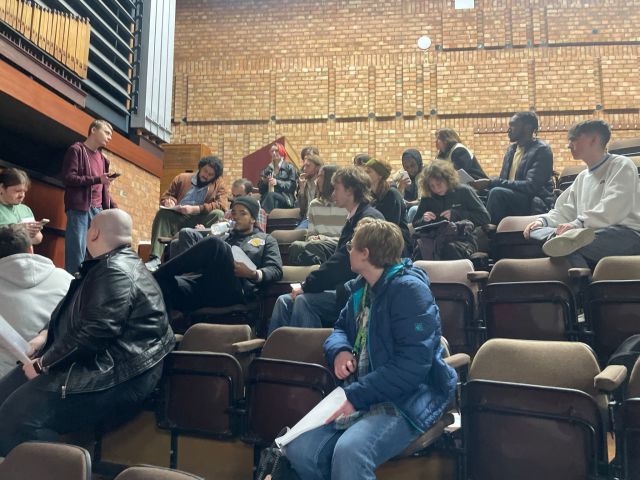
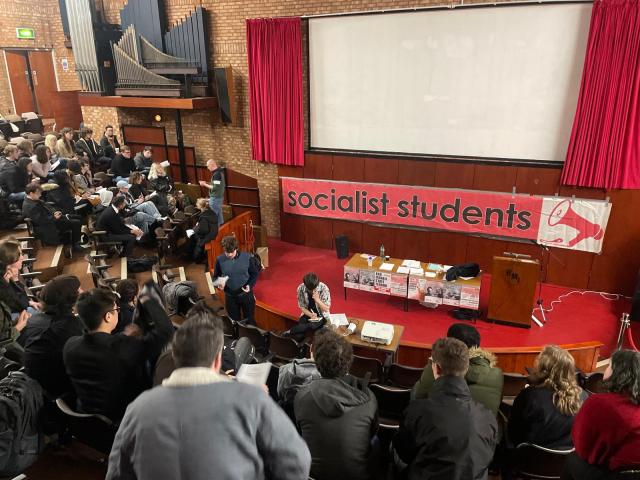
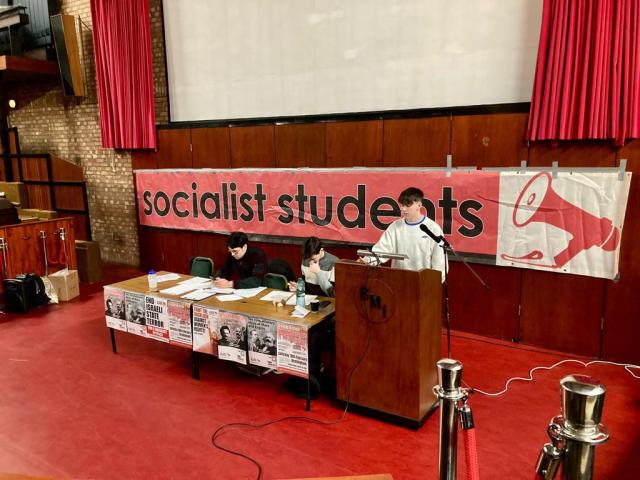
From the discussion on the main motion, ‘Organising, fighting and striking back against the student cost of living crisis’. (Credit: Liverpool Socialist Students)
Organising, fighting and striking back against the cost of living crisis
Socialist Students steering committee
The student cost of living crisis
At the same time that workers are taking strike action against the biggest single drop in living standards since the 1950s, students face a severe cost of living crisis of our own.
With inflation at the end of last year reaching the 41 year high of 14%, maintenance loans for the 2022/23 year only increased by 2.3%. The average monthly shortfall between students’ loans and living costs has risen to £439 this year, up from £340 in 2021/2022, and nearly double the position in 2020/2021, at £223.
The financial squeeze has already had a devastating effect on the day to day lives of students. The Office for National Statistics found last year that 40% of students are studying at home more to save money. A fifth are attending lectures remotely. An additional survey by the Sutton Trust found that 18% of students have avoided buying educational resources needed for their courses.
But it isn’t only in the realm of study that students are feeling the cost of living squeeze. 11% of students now use foodbanks. 28% reported skipping meals to save on food costs, 47% are going out less with friends, and 14% are travelling to campus for free energy use.
With inflation projected by the Bank of England to continue running high throughout 2023, the Tories’ decision to increase maintenance loans by only 2.8% will be another vicious cut in the living standards of hundreds of thousands of students. This will in particular affect students from working class backgrounds who are less able to rely on financial support from their families.
The roots of the cost of living crisis
The student cost of living crisis is fundamentally the result of the marketisation of higher education.
The introduction of tuition fees by Tony Blair’s New Labour government in 1998 marked the beginning of the gradual ‘weening’ of universities off public funding, and taking its place a self-funding model, leaving universities’ income increasingly reliant on student tuition fees.
What followed was a decades-long expansion of student numbers as universities attempted to make up for funding lost from government. This massive increase in student numbers however has not been met with increased investment in the educational resources both students and staff need. For students this has meant overcrowded lecture theatres, a lack of student support services available on campuses, overcrowded and unaffordable student accommodation, and the overall decline of the quality of education.
This expansion has been financed through a massive piling up of government debt. Government owned student debt – which reached £201 billion across the UK in 2022 – was at one stage tolerable for British capitalism.
But with a new stage of crisis in the long term historic decline of British capitalism – underscored by the Truss/Kwarteng budget crisis – this mountain of state-owned student debt is an increasingly intolerable economic burden for British capitalism.
Despite splits within the Tory leadership over the question of how to handle the crisis in Higher Education, the currently prevailing approach being forwarded by the Tory leadership is to now attempt to limit student numbers, particularly numbers of students enrolled in arts and humanities courses, which the Tories deem as ‘low value for money’.
The resulting Tory policy – to in effect freeze maintenance loans, as well as the tuition fee cap at £9,250 – is to pass the costs of the inflationary crisis further onto the shoulders of universities, students and staff to pay for the current crisis.
The scale of the current inflationary crisis means not only a cost of living crisis facing students, but also a massive real terms decrease to the value of tuition fee payments to universities, and therefore university funding.
As the student cost of living crisis drags on, the possibility exists for a spike of student dropouts from university, as well as decreased enrolment on future university courses, threatening to exacerbate this funding crisis even further.
Indicative of the scale of the funding crisis is the growing level of disquiet and in some cases open protest from university Vice Chancellors at the government’s policies.
This includes in September 2022 when the head of the UUK – a body bringing together university management from across the country – publicly called on the government to provide a new funding model for HE. This is significant from university management who have and continue to oversee on the campuses the implementation of Tory attacks to our education, including course closures, jobs cuts, and attacks on staff wages and conditions.
The funding crisis has now reached such heights that some universities, including Brunel and Worcester, have moved to introducing medical courses which are only open to international students in order to secure higher tuition fee payments, in effect circumventing the current domestic tuition fee cap.
The question however is what funding model ought to be implemented, and who in society should be made to pay for it. Socialist Students says that the tuition fee system and marketisation as a whole should be scrapped and replaced with free, fully funded education – financed by taking the wealth off the super-rich in society.
Fighting student organisations needed
Despite the level of crisis facing students, no generalised fight back has yet emerged on the campuses against the attacks students face. The general response of students so far has been to ‘grin and bear it’ – with figures showing that 62% of students are now cutting back on essentials, while 52% are using their savings, and a staggering 25% have reported taking on new debt to finance their living costs.
This is largely down to the massive weakening of student organisation over the last decade, which includes the abdication of the NUS and local Students’ Unions from helping to organise and lead students in struggle. This was underscored by the last national demo called by the NUS – now a whole year ago – which only around 500 students attended.
This was not a reflection whatsoever of a lack of appetite on the part of students to struggle. It reflected the complete lack of programme and strategy put forward by the NUS at that stage, as well as the complete failure organisationally to mobilise students.
Central then to the building of a fighting student movement in this period is the rebuilding of democratic and fighting student organisations on the campuses, capable of linking up nationally in the fight for free education. The key task facing the student movement as a whole – and Socialist Students – is not only to build our own forces, but to aid in the rebuilding of broader student organisation too.
That isn’t to say that student struggles will be delayed until such organisations are built. On the contrary, with continued attacks on students, spontaneous outbursts of struggle on the campuses, like those which broke out on campuses during the Covid pandemic, are likely.
Out of these spontaneous struggles can emerge new forms of student organisation. The rent strike movement, which involved 55 universities at its peak at the start of 2021, is an example of what can be thrown up by students in the course of struggle.
Despite the political and organisational limitations of the rent strike’s national leadership, Socialist Students intervened into meetings on campuses and at a national level as well to put forward a programme and strategy to help further organise students and broaden the struggle against marketisation. Socialist Students should continue to take the same approach of attempting to act positively as a lever on new student campaigning organisations which may be thrown up in the course of future struggles.
Also lacking in this period is any kind of political alternative to the policies of the Tories. Starmer’s Labour has completely ruled out the possibility of introducing free education, as well as continuing to demonstrate to big business that Labour is now a safe party to represent the interests of big business and capitalism. That’s why Socialist Students fights for a new workers’ party.
Notwithstanding the weakening of student organisation and leadership in this period, the strike wave is demonstrating in practice the power of the working class and the potential of mass collective action. This gives Socialist Students a massive opportunity to argue the need for students to also get organised, not only to more effectively link up with workers in struggle and to support the strikes on campuses, but also to formulate our own programme of demands in the cost of living fightback.
The programme
Any steps taken to help resolve the crisis of student organisation on the campuses and nationally would be positive.
Being organised in and of itself however is not enough. Also central is the question of around what programme and set of demands can students be mobilised in the struggle against the cost of living crisis and for free education.
Socialist Students has almost alone raised the need to build a movement to fight for free education. The new student cost of living crisis however means it’s necessary for Socialist Students to adapt to the concrete situation with a set of demands which offer a way forward for students looking to fight back on the cost of living.
Developments in recent months of universities giving small emergency energy grants to students, like at York University, and small rent relief, like at Manchester University, can lift the confidence of students to struggle for the same elsewhere and more.
This raises the opportunity for Socialist Students to build on these developments a programme of demands which students could mobilise around in the battle against the cost of living crisis on campuses.
These demands include but are not limited to:
For emergency cost of living grants available for all students who need them. Replace student loans with living grants, rising with the rate of inflation.
For subsidised university canteen meals for students struggling to feed themselves; against early closures of campus spaces due to the energy cost crisis.
For heated and safely staffed campus spaces available 24/7 to students and staff who need them.
To take third-party student halls under the control of our universities, as a step towards introducing democratic rent controls.
For an end to and a reversal of cuts to our education, including courses, jobs, and student support services.
Any and all of these demands can be campaigned for locally on the campuses, directed at university management and Vice Chancellors to take action to alleviate the crisis facing students.
But campaigning for any of them would also pose to students the need for a struggle to win the funding our universities need from central government in order to secure them on a permanent basis – and therefore the need to build a national student movement to fight for a new funding model in our interests, of free education.
The crisis of capitalism is pushing students and young people towards socialist ideas and conclusions. The Institute for Economic Affairs (IEA) found in 2021 found that 67% of under 35 year olds in Britain today consider themselves socialist. That’s why vital in this period is to boldly raise socialist ideas as well as explaining what a socialist transformation of society would mean – i.e. the democratic public ownership of the banks, monopolies and major industries to provide young people with a future.
But the current cost of living crisis has the potential to affect and radicalise a whole layer of students not yet familiar with socialist ideas or having yet reached socialist conclusions. The potential exists for all Socialist Students groups then to build and lead campaigns on the cost of living crisis, not only involving current Socialist Students members but students not yet politically active on the campuses.
Part of this process will sometimes mean reaching out to other campaigning organisations on campuses in order to discuss and when necessary to debate democratically around what programme of demands students should organise around as part of building broad cost of living campaigns.
This conference resolves:
To launch cost of living campaigns on university campuses and colleges where Socialist Students is present.
To campaign as widely as possible to build such campaigns – including stalls on campuses, building for public meetings, campus protests, open letters and petitions to management, to Students’ Unions and course reps, and inviting trade union branches and other campaigning organisations to participate within them.