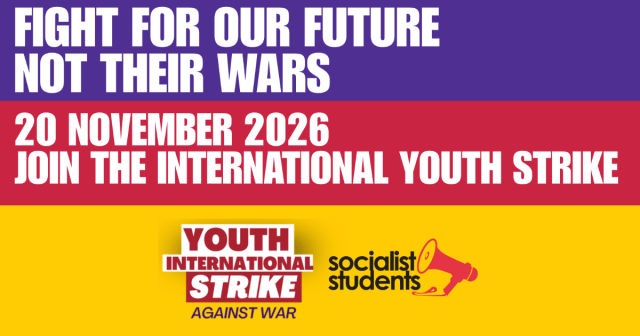
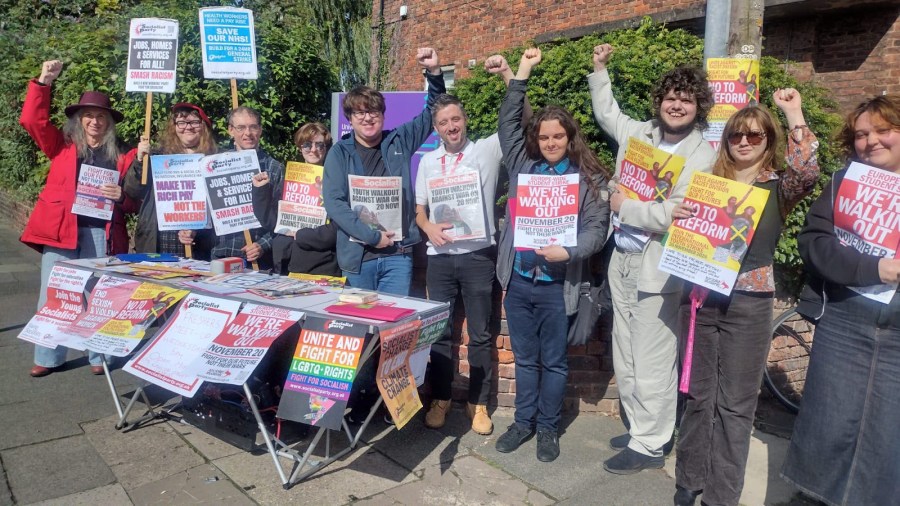
Socialist Students attended an ‘anti-militarist’ meeting near Berlin between 30 October and 1 November. We were invited by Die Falken, a German youth organisation which, like Socialist Students, belongs to the network of groups building for the international youth strikes on 20 November.
The discussions coincided with about 100,000 people taking to the streets in Germany “in echo of last month’s French riots”, in the words of the pro-capitalist Financial Times.
Socialist Students also attended a meeting in Paris a few weeks ago which included 27 organisations from eleven countries and focused on concrete next steps for 20 November. (See ‘European youth organisations meet to plan 20 November walkouts’ at socialiststudents.org.uk).
The German meeting was smaller. It was attended mainly by German youth organisations, with representatives from Senegal and Peru, but it included workshops and sessions on militarisation in society, war across the world, and how to build on the eruptions seen across Europe.
Our delegation explained that we are living through a period of profound crisis for world capitalism. Economic instability, inequality, environmental destruction and escalating international conflict are shaping millions of lives. Young people face unemployment, unaffordable housing, student debt and declining living standards, while enormous wealth accumulates among a super-rich minority.
Discussing anti-militarism is important at this juncture because the accelerating drive towards militarisation is one of the clearest expressions of this crisis. The decline of US imperialist dominance and the rise of China have intensified competition between capitalist powers over markets, resources and geopolitical influence. Governments are responding with military expenditure and rearmament. The wars in Ukraine, Gaza and Iran demonstrate the devastating consequences.
Young people are increasingly resisting this future. Across Europe and internationally, demonstrations, school strikes and student movements are developing against conscription, austerity and imperialist war. These struggles demonstrate the potential for international solidarity.
We emphasised that, while young people can provide the initial spark for mass movements, the organised working class holds the decisive power to transform society. The events of France in May 1968, for example, were only given a potentially revolutionary character when ten million workers entered a general strike following student occupations.
The trade union movement must therefore play a central role in opposing militarisation, because workers can disrupt arms production and transportation through industrial action. Socialist Students led a session on linking the trade union movement to the 20 November international youth strike. Some in Germany are rightly frustrated that the trade union leadership has not supported the German youth strikes against conscription. We explained, however, that right-wing union leaders who defend the arms industry only strengthen the case for socialists to orientate towards the unions’ working-class base, rather than abandon workers to pro-capitalist ideas.
An appeal should be made to trade union branches across Europe for joint action against militarism. This approach has succeeded in Britain, where Socialist Students has won the support of the NEU, UCU and Unison, which together represent almost two million workers, for the international youth strike. This is not support on paper alone. The NEU in particular has offered practical support and pledged to back any students facing disciplinary action.
The 20 November strike offers an opportunity to unite students, education workers and the wider trade union movement. Ultimately, ending imperialist competition and war requires an international socialist transformation. By nationalising the banks, utilities and major monopolies, society’s wealth can be democratically planned according to human need. Our fight against war must therefore be inseparable from the struggle to replace capitalism with socialism, the only way to secure our futures. That struggle will be led by the working class, which, because of its role in production, has the power to transform society in a socialist direction, beyond capitalist war driven by competition and instability.
Joe Woolfall, Liverpool Socialist Students